How to Read an Agency Scope of Work Before You Sign It
One proposal offers twelve posts and four reels a month, another eight and eight. Neither says which is more work.
Two proposals, different numbers, no way to compare
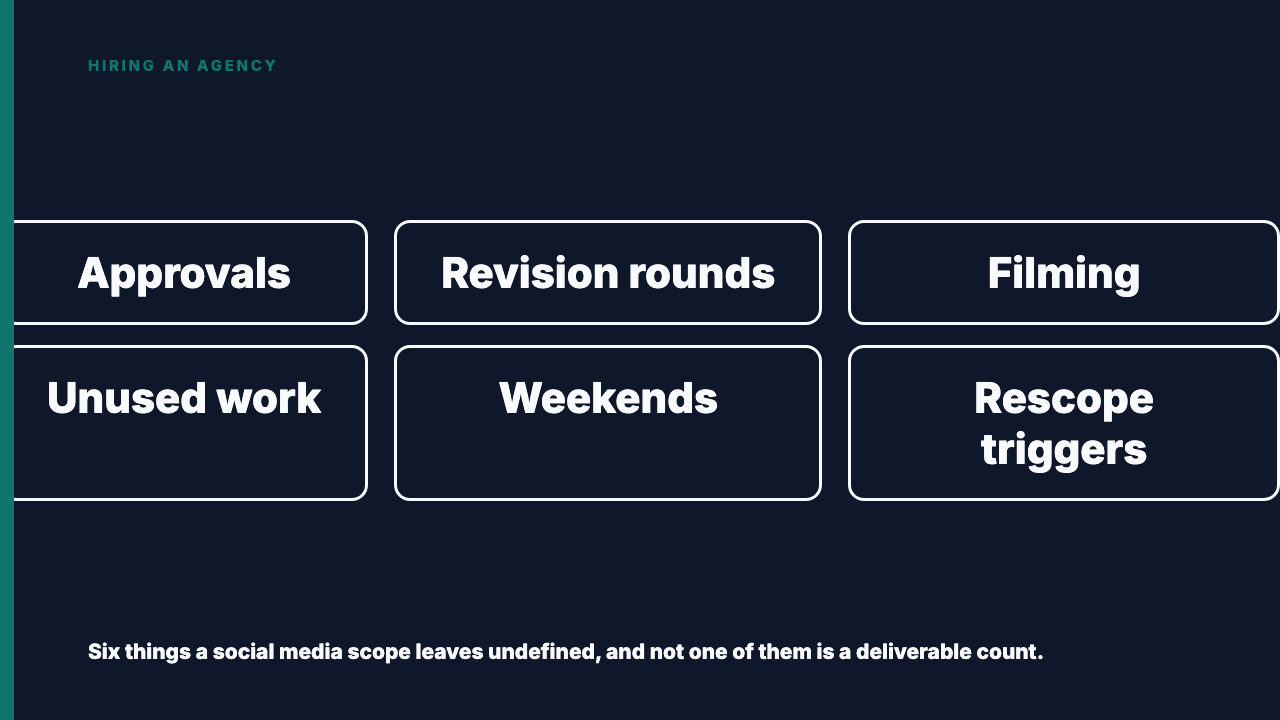
Six things it omits: who writes and approves, how many revision rounds, whether filming is in scope, what happens to unused deliverables, whether weekends are covered, which platform changes trigger a rescope. Counts look comparable, so they absorb the negotiation while the exclusions go unasked. Judge a scope by those and its change process, not its numbers. The wrapper: what to check in the contract itself.
Five scope lines and what each leaves open
Illustrative, read at both ends.
| The line as written | What it can mean | Ask for this in writing |
|---|---|---|
| 12 posts per month | Captions on images you supply, or produced assets | Define one deliverable: is a carousel one post or one per slide? |
| 4 reels per month | Edits of your footage, or a shoot the agency runs | Who films, who appears, who licenses music, who holds raw files |
| Community management | Business hours on one platform, or all of them including weekends | Coverage window, response target in hours, escalation path |
| Monthly reporting | A platform export, or an analyst recommending changes | A sample report from another account, client details removed |
| Strategy and planning | A content calendar, or quarterly work with named participants | How many hours, and whose |
Revision rounds are where the hours actually go
A round is one consolidated set of feedback returned once, not four people commenting over nine days.
“Unlimited revisions” is a warning: uncapped rework is priced into the retainer or taken out of the first version. A workable clause: two rounds per deliverable, one named approver consolidating feedback, turnaround windows both ways, a written rate beyond the cap. A bad one caps nothing, defines nothing, and lets a missed window compress the month. Name the approver during your first thirty days.
Nobody said who shoots the reels
Three arrangements get written as “four reels”: you supply footage and the agency edits, the agency assembles stock, or the agency shoots.
A shoot in scope names shoot days, location and travel, talent, who pays for props and for stock or music licensing, and whether those pass at cost or marked up. Ask whether raw footage and project files reach you on request and at exit. Paying the invoice does not settle it: ownership of commissioned work carries legal conditions, jurisdiction specific, so write it down. More on who owns the accounts and the assets.
The coverage questions to put in writing
- Which days, hours and time zone, and public holidays.
- Response targets for a comment, a message and a complaint, in hours.
- Out of hours: included, priced separately or absent, and who is on call.
- Who can reply without approval, and where a reply becomes an escalation.
- In an incident: who is contacted, how fast, who can pause posts.
- Which platforms by name, because “social” expands quietly.
What happens to the deliverables you did not use
Unused deliverables usually expire at month end, so a slow approval month is paid for and not received. The agency staffs to a monthly commitment, so rollover costs it money, and a backlog means stale content.
Carry forward capped at one month works, or a written trade into strategy hours. Then the clause most scopes omit: when the agency underdelivers, is that a credit, a make good, or nothing?
The change process is the most important clause
The change process keeps a living document honest: who can request a change, in what form, how it is priced, how long the quote holds, and what continues while it is agreed.
Triggers for review rather than silent absorption: a platform changes or retires a format the scope names, a platform is added, approval volume shifts, a launch adds a workstream, or paid media budget moves enough to change the effort. A scope naming a format is pinned to something the agency does not control, so it needs a mechanism, not an assumption. Exclusions and a change process make the counts comparable. How readily an agency writes them down tells you the rest.
A scope excerpt, marked up
Hypothetical, as proposals are written:
Social Media Management Retainer. 12 static posts monthly, two channels. 4 short form video assets. Community management. Two rounds of amends.
- “12 static posts”: one post, or one per slide, and whose images?
- “4 short form video assets”: who films? Edit, stock or shoot?
- “Community management”: which hours, which response target, weekends?
- “Two rounds of amends”: what is a round, the turnaround each way, the rate beyond two?
- Unused deliverables: carry forward, and what is owed if the agency underdelivers?
- Changes: requested how, priced how, and what continues meanwhile?
The send back list:
- What counts as one deliverable, and how is a carousel counted?
- Who films, who appears, who licenses music, who holds raw files?
- Coverage window, response target, weekends?
- What is one revision round, and the rate beyond the cap?
- Do unused deliverables carry forward, and what if you underdeliver?
- How is a change requested, priced and agreed?
Where to start
Building a shortlist? The directory lists 63 vetted agencies. Browse vetted agencies, then the questions that disqualify an agency. Agencies can list your agency free.
FAQ
What is the difference between a scope of work and the contract?
The contract governs term, notice, liability and ownership. The scope governs the work, and a vague scope argues monthly.
How many revision rounds are reasonable?
No norm binds an agency. Test the clause: a stated cap, a defined round, turnaround windows both ways, a rate beyond it. Definition matters more than the number.
Should I insist on unlimited revisions?
No. Uncapped rework is paid for in the retainer or out of the first version’s hours. A defined cap with a fair rate is better.
The scope says four reels but not who films them. Is that normal?
Common, and the most expensive ambiguity in a social scope. Ask who films, whose footage, who appears, who licenses music, who holds raw files, and whether shoot costs pass through.
Can the agency change the scope mid-term?
Only through the change process the scope defines, so an undefined one is a problem. Require written requests, a priced quote, and continuity meanwhile.
What if the agency will not put the exclusions in writing?
Treat the refusal as information. An agency that will not define a deliverable, a round or a coverage window keeps the right to decide later.
Sources
- United States Copyright Office, Circular 30, Works Made for Hire, fetched 2026-08-26.