Check the Agency’s Financial Stability Before You Sign
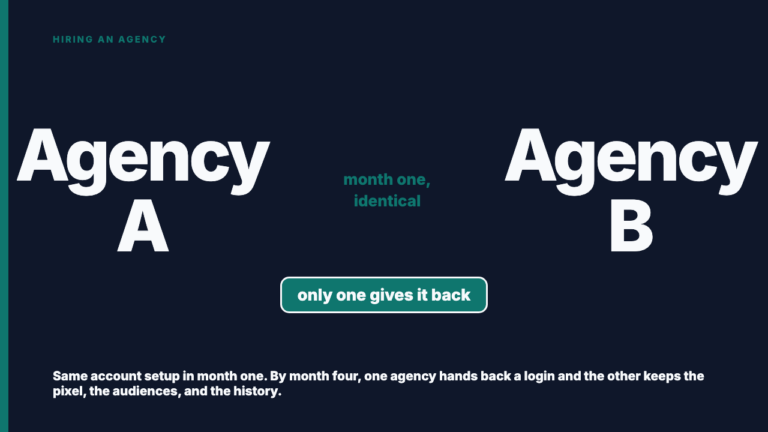
You have reviewed the work, met the team, and called two references. The contract runs twelve months. Nobody has checked whether this agency will still exist, staffed the same way, in month nine.
Why financial stability belongs in due diligence
Almost every evaluation answers one question: is this agency good. A year-long contract asks a second one that rarely makes the scorecard: will this company still exist, staffed the same way, in month nine. You answer it without financial information, because agencies are almost always privately held, with no obligation to publish accounts. All you get is external, circumstantial signals.
Closure is the rarest failure mode. The realistic ones are quieter: the agency loses one large client whose fees funded a chunk of the headcount, and your senior strategist ends up covering five accounts. The founder or your lead strategist leaves. The agency is acquired mid-contract and your account becomes a rounding error inside a group. Or margins are thin and the squeeze shows up as slower work and junior substitutions.
The signals you can actually check before you sign
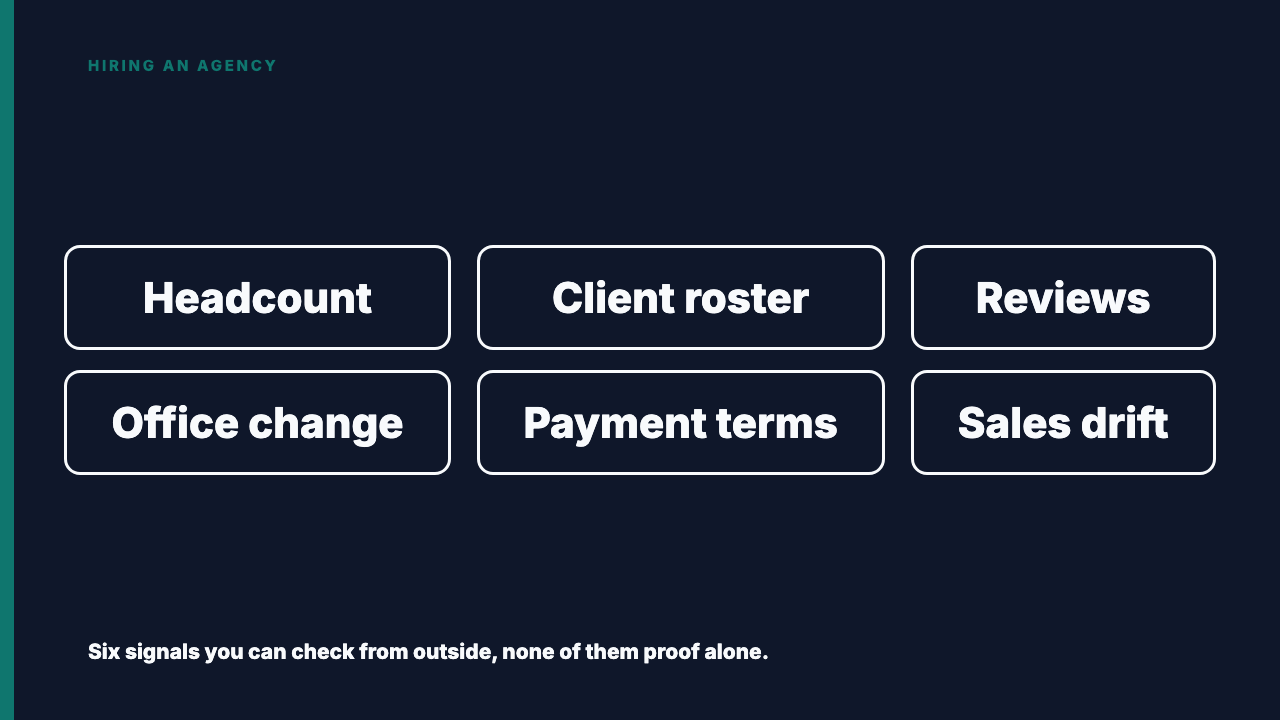
All six are visible from outside, and none is proof alone.
- Headcount trend on LinkedIn over the past six to twelve months. Look at who lists the agency as a current employer, then at the account managers and strategists who recently moved that role into their past positions. Three account people gone in a quarter reads differently from one designer leaving. LinkedIn’s Page analytics are admin only, so you are reading the public page, not their numbers.
- A client roster that has stopped moving. If the newest case study is over a year old, either it has stopped winning work worth publishing or nobody is free to write it up. More telling: logos that disappear between visits.
- Reviews that mention turnover specifically. Independent agency review directories are noisy; general complaints tell you little. Hunt for the review saying the client had three account managers in eight months. Repeated across reviewers and years, that predicts your own experience: see what happens when your account manager quits.
- An office or address change. A move to a smaller space, or a shift to fully remote by an agency that pitched its studio culture, is a cost signal worth asking about, not an automatic red flag. An expiring lease and a scattered team is a coherent answer. Evasion is not.
- A change in payment terms that arrives late. If the proposal said monthly and the agency asks for quarterly or full prepayment as you approach signature, that is a cash timing request. Ask whether it is a discount structure or a working capital need.
- Drift in the sales process itself. A proposal two weeks late, an onboarding date already pushed once, or the pitch strategist unavailable for three weeks is a capacity problem in the phase where capacity is never a problem.
What to ask directly, and what answer should worry you
Ask openly, framed as routine diligence, alongside what to ask on an agency reference call. Three questions cover it: how long the leadership team has been in place, whether there have been layoffs in the past twelve months, and what share of revenue comes from the three largest clients.
The last one matters most. If one client is a large slice of revenue, the agency’s staffing plan depends on that relationship continuing. When it ends, the agency resizes across the whole business, so your account gets thinner because of something that happened on an account you never heard of.
Picture two agencies answering. The first: our top three are about forty percent combined, the largest is twenty, and that client renewed in March on a two year term. Specific, from someone who has thought about the exposure. The second says it has a healthy diversified book and has never had an issue. A non-answer tells you the agency will not discuss its business, which is not proof of trouble.
Structuring the contract so the risk sits with the agency, not just you
Screening is imperfect. The more reliable protection is in the paper, part of what to check in a social media agency contract. Neither clause below is automatic, and enforceability varies by jurisdiction, so treat both as negotiation asks.
A change of control clause covers an acquisition or a change in majority ownership during your term. The acceptable version gives you a defined right to exit without penalty, or to renegotiate, within a set window after written notice. Most contracts are silent: the agency sells in month four, your contract transfers as written, and the team you actually bought is reassigned without you in the room. A key person clause covers staffing instead. The acceptable version names your lead strategist and account manager, requires advance written notice if either leaves, and obliges the agency to propose a named replacement you may interview. The weak version promises “a senior team” and commits to nobody.
The simpler answer is to shorten the commitment. Better to buy a paid pilot before a twelve month retainer, or start on a ninety day term.
What this is not
Read these signals backwards and you will talk yourself out of good agencies. An agency hiring three account people and taking a bigger office is showing growth, not contraction. One departure or one stale case study page is a reason to ask a question, not a verdict. This is a continuity check only: whether the creative work is good, and whether case study numbers hold up, are separate disciplines this site does not cover.
Where to start
You can browse vetted agencies by specialism and location and build a shortlist before you commit to one shop. If you run an agency, you can list your agency free.
FAQ
Can I just ask an agency directly if they are financially stable?
Yes, and frame it as routine diligence rather than an accusation. Keep to what they can answer without opening their books: leadership tenure, layoffs in the past year, and how concentrated revenue is. Treat evasiveness as one more data point, not proof anything is wrong.
Is a recent layoff automatically a dealbreaker?
No. Agencies resize as they win and lose accounts. The question that affects you is narrower: did the layoff touch the team who would be assigned to your account, and is the person named in your proposal still employed. Ask directly rather than inferring from a headcount number.
Sources
- LinkedIn Help: LinkedIn Page analytics, which states that Page analytics are available to Page admin roles. Fetched 7 September 2026.