Own the Handle, Not the History: Analytics After an Agency Exit
You own the handle, and the account stays with you when the agency leaves. The performance history built up while they ran it usually does not come with it.
The handle and the history are not the same asset
“Historical analytics” means something specific here: month over month follower growth, engagement rate plotted over time rather than reported as one number, which content formats outperformed which, and the benchmark figures a new agency would use to judge whether it is doing better or worse than the last one. Without them, your next agency will tell you engagement is up. Up from what?
Nearly all of it lives inside a third party social media management or reporting platform that the agency pays for. It is not in a document you hold, and often not fully in the platform’s insights panel either. You can own your Instagram account outright and still have no access to the multi year trend built while someone else ran it.
What actually happens when the subscription lapses
The engagement ends, the agency hands over logins, and weeks later stops paying for a seat covering a client that left. The dashboard goes dark for everyone, the agency included. Your request lands after that anyway, triggered by a new agency wanting a baseline months later.
Native insights are different: they live with the account, and you can still see Instagram, Facebook, TikTok or LinkedIn analytics through your own login. But a native panel generally holds a shorter, shallower history than a reporting tool accumulated. LinkedIn’s developer documentation shows the shape of the problem, though it covers the API rather than the in app panel: its follower statistics endpoint returns data from twelve months before the request date, and its share statistics endpoint works on a rolling twelve month window.
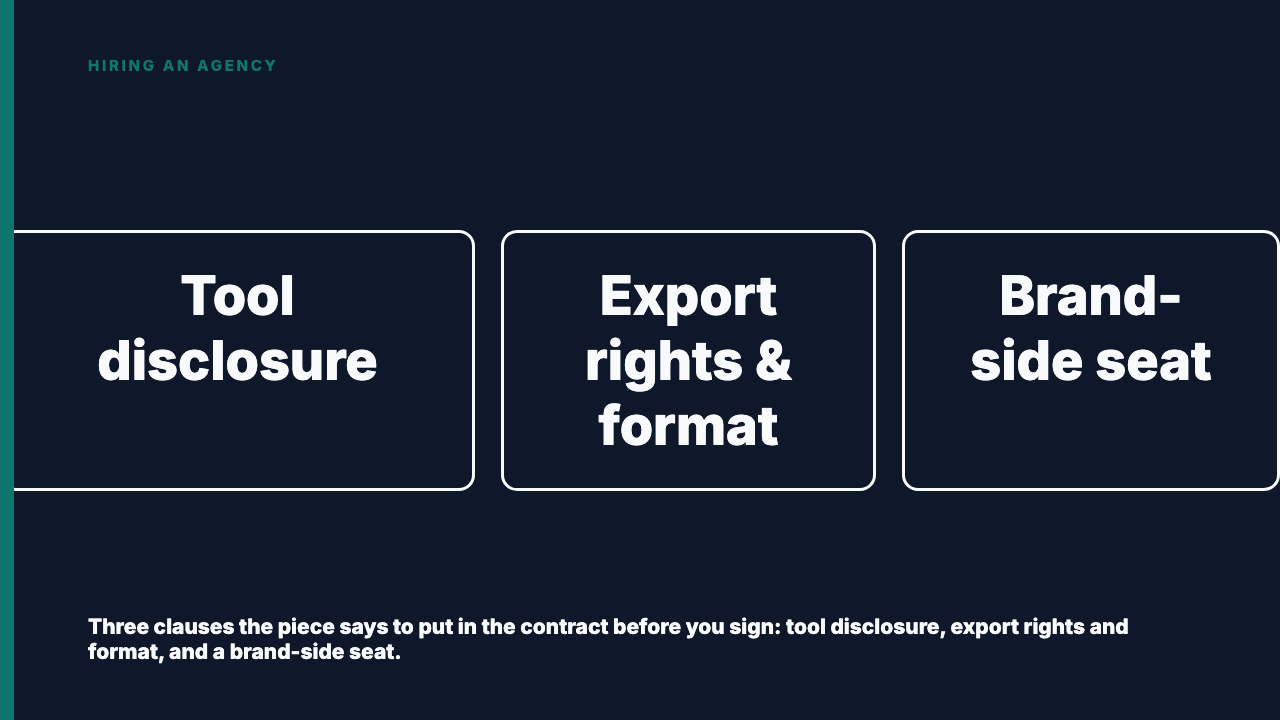
The three things to put in the contract before you sign
- Tool disclosure. The contract names which platform holds your data and states the reporting cadence built on it. The bad version names it nowhere, so you end up asking a departing account manager to remember.
- Export rights and format. You can request a full export at any point, and one arrives automatically at offboarding. Specify the format. “Exports available on request” reliably produces a PDF deck. Ask instead for raw, row level data in CSV form, at no separate fee, within a stated number of days of termination. Ten business days is reasonable. Name the number.
- A brand side seat. Where the tool allows it, hold your own login for the duration, read only. A brand that can log in never has to ask for anything afterwards.
What a good export looks like next to a bad one
Two illustrative brands, both invented. Willowfen Home wrote an export clause in at signing and got a spreadsheet on its last day: monthly follower counts by channel back to month one, engagement rate by content format, and a row per post with reach, saves and comments.
Bricketts Pet Supply asked six weeks after offboarding, once its new agency wanted a baseline. The subscription had lapsed a fortnight earlier. It got the quarterly PDF decks, which summarised results with no data underneath the charts. Its new agency now rebuilds a baseline from whatever the native panels still show, a cost that never appears on an invoice.
This has to be a kickoff conversation, not an offboarding one
At signing you are a prospect the agency wants and the clause costs them nothing. By the time you want the data you are a departing client asking a team with no commercial interest in you to build an export. This is one narrow addition to work you should already be doing: it sits alongside what to have ready before you sign, it is a line item inside what to check in a social media agency contract, and the wider handover is covered in leaving a social media agency without losing the history.
What native platform insights keep, and what a reporting tool adds
| Native platform insights | Agency’s reporting tool | |
|---|---|---|
| Retention window | Varies by platform, check each platform’s current documentation | Retains data while the subscription is active, independent of platform limits |
| Who controls access | You, through your own login to the account | Whoever holds the paid seat, usually the agency |
| What is measured | Generally one platform at a time | Aggregated across platforms on one timeline, the view a new agency needs |
What this is not about
Two adjacent questions are not this one. Who owns the handle itself is a separate negotiation. You can win that argument and still lose the history, so read who owns your social accounts when an agency runs them instead. The other is who pays for the reporting tool during the engagement. Worth settling, but separate: funding the tool does not create export rights.
Before you sign the next one
Browse vetted agencies while you shortlist, and if you run an agency, you can list your agency free.
FAQ
If I own my Instagram and Facebook accounts, don’t I already have my historical data?
You have whatever each platform’s insights panel retains, which is generally narrower and shorter than what a reporting tool accumulated. It also shows one platform at a time, not the cross channel timeline a new agency wants.
Should I ask my agency for a PDF report or the raw data?
Raw data, in a spreadsheet or CSV. A PDF deck presents conclusions rather than the numbers underneath them, and nobody can recalculate anything from a chart image. Ask for row level exports; the decks are an extra.
What if an agency refuses to put a data export clause in the contract?
Read it as information about the exit. An agency that will not commit in writing to handing back your own performance data is telling you now what offboarding will feel like later. A practical constraint in the tool is answerable; a flat no with no explanation is a red flag.
Is this the same issue as who owns my social media accounts?
No. Handle ownership decides who can log into the platform and who keeps the account when the contract ends. This post is about whether the performance history sitting inside a separate reporting tool can be retrieved at all. You can settle the first question completely and still lose the second.
Sources
- LinkedIn Marketing API, Follower Statistics, fetched 7 September 2026.
- LinkedIn Marketing API, Share Statistics, fetched 7 September 2026.