Who Owns the Ad Account When an Agency Runs Your Paid Social
You can hold every password to your Facebook Page and still not own the thing that spent your money. Most brands learn this at the one moment it is expensive to learn, when they change agencies.
The Page is not the ad account
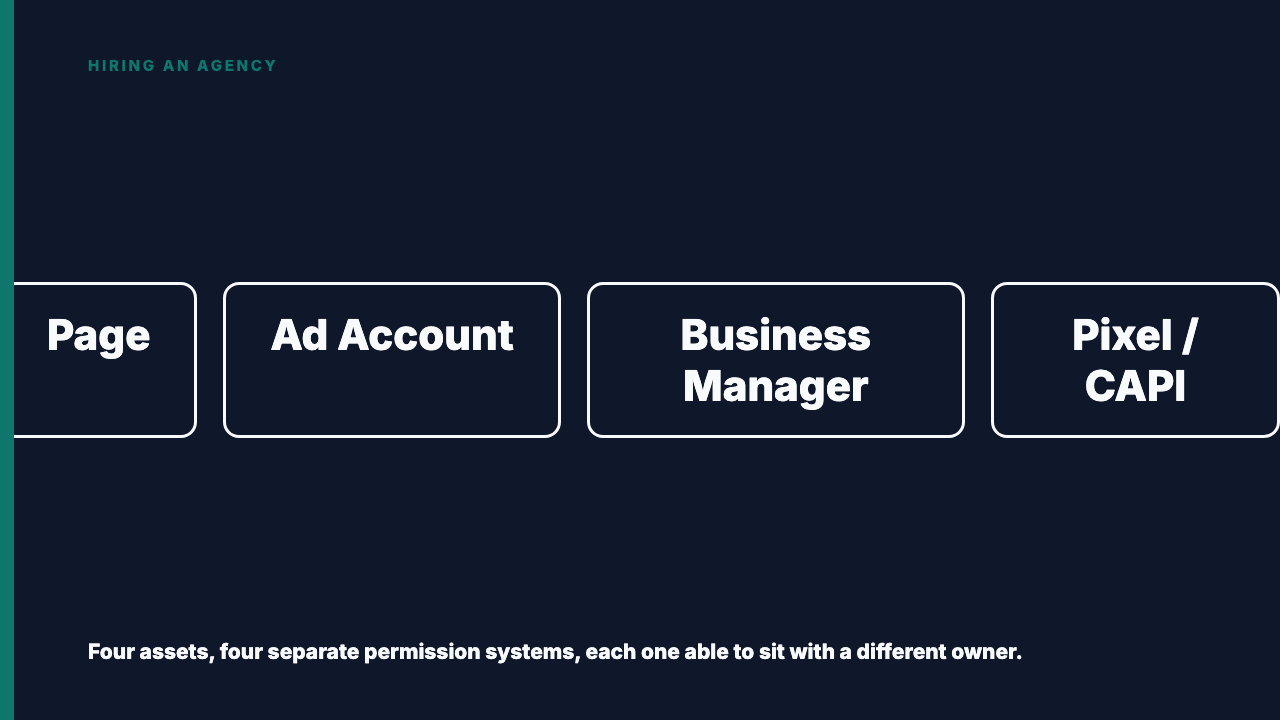
Four separate assets are in play, and each can sit with a different party: the Page your customers follow, the ad account that holds campaigns, billing, and spend history, the business container housing it, called Business Manager on Meta, and the pixel or Conversions API dataset that feeds your retargeting audiences.
Each runs on a different permission system. You can be sole admin of your Page and own none of the ad account running against it, so an agency that reassures you about Page access has answered nothing. This is the technical half of who owns your social accounts when an agency runs them.
Two ways an agency can be structured into your ad account
In the first structure, your own business container owns the ad account. You created the container and the account inside it, then granted the agency a role: partner access, admin access, or something narrower. End the relationship, remove the role, and the account stays put with its history intact.
In the second, the agency’s container owns the account, created during onboarding because that was faster and nobody asked. Your access exists only because the agency granted it, so revoking the agency is not a move available to you.
Confirm the specifics against your platform’s current business help documentation, since names and mechanics change. Google Ads, whose documentation is publicly readable, says a manager account can be given ownership of a client account, and that this ownership is what controls user access. That is one platform’s version of the split, not every platform’s.
Why this matters more once an ad has spent money
An empty ad account is replaceable in ten minutes. One with two years of spend behind it is not. Delivery history and campaign learning sit with the specific account they were built in, so rebuilding elsewhere behaves like a restart, not a copy and paste.
The pixel is sharper still. It accumulates conversion history that your retargeting and lookalike audiences derive from, so a dataset in the agency’s container holds signal you already paid for. Google’s documentation on how audience segments work notes that remarketing lists can be revoked or closed by a change in permissions, after which they cannot be targeted. Confirm both mechanics in your platform’s current documentation.
Picture, purely as an illustration, a retailer two years into continuous paid social. At renewal, someone opens the business settings and finds the ad account, the pixel, and every saved retargeting audience listed as shared with the company, not owned by it. That retailer is now negotiating for its own customer signal back.
What to ask before you sign
- Which business container will the ad account be created in? The answer you want is your own, created by you before onboarding. An agency offering to “set everything up on our side” has already answered.
- Will the agency hold a revocable role? Good version: the agreement names the role, states that your business retains ownership, and confirms you can revoke it at will. Bad version: the agency will “manage” the account.
- Who owns the pixel and any server side Conversions API integration? Separate question, separate answer, both belong in your container. Running a server side feed and owning the dataset behind it are different things.
- What happens on termination? Write it down: access revoked within a stated number of days, data exported, audiences staying put. Assumptions are not terms, so review what else to check in the contract.
What to check if you are already signed and unsure
Open your own business settings, not a dashboard the agency built for you, and read the asset lists, which separate what your business owns from what another business shares with you. If the ad account and pixel are not listed as yours, the agency built them in its container.
Fixing that requires the agency’s cooperation. There is no button you press unilaterally, and your leverage peaks while the relationship is still good, so raise it in a quiet month, not in the email where you give notice. Still evaluating? See what to vet differently for a paid social agency.
What a clean handover actually requires
A clean paid social exit has a specific shape: the ad account, the pixel, and every saved audience already sit in your own container, so the handover is a revocation rather than a transfer. You remove the agency’s role and everything stays where it is.
That is the technical version of the general handover problem, and the rest of the exit checklist covers logins, Page roles, and files. The failure here is silent: a pixel you never owned is one you notice two years in.
Find an agency that will answer this straight
An agency that hedges on ad account ownership is telling you how it treats clients who leave. Browse vetted agencies, or list your agency free.
FAQ
Is having Page admin access the same as owning my ad account?
No. They are separate assets under separate permission systems. You can be the only admin on your Page while the agency’s container owns the ad account and the pixel behind it.
What is the difference between partner access and account ownership?
Partner or admin access is a role granted inside an account your own business owns, and you can withdraw it. Ownership means the account was created inside that container to begin with. If it is the agency’s, you hold the granted role.
Can I just ask my agency to transfer the ad account to me later?
You can ask, and many agencies will agree. But it depends on their cooperation at the moment you are giving notice, and nothing lets you pull an asset out of another company’s container unilaterally.
Does it matter who owns the pixel if I already own the ad account?
Yes. The dataset is a separate asset and can sit in a different container than the ad account it feeds. If the agency owns it, you keep the campaign shell and lose the history behind it.
Sources
- About Google Ads manager accounts, Google Ads Help, fetched 5 September 2026.
- How your data segments work, Google Ads Help, fetched 5 September 2026.