Your First 30 Days With a Social Media Agency: What You Owe
You have signed, the kickoff call is booked, and every onboarding checklist you can find describes what the agency does internally. None of them tell you what you owe.
Month one usually stalls on the client’s side of the table
An agency cannot publish without assets, access, and an approver. All three are yours. Week one fails four ways: assets buried in a designer’s folder or a slide deck, access promised on the call and never granted, nobody appointed to approve, and nothing written about what the agency may say.
A stalled month one is busy: recurring calls, a revised calendar, nothing live. A working one looks less impressive: the first posts go out inside two weeks, deliberately unambitious. The bill lands in month four, when three months of output are judged against a start date you delayed.
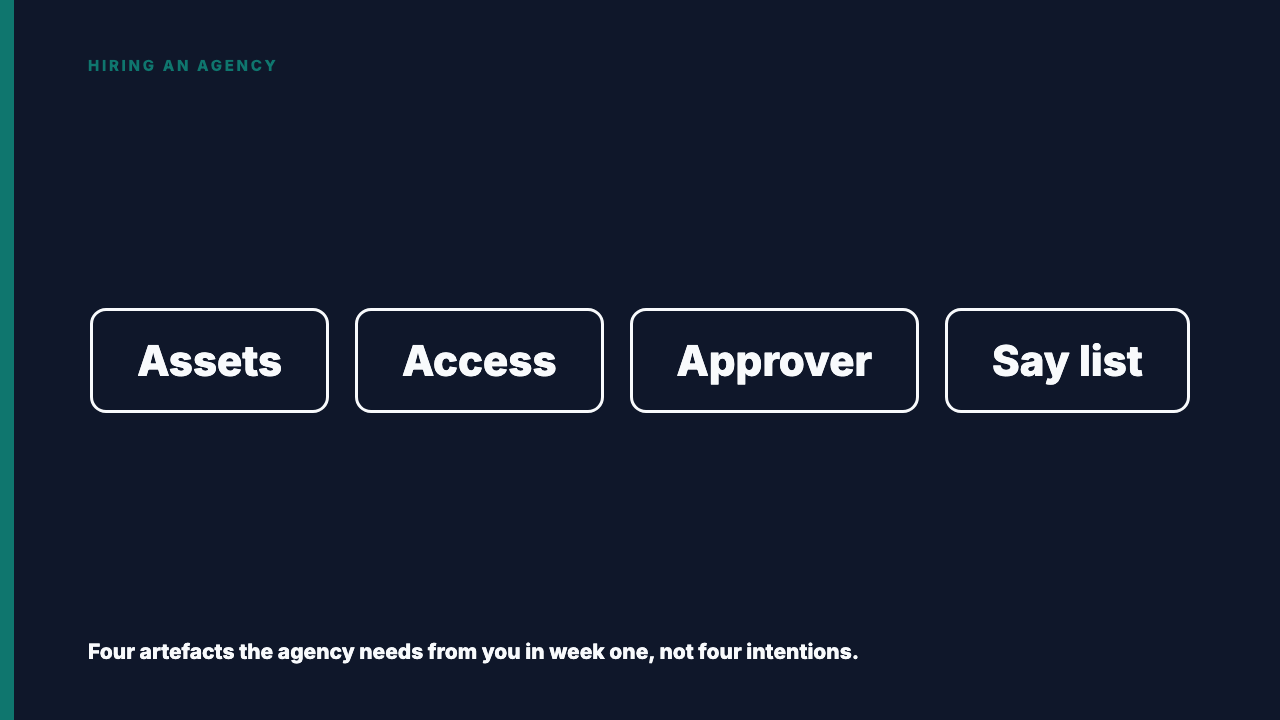
The four things the agency needs from you in week one
Four artefacts, not four intentions.
- Brand assets, usable. Editable logos, fonts with a licence note, product or location photography, any tone of voice document, and what the brand may not show. Good: one shared folder, dated subfolders, a named owner. Stalling: “ask marketing, they have it somewhere.”
- Access at the account level. From your own business account, at a permission level you chose, granted during the call. Stalling: a password pasted into chat.
- An approver and a deputy, both named. With the hours each is reachable, in writing. Stalling: “run it past the team.”
- A written say list. Claims, offers, prices and topics publishable without a second signature. Good: one page, three tiers. Stalling: silence, which the agency reads as check with us first.
Access granted, not promised
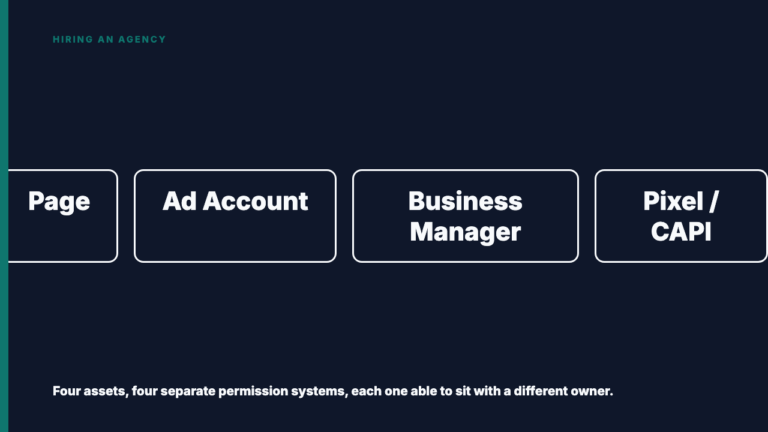
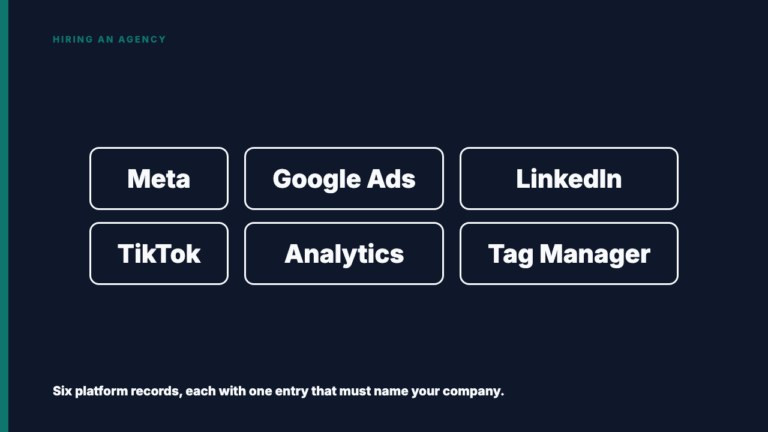
Your business account owns the pages, ad accounts and tracking, and the agency is added to what you own. Never the reverse, never a personal login, never a domain or ad account in the agency’s name. Roles are tiered, so publishing is a different grant from billing. See what the contract should already say about access and exit and who owns the accounts the agency is publishing from.
| What the agency asks for | The acceptable version | The version you will regret |
|---|---|---|
| A business account | Yours, agency added as a partner | Created under the agency’s roof |
| Publishing on your page | A content level role. LinkedIn separates content admin, for posts and events, from super admin, which grants every permission | Super admin on day one |
| Ad account and billing | Your account, your card, agency granted access | Their account, their card |
| Analytics | Read only. Google Analytics has Administrator, Editor, Marketer, Analyst and Viewer roles, plus No Cost Metrics and No Revenue Metrics restrictions | Editor rights, never removed |
| Scheduling or reporting tools | Their licence, your accounts, you can disconnect | Your only archive inside their tool |
| Removal on exit | You test revoking on day one | You find out at exit you cannot |
One named approver, and what happens when there isn’t one
Define the approver by duties, not seniority: reviews inside a stated window, resolves internal disagreement rather than forwarding it, and can approve copy touching price, claims or customers.
The committee is the usual failure. Three reviewers with equal veto produce work shaped by the most cautious of them, and the agency learns to submit safe work because safe work clears faster. Appoint a deputy with equal authority and pick the default now: when the window lapses, either the deputy decides or the piece publishes as submitted. Write down the window in hours, the deputy’s name, and who breaks the tie on a piece nobody will sign.
The say list: what the agency may publish without asking
Three tiers: publish freely, publish after one named approval, never publish without legal or executive sign off. Then place the items that cause delay.
- Pricing, discounts and offers.
- Product claims and comparative claims against competitors.
- Hiring posts and internal news, usually tier one.
- Customer names, logos and customer content, which need a permission trail.
- Complaint and refund replies in comments and messages, including where a thread becomes yours.
- Anything touching a live incident, which gets a standing hold.
- Paid, gifted or incentivised content the agency arranges. In the United States, the Federal Trade Commission publishes guidance on endorsements, influencers and reviews, including disclosure of material connections between advertisers and endorsers. Other jurisdictions differ.
Settle who answers a hostile comment, and what the agency may delete rather than hide. Every item not on this list becomes a meeting.
What a working 30 days actually looks like
Illustrative and hypothetical: a regional dental group with two internal marketers, a new agency on retainer.
Week one. Access granted in the call and verified. Assets delivered. Approver and deputy named, with hours. Say list drafted.
Week two. The audit and first content plan land, the client responds inside the window, and the first low risk posts go live.
Week three. Reporting shape agreed. A hostile comment tests the community rules. Feedback in writing, not on a call.
Week four. A review of the process, not the results. Four weeks of posts cannot say whether the strategy works. Month one buys a functioning operation.
The day 30 review: process, not performance
Ask about turnaround, publishing consistency, brief quality, and whether the people who pitched are the people on the account, which belongs to the questions that should have been asked before signing. Then admit your own side: late approvals, assets delivered in week three, direction changed after the work was made.
Avoid both day 30 mistakes, reading early engagement as proof and rewriting the strategy because week two underperformed. A fixable problem sounds like a slow brief or a reporting format nobody wants. A structural one sounds like an account team that does not understand what you sell, and at day 30 that costs a month rather than the year it costs at month six. If so, browse vetted agencies and shortlist against what you now need. Agencies can list your agency free.
FAQ
Should we give the agency our account passwords?
No. Your business account should own the pages, ad accounts and tracking, with the agency added at a role level suited to the work, publishing rather than billing, read only for analytics. Shared credentials break when someone leaves and leave no audit trail. Access granted in ten minutes should be revocable in ten, verified on day one.
Is it normal to have nothing published in the first two weeks?
It is common, and usually a client side symptom. An audit period agreed in the scope of work justifies a quiet fortnight. If the scope promised publishing and nothing is live, ask what the agency is waiting for. If the answer is access, assets or an approval, the delay is yours.