Define Your Agency’s Community Management SLA Before Signing
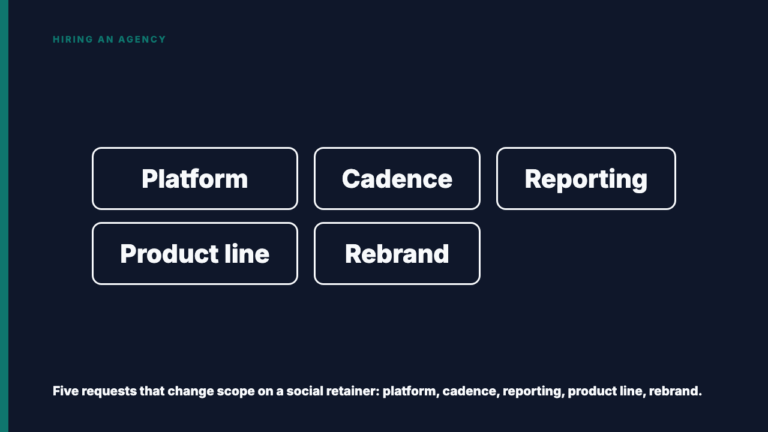
Your scope of work says “community management included.” It does not say when. Not which days, which hours, or how long an angry comment sits before a human answers it. That silence costs nothing until the first Saturday something goes sideways under a post, and then it costs you a weekend of argument over what the line meant.
The line item that hides the real question
Two things hide inside the phrase “community management.” The first is a task: somebody replies to comments and messages. The second is a service level: replies happen within a set number of hours, on set days. Every agency does the task. Far fewer have written down the service level, and one that has not is not staffed for it either.
Picture a hypothetical proposal whose scope reads “daily community management across Instagram and Facebook.” The owner pictures someone watching the accounts through the day, catching a bad review early. The agency reads it as one inbox pass each weekday morning by a coordinator covering six accounts. “Daily” is a frequency, and a frequency says nothing about latency. A comment left overnight and answered next morning was handled daily.
What a coverage window actually has to specify
A clause is enforceable when a reader can tell whether it was met. Five specifics:
- Days of coverage. Weekdays only, or all seven. “Ongoing” is not a set of days.
- Hours on each covered day, with a time zone. You are picking one of three tiers: business hours, extended hours, or genuine 24/7. The last is a separate and more expensive commitment that has to be named as such, never assumed. Anchor the tier you pick to a time zone, or an unanchored “9 to 6” covers the agency’s morning, not your audience’s evening.
- A response target as a number and a unit. Within N hours, or within N business hours. “Promptly” is an adjective you cannot hold anyone to.
- A separate, faster target for flagged items. A store hours question and a public accusation do not deserve the same clock. Define what counts as flagged, and who can flag it.
- An escalation contact by name or role. Who picks it up when the front line responder is on leave.
Business hours, calendar hours, and why the difference is not pedantic
“Within 24 hours” is two different promises depending on which clock runs. Take a hypothetical complaint posted 6pm Friday. Under “within 24 business hours” with weekday-only coverage, the clock does not start until Monday morning, so a reply landing Monday afternoon is compliant. The same target on calendar hours with seven day coverage gets that customer an answer by Saturday morning. Same number, two days of difference.
Holidays need their own sentence. Left unaddressed, they get settled after the fact by whoever holds the stronger position, and that is not you. Name the calendar and whether coverage pauses.
The verbal promise versus the contract term
A written agreement is generally read as the complete deal between the parties, and agency contracts commonly say so explicitly. A reassuring sentence from a sales call counts for very little after signature.
If coverage hours or a response time came up in the pitch or in a deck, that language goes into the scope of work or the contract before you sign, with numbers. Always-on coverage is marketing until it is a dated, numbered clause. Read it alongside how to read a scope of work before you sign it and what else to check in the contract.
What the good version and the bad version look like side by side
The version to watch for:
Agency will provide ongoing community management.
No days, no number, no owner. An illustrative rewrite, with figures invented for the example rather than benchmarks:
Agency provides community management coverage Monday through Sunday, 8am to 8pm US Eastern, excluding the public holidays in Schedule B. Routine comments and direct messages receive a first response within eight covered hours. Items flagged as escalations by either party receive a first response within two hours during covered hours. The escalation contact is the Agency Account Director, with the Head of Client Services as named backup.
A good clause is short. It just cannot be vague.
Where this fits relative to a live incident
This clause sets the routine baseline: ordinary comments, ordinary messages, ordinary hours. A post that spikes at 11pm belongs to a separate escalation protocol.
Negotiate it before signing. Beforehand a clarifying sentence costs the agency nothing, because it wants the deal. Afterwards, you are asking someone to accept blame while holding a document that never promised otherwise, and the gap gets explained as a misunderstanding, which is a polite way of saying you absorb it. Put it on the same pre-signature list as what to have ready before you sign.
Questions to put to the agency before you sign
- Send the coverage window and response time in writing, not verbally, so it goes into the scope.
- What happens to a comment or DM that arrives outside the covered window, and who sees it first?
- Is the response target the same on every platform you manage, or different by channel?
- Who is the escalation contact, by name or role, with a backup? “The account manager” is a job title, not a Sunday phone number.
Those sit inside a longer list of questions to ask before you sign.
Take it to the shortlist
Draft the clause first, then hand it to every candidate and see who accepts it. Browse vetted agencies to build that shortlist, or list your agency free.
FAQ
Is “community management” the same as a 24/7 commitment?
No. As a task description it implies nothing at all about hours. Genuine 24/7 coverage means someone rostered overnight and at weekends, a specific and more expensive commitment that has to be named explicitly in the contract if that is what you want, not assumed to come bundled inside the phrase.
What response time should I ask for?
No industry standard number is worth quoting. Set it from your own exposure: how fast complaints travel in your category, and whether customers use DMs for support. Then get whatever you agree on written down with a unit attached, business hours for routine items and something tighter for flagged content.
What if the agency will not commit to specific hours in writing?
Treat that as information. An agency that resists putting any hours into the document is telling you how it will go the first time you feel underserved: there will be nothing to point at.