Who Owns Your Social Accounts When an Agency Runs Them
Ask who owns your social accounts and you hear “ours, obviously.” That is not a record. Ownership is an administrative entry that either names your company or does not. Still shortlisting? See how to choose a social media agency.
Ownership is a record, not a relationship
Paying for the work does not create ownership, and your brand’s name on a page says nothing about which entity controls it. Brands collapse three things into one word: the asset (the page or ad account), the container above it (the business level account), and the login with rights over the container.
So run the test. Can a named person inside your company, on your own domain, remove the agency’s access without its help? If not, you do not own it.
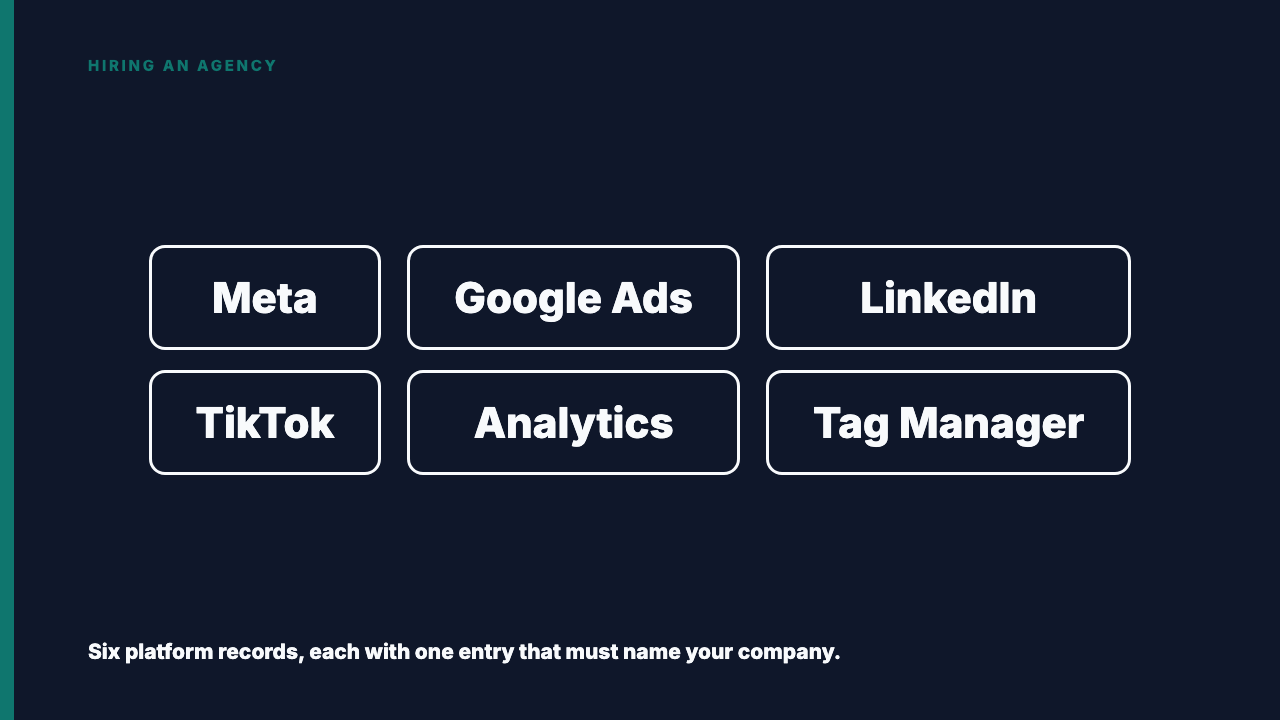
The record you must hold on each platform
You hold the container and the asset; the agency works inside it. Meta and TikTok rename screens, so check their own help pages.
| Platform | You hold | Agency is granted | If they hold it |
|---|---|---|---|
| Meta page and ad account | Business level container in your name, holding both. | Operating access from your container. | Ad account and spend history theirs. |
| Google Ads | Your account and billing identity; their manager merely linked. | Manager link at Standard, below hierarchy management. | Access, billing and hierarchy on their side. |
| LinkedIn Page | Super admin on two employees’ member accounts. | Content admin, analyst or paid media role. | Control leaves when their staff leave. |
| TikTok | Business level account in your name. | Publishing, campaign and reporting access. | Spend history stays with them. |
| Analytics property | Account and property, your staff as Administrator. | User access, revocable by you. | You lose the measurement baseline. |
| Tag container | The container, two internal administrators. | Publishing and editing rights. | Measurement deploys outside your control. |
Two rows rest on documentation. Google describes a manager account as one account managing others beneath it, says linking does not by itself grant administrative ownership, and notes ownership of a client account can be granted separately, which you withhold. An administrative user on the client account can unlink the manager at any time, the test above applied to Google Ads. Access inside comes in defined levels, Standard excluding hierarchy management. LinkedIn control is named admin roles on individual member accounts: super admin adds and removes admins, with content admin, analyst and paid media roles below.
How to give an agency everything it needs and nothing it can hold hostage
An agency starved of permissions does worse work. Sit one level above it.
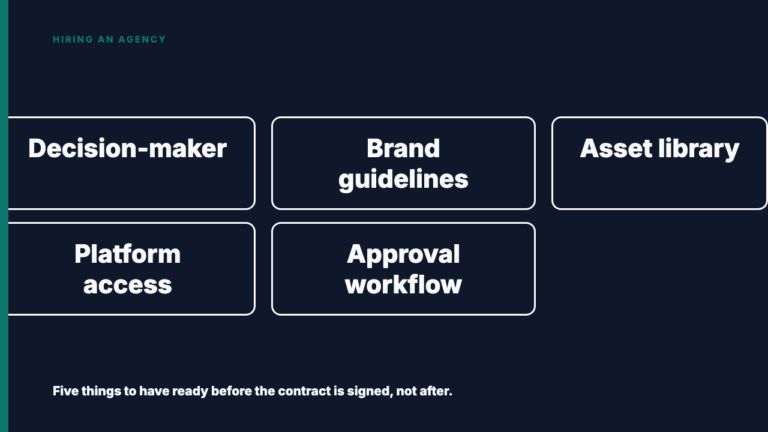
- Create the container first, then invite the agency, from an address on a domain you own.
- Put a company controlled mailbox on the top record. A mailbox IT can reassign survives resignations; a personal login leaves with the employee.
- Grant generously at the operating level: campaign creation and editing, publishing, comment and message handling, reporting.
- Keep three powers: adding and removing admins, changing billing identity, moving an asset to another container.
The setup offer that quietly costs you the account
Picture a regional dental group, hypothetically. The agency offers to handle setup, creates the container under its own entity, opens the ad account there, and adds the client’s staff as users. At the exit, the ad account and its signals stay with the agency, the page becomes a negotiation, and the next agency starts from zero.
Three sentences signal it. “We will set the ad account up for you.” “Simpler if spend runs through our account.” “Let us get live and sort access later.” The good version: the agency shares a screen while your person creates the container, then accepts the invitation. Ask early, with your questions to ask before you sign.
If you are already mid contract and cannot log in
Establish what exists before you raise it: asking the agency to explain the setup tells it you have no leverage. Note which entity holds each container and which individual holds the admin login. Then ask as routine governance, not accusation: every container in our entity, our mailbox on the top record, access unchanged. A cooperative agency answers with a date.
Promise nothing internally yet. Some assets move cleanly between containers and some do not, the mechanism differs by platform and changes, so check the platform’s documentation first. If the agency stalls, a page, a tag container and a fresh ad account can be rebuilt in parallel. The expensive loss is the ad account’s history, earned back only with spend.
What to put in writing, and what a contract cannot create
The clause is narrow: all platform assets and business level containers held in the client’s entity, the agency’s access granted rather than owned, and access returned on termination within a stated number of days.
It is a remedy, not a control. If the agency created the ad account under its own entity, the clause hands you a claim, not a login. Before the first post goes out, get written confirmation of which entity holds each container, with the name and email on the record. For the rest of the paper, see what to check in a social media agency contract. Still comparing? Browse vetted agencies, or list your agency free if you place clients in their own containers.
FAQ
Can an agency legally keep our social accounts after we leave?
Whoever holds the top level record controls the asset in practice, whatever either side believes. A contract gives you a claim to pursue, not a way to sign in. Not legal advice: ask your counsel.
Our agency says it is easier if the ads run through their account. Is that true?
Easier for them, sometimes faster to launch. You absorb the cost: no independent view of spend, no account history that stays with you. The middle ground is your account, with the agency inside it at high permission.
What if one of our employees set everything up under a personal login?
Same failure, different holder. Move the top record onto a company controlled mailbox and add a second internal admin, so no individual is a single point of failure. Check the platform’s documentation for the current mechanism.
How much access is too much to give an agency?
Wrong axis. Operational permission should be generous, admin permission over the container never shared. The line is adding or removing admins and changing billing identity. An agency needing either sits in the wrong entity.
Sources
- Google Ads, manager accounts, 2026-08-25.
- Google Ads, manager access levels, 2026-08-25.
- LinkedIn, Page admin roles, 2026-08-25.
- Analytics, managing users, 2026-08-25.
- Tag Manager, user permissions, 2026-08-25.