The Payment Terms Buried Below the Retainer Number
The proposal is in front of you and everyone is discussing the monthly number. Below it, on a page headed Billing, sits the part that decides what happens if the work slips, if you want out in month four, or if you dispute a deliverable. Most buyers skim it.
Why the retainer number is the wrong thing to compare first
Two agencies, hypothetically, pitch the same scope at $6,000 a month. Agency A wants 50% upfront before kickoff, then invoices due on receipt. Agency B takes no deposit and invoices net-30. Both land in the same spreadsheet cell. They are not the same deal. Agency B extends a month of credit on every invoice, nearer six weeks once your accounts payable adds its own cycle. Agency A holds three thousand of your dollars before a post is drafted. Neither fact says anything about the work. Payment terms are negotiable too, which almost nobody tests. Buyers push on the retainer because it reads as a price, and sign the schedule beneath because it reads as boilerplate. It is boilerplate, which is why it moves.
Deposits: what they protect and what they should not lock in
Deposits exist for good reason. Onboarding is front-loaded: discovery, account access, a first content calendar, reporting setup, all before the first invoice closes. What matters is what the deposit becomes. A reasonable one is credited against your first month or two. Wikipedia’s summary of retainer agreements notes that absent an agreement to the contrary, a retainer fee is refundable where the work is not performed. Worth remembering when an agency says theirs is not. Get it into the contract: a percentage of one month’s retainer, credited, or a separate non-recoverable fee kept even if you cancel before anything ships? Not just an invoice line.
Net-30 versus due-on-receipt: what each one signals
Net-30 means the full amount is due within 30 calendar days of the service being provided, weekends and holidays included. That is the standard trade credit convention, and net-10 and net-15 are common variants, especially for service businesses. Due on receipt means the clock is not 30 days, it is now. Short terms are a cash flow decision, not a red flag: asking for money quickly beats quietly running an overdraft. Longer terms suggest confidence in the pipeline. A paid pilot before a twelve month retainer tests this cheaply. Whichever term you agree, put it in the contract, because invoicing habits drift.
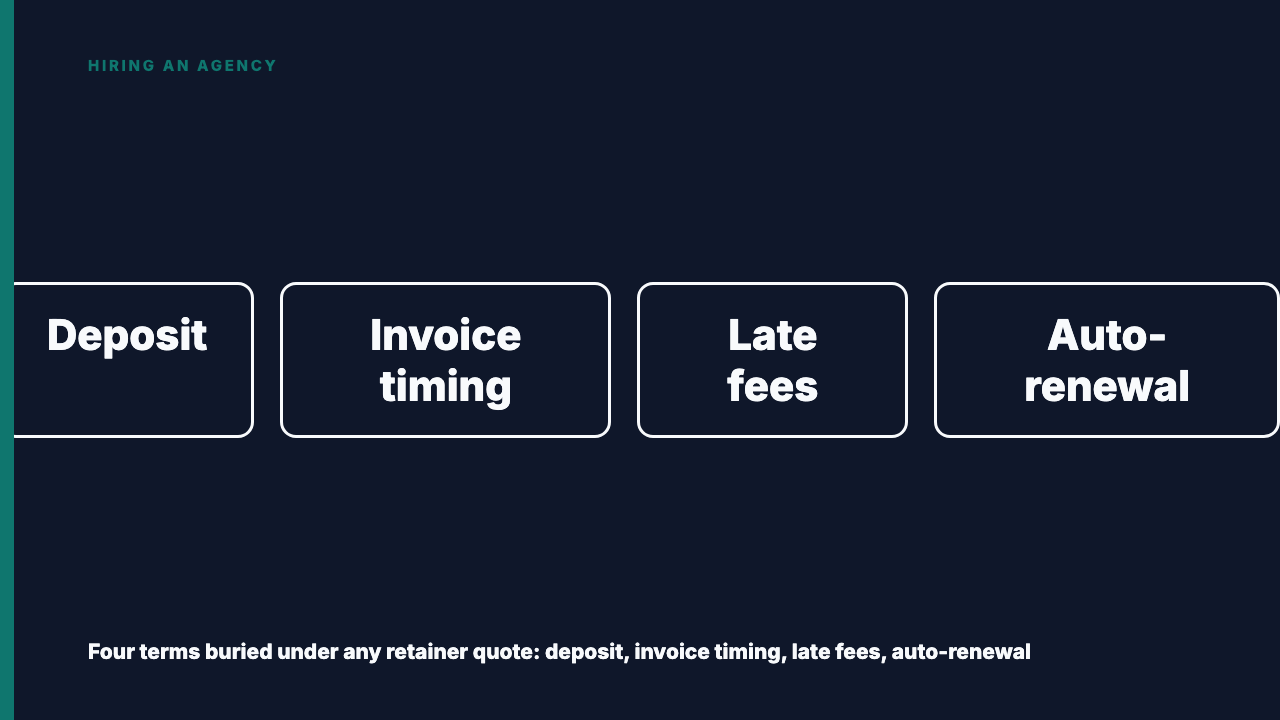
The four payment terms to compare across every proposal
- Deposit amount and status. Credited against future billing, refundable, or gone once it clears?
- Invoice timing. Net-15, net-30, or due on receipt, against your own AP cycle. If finance pays on the 1st and 15th, a due-on-receipt invoice arriving on the 16th is late already.
- Late fee structure. A stated fee or interest charge, from the due date or after a grace period, compounding or not?
- Auto-renewal terms. Renewing at the same rate or a higher one, and how many days of written notice to opt out?
Late fees are a leverage clause, not a formality
A late fee is not about the money. It is a statement about what happens under strain, and strain rarely looks like a client who forgot to pay. It looks like one who is unhappy. A late fee is a charge for not paying by the due date, and organisations reinforce it by suspending service until fees are settled. So, hypothetically: month five, deliverables were thin, two assets never shipped, you hold payment. Under one contract the fee accrues from day 31 and the agency may suspend everything, so paid campaigns go dark during an argument about organic content. Under a better one, written notice of a dispute pauses the fee and the stoppage both. Ask what triggers a stoppage: that matters more than the percentage.
Auto-renewal billing: the clause that renews the price along with the term
Separate two things contracts bundle. One is renewal of the term: the engagement continues past its end date. The other is renewal of the billing authorisation: the ACH mandate or card on file is charged for the new term automatically, nobody approving the amount. Some contracts fold a rate increase into the renewal, so an authorisation you signed months ago silently covers a higher figure. The FTC maintains a rulemaking on negative option plans, aimed at recurring charges people did not intend, though it targets consumer subscriptions, not business agreements. Find the exact notice window your contract states, since windows vary too widely to assume a norm, then calendar it against the term end date with buffer. It belongs in what to have ready before you sign.
What to actually change before you sign
- Cap or remove the non-refundable portion of the deposit. If part must stay non-recoverable, ask them to name the onboarding costs it covers.
- Add a written dispute process that pauses late fees and work stoppage on the disputed amount. You still pay the rest on time.
- Make the auto-renewal deadline date-driven. Not “reasonable notice”, a number of days against an actual date, plus written confirmation before any renewed term is billed, at the stated number if there is an uplift.
None of these touch the retainer figure, which is why agencies move on them. The wider review this sits inside is what to check in a social media agency contract. Still choosing between a retainer, percentage of spend, or performance fee? Settle that first.
Find an agency worth negotiating with
Good terms are worth little from the wrong agency. Start with a shortlist you can trust: browse vetted agencies. Run an agency? List your agency free.
FAQ
Is a deposit before work starts a red flag?
No. A deposit credited against your first invoice or two is ordinary practice, covering onboarding done before any billing cycle closes. Scrutiny belongs on a separate, non-refundable fee kept even if you cancel during onboarding with nothing delivered. Get the answer into the contract.
What is a reasonable late fee in an agency contract?
Judge the process, not the percentage. What matters is the grace period, whether written notice is required before the fee accrues, whether a raised dispute pauses it, and whether non-payment lets the agency stop work. A modest fee with an instant stoppage trigger is worse than a higher one with a real dispute process. Late fee limits vary by jurisdiction too.
Sources
- Net D, Wikipedia. Fetched 2026-09-07.
- Late fee, Wikipedia. Fetched 2026-09-07.
- Retainer agreement, Wikipedia. Fetched 2026-09-07.
- Negative Option Rule, Federal Trade Commission. Fetched 2026-09-07.