What to Check in a Social Media Agency Contract
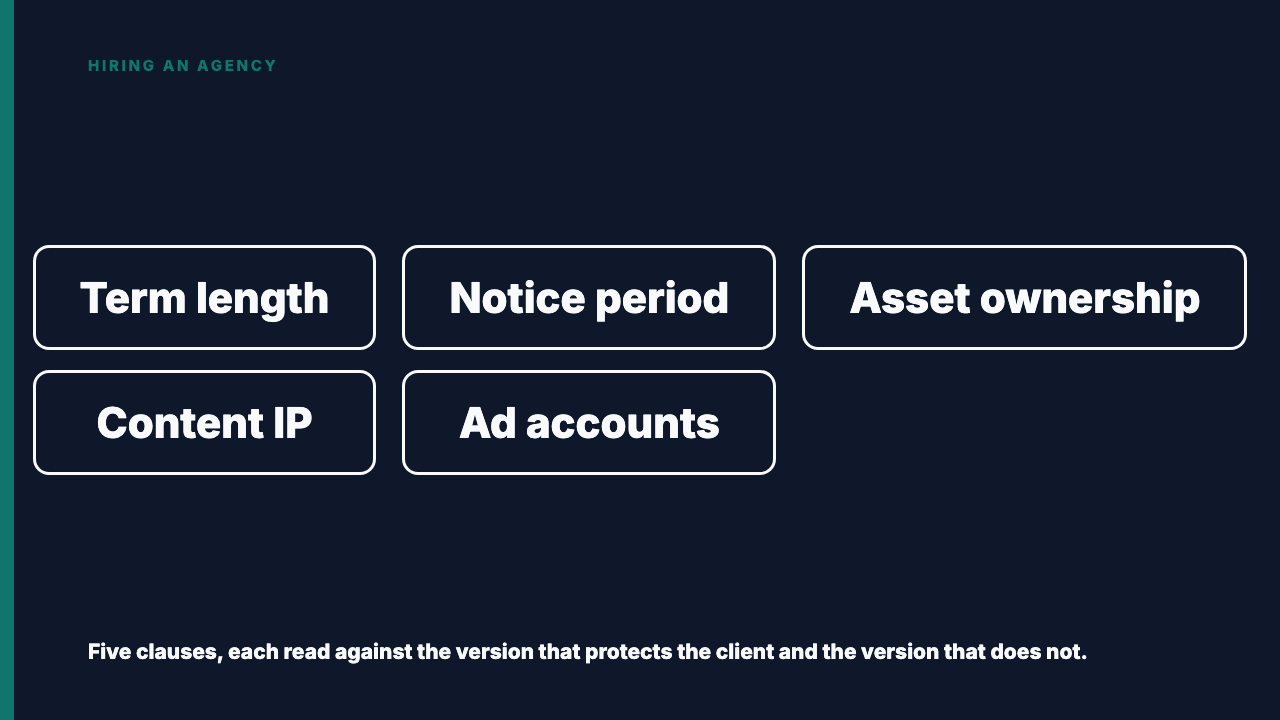
Most brands find out what their social media agency contract actually says on the day they try to leave. By then the leverage is gone. The clauses that matter are boring on page one and expensive on page nine, and agencies know most clients never read past the pricing table. Before you sign anything, check these five things: how long you’re locked in, how much warning you need to give to get out, who owns the assets once the relationship ends, who holds the copyright on the content, and what happens to your ad accounts the day the contract ends.
Term length: know what you’re actually committing to
Agencies pitch annual contracts as a sign of commitment. Sometimes that’s true. More often it’s a hedge against churn, because social results are slow to show and a twelve month term buys the agency room to underperform without consequence. A good contract offers an initial term of three to six months, long enough to see real output, then rolls month to month unless either side cancels. A bad contract locks you in for twelve months with no exit clause and a penalty for early termination that’s vaguely worded on purpose.
Picture a boutique fitness studio that signs a twelve month deal because the agency promised a discount for the longer term. Three months in, the content is generic and engagement is flat. The studio is stuck paying for nine more months of work it doesn’t want, because nothing in the contract lets it leave without a penalty. That’s not a hypothetical failure of judgment, it’s a predictable outcome of not reading the term clause before signing.
Notice period: the clause that decides how fast you can move on
Term length tells you the minimum commitment. Notice period tells you how much runway you need before you can actually walk. A 30 day notice period is standard and fair to both sides. It gives the agency time to wrap up in-flight work and gives you time to line up a replacement. Anything past 60 days should raise a question, and anything past 90 days is a sign the agency is designing the contract to make leaving painful rather than earning renewal through good work.
Ask directly: if I give notice today, what is the exact date the relationship ends, and what happens to scheduled posts and campaigns in that window. A good agency answers in one sentence. A vague answer here usually means the notice clause was written to be ambiguous on purpose.
Asset ownership: who keeps the accounts, the calendar, the login
This is the clause most business owners assume is obvious and never confirm in writing. When the contract ends, do you get the content calendar, the creative files, the analytics history, and admin access to every platform, or does the agency keep it as leverage until final invoices clear? The good version states plainly that all social accounts, admin credentials, content files, and performance data belong to the client at all times, and that the agency’s role is managing them, not owning them. It also spells out a handover timeline, typically five to ten business days after termination, with a checklist of what gets transferred.
The bad version says nothing about ownership at all, which usually defaults to whoever has the login credentials at the moment the relationship ends. If the agency set up your accounts using their own email addresses or a shared login you never had direct access to, you don’t have a social media presence anymore, you have a former vendor holding it hostage. Ask for admin access on every platform on day one of the engagement, not as a negotiating point during a breakup.
IP on content: who owns the posts, graphics, and video after the invoice is paid
Term and notice govern how you leave. Ownership and IP govern what you leave with. They’re related but not the same thing, and a contract can get one right and the other wrong. Paying an agency’s monthly retainer does not automatically mean you own the creative it produces. Some contracts grant the client a license to use the content, which sounds fine until you realize a license can be revoked, restricted to certain platforms, or tied to continued payment. Others assign full copyright to the client on delivery or on payment, which is what you actually want.
The good version states that upon payment, all content, including video, graphics, copy, and any raw footage or source files, becomes the client’s property outright, with no ongoing license terms attached. The bad version is silent on IP entirely, or it grants the agency a perpetual right to reuse your content in its own portfolio and case studies without a separate conversation. Reusing your brand’s work as their case study isn’t inherently a problem, plenty of clients are happy to be featured, but it should be something you agree to, not something buried in boilerplate.
Ad accounts on exit: the clause everyone forgets until it’s too late
If the agency runs paid social alongside organic, ad account structure deserves its own line in the contract, separate from general asset ownership. Ad accounts should live under your business manager, with the agency added as a partner or given admin access to that account, never the other way around. If the agency creates the ad account under its own business manager and grants you access as a guest, you’re one dispute away from losing your pixel data, custom audiences, and campaign history, all of which took months to build and can’t be rebuilt overnight.
Before you sign, ask who owns the Meta Business Manager, who owns the Google Ads account, and what happens to the pixel and conversion data if you switch agencies. A good agency will have already set this up correctly, because they’ve done enough exits to know it protects both sides. An agency that hasn’t thought about this, or gets defensive when asked, is telling you something about how many clients have left before and how those exits went.
Find agencies that don’t need this checklist
The agencies that get defensive about these five clauses are usually the ones counting on you never asking. The ones worth working with will have already answered them before you bring it up. Browse vetted agencies with named client work to see how the ones that do this well operate, or if you run an agency that gets contracts right, list your agency free.
FAQ
Is a 12 month contract with a social media agency ever reasonable?
It can be, but only if it comes with a fair exit clause, such as a 30 day notice period after an initial 90 day evaluation window. A long term without any early exit option shifts nearly all the risk onto you, since social results take time to show and you have no recourse if the work isn’t working.
What should I do if my current contract doesn’t mention asset ownership at all?
Don’t wait for a dispute to find out. Request admin access to every account, ad manager, and content library now, and ask the agency to confirm in writing, even by email, that all assets belong to you. If they resist a simple written confirmation of something they claim is already true, that reluctance is the answer.