Should You Tell an Agency Your Budget Before It Pitches?
The RFP is nearly finished and one line is still empty. Budget. Leaving it blank feels like the disciplined choice, and it quietly ruins the comparison the RFP exists to produce.
The case for silence, and why it stops working at the proposal stage
The conventional advice, absorbed by most buyers without much questioning, is to hold the number back so the agency does not spend all of it. Tell them $12,000 a month and you will get a proposal that costs $12,000 a month.
That fear is aimed at the wrong risk. The problem is not that an agency builds a plan to your number. It is that without your number every agency builds a plan to a different guess. One anchors low and strips scope to hit a figure it thinks you can stomach. Another anchors high and pads the scope with workshops and quarterly planning. A third splits the difference for no articulable reason.
What arrives is not three bids for the same job. It is three different products, and you cannot rank them.
A blank budget line, played out
This is an illustrative scenario, not a real case. Picture a regional home services company sending the same RFP to three agencies. Same brief, budget line blank. Agency A assumes a modest budget and proposes execution only: twelve posts a month, one revision round, a monthly summary. Cheap, and silent on strategy, because at its assumed number there was no room for any. Agency B assumes a serious budget and proposes discovery, a strategy refresh, organic plus paid, an account lead and a dashboard. Thorough, expensive, impossible to set against Agency A.
Agency C asks what the budget is. The brand, still holding the number, says it wants the agency’s recommendation, so Agency C guesses too. The brand ends up with three proposals and no way to choose. The one variable it controlled is the one it withheld.
Why a range, not a number, is what makes proposals comparable
A single hard figure does invite agencies to hit it exactly. State $12,000 a month and you will get proposals at $11,800 and $12,400, and learn nothing about how each agency thinks.
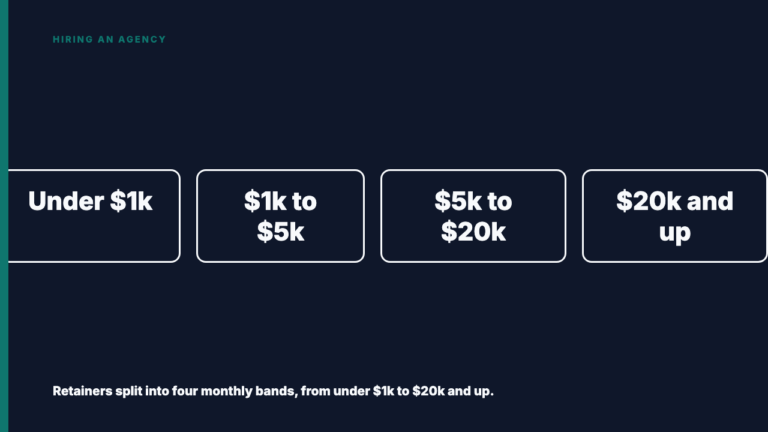
A range works differently. Give agencies a band, say $5k-$20k/mo, and you have not told them what to charge. You have told them what to solve for. Ask them to show the work at the bottom of that band and at the top. The gap between those two versions tells you what they consider essential, what they consider an upgrade, and what they would cut first under pressure.
Know the general bands social media agency pricing falls into first, so the range you state is one agencies recognise.
What to put in the RFP, and what to leave out
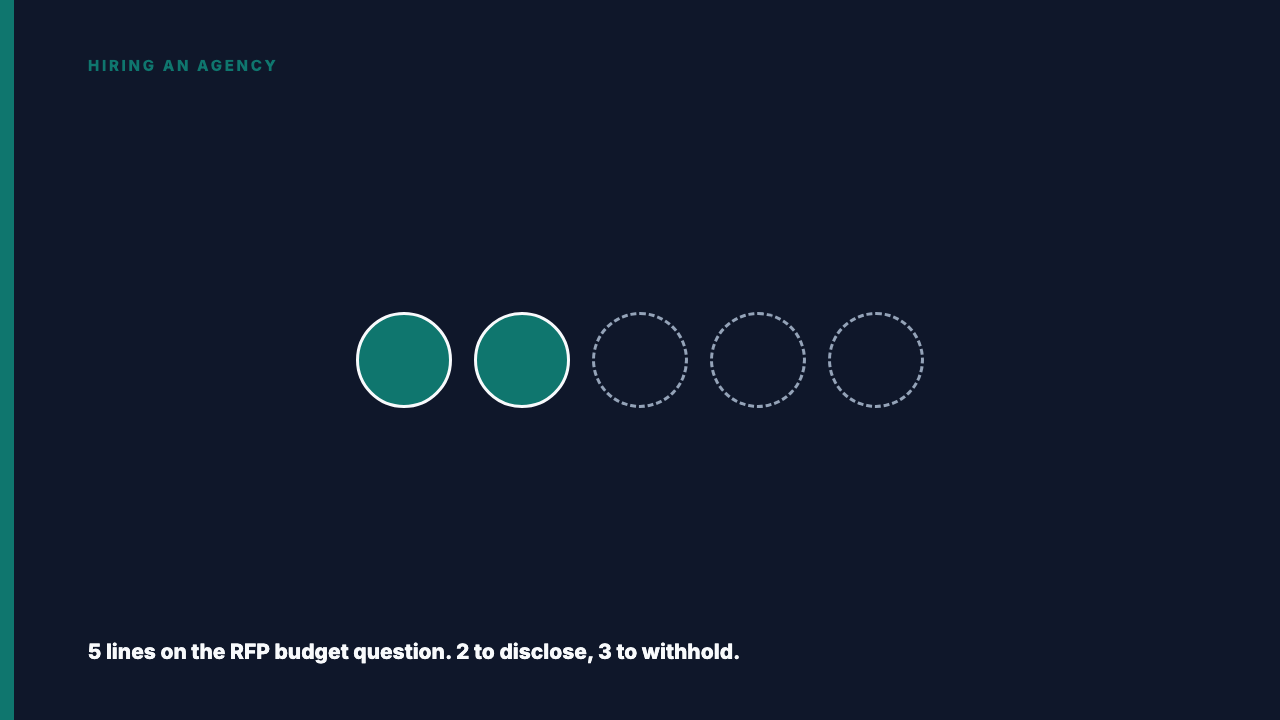
Disclosure is not transparency about everything. There is a line between what makes proposals comparable and what hands over your negotiating position.
| Item | Disclose or withhold | Why |
|---|---|---|
| A monthly or annual budget range, and the general band it sits in | Disclose | The shared constraint. Without it there is no comparison. |
| Whether the number is fixed or has room to move for the right scope | Disclose | Tells agencies whether to propose one version or an upgrade path. |
| The true top of what you would approve if you loved the proposal | Withhold | Your real maximum turns every proposal into a bid at your maximum. |
| What a previous or competing agency quoted you | Withhold | Anchors proposals to someone else’s pricing logic, not your requirements. |
| Your internal approval ceiling or procurement cap | Withhold | A governance limit, not a scoping input. It says nothing about the work. |
How the budget line actually reads, good version and bad version
The bad version is a single unqualified figure. “Budget: $8,000 per month.” and nothing else. It reads as a price to be met, not a constraint to be reasoned about.
The good version states a band and a sentence about flexibility. The phrasing below is illustrative, not a template to copy:
We expect this engagement to sit in the $5k-$20k/mo band, with some room at the upper end for a scope that justifies it. Show us what you would prioritise at the lower end and what you would add at the upper end.
That last sentence converts the disclosure into a request for reasoning. When proposals come back, read the scope of work each proposal actually promises, because stripped deliverables and padded ones can both land inside the same band.
When it is still fine to hold the number back
The comparability argument only applies once someone is producing a comparable document. Before that, silence costs nothing.
Early exploratory calls are the clearest case. Nobody is writing a proposal yet, and volunteering a budget narrows the conversation. Sourcing is the other. While you build a short list by specialism, location and fit, there is no reason to attach a number. Send the RFP with the range attached to the handful that made the cut, then move to the questions that separate a real proposal from a polished one.
Building the short list
If you are sourcing now, browse vetted agencies by specialism and location, then send the RFP with your range only to the ones worth a proposal. If you run an agency, you can list your agency free.
FAQ
Will disclosing my budget just mean every proposal comes in at exactly that number?
Largely yes, and that is the point. Comparability requires a shared ceiling. Once every agency builds to the same range, they compete on how they would allocate it, not on who guessed your number best.
What if my real budget is genuinely flexible?
Say so inside the range itself. State the band you expect to invest in and note there is room to move for a scope that earns it, rather than one hard figure that reads as fixed. That invites an upgrade path.
Does stating a budget range mean I have committed to spending it regardless of who pitches?
No. A range sets a planning expectation, not a promise to spend. Every agency still has to earn the business on scope, staffing and fit, and a proposal that fills the band without justifying it is a reason to decline.
Should I give a different budget range to each agency I am evaluating?
No. Every agency in the same RFP round gets the same range. The whole value of disclosing it is that proposals come back built against an identical constraint. Varying the figure by agency destroys that.