Retainer vs Percentage of Spend vs Performance Fee
Two agencies quote you for the same work. One sends a flat monthly number, the other a percentage. Until you convert both into the same unit, you are not comparing proposals. You are comparing paperwork.
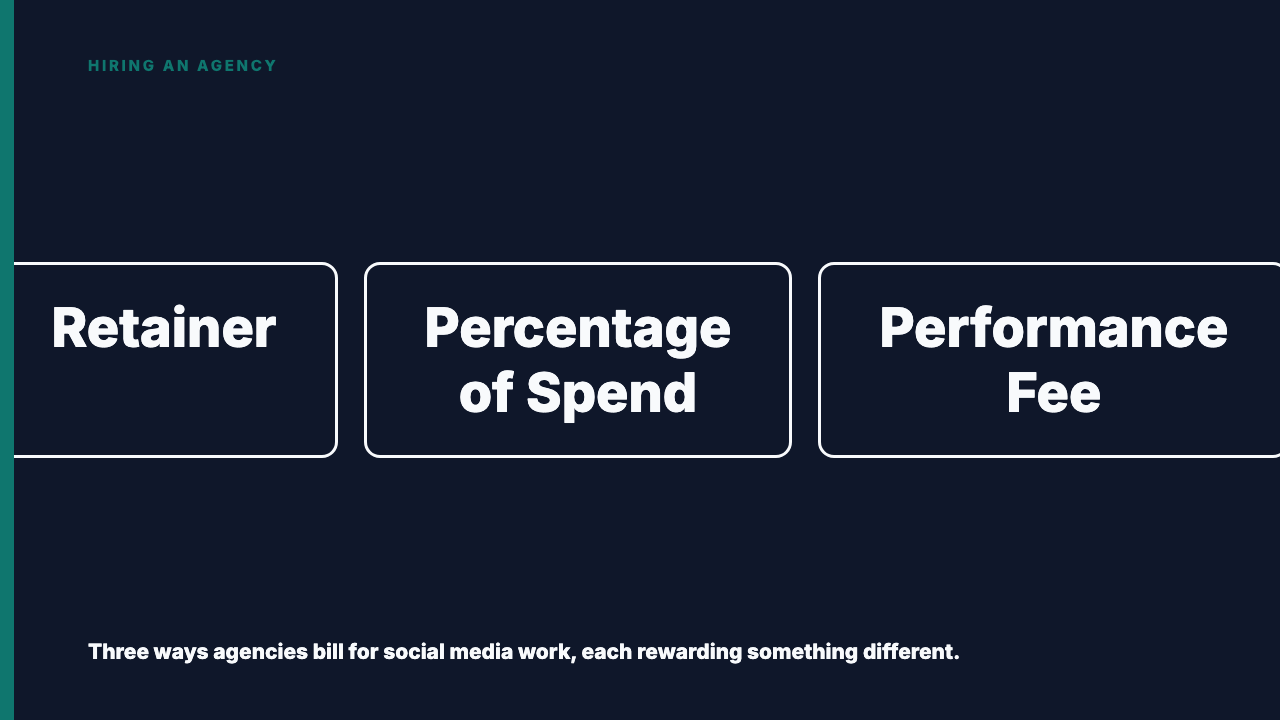
The three ways agencies bill for social media work
Nearly every proposal is built from three mechanisms. A retainer is a fixed recurring fee for a defined scope, independent of media spend and of results. A percentage of ad spend, sometimes called a commission, is a share of the media budget the agency manages, so it moves when the budget moves. A performance fee ties some or all of the fee to a named, measurable outcome instead.
Hybrids are the norm, not an edge case. A base retainer plus a smaller spend-based or performance-based component is ordinary rather than exotic.
What a retainer actually buys
The retainer’s virtue is what it disconnects. Because the fee has no relationship to the media budget, nobody gets paid more for recommending you spend more. The tradeoff shifts the risk from overspending to underdelivering: if the scope is vague, a stretched team does the minimum the document can be read to require.
So a retainer is only as good as its scope. A well defined one names things you can count: content pieces per month and in which formats, revision rounds, platforms, report contents, hours of media management included. A poor one leaves it open-ended, ongoing content creation and strategic support, unenforceable by month seven. Work through how to read the scope of work before you sign.
Percentage of ad spend, and the incentive it creates
The fee is a share of whatever media budget flows through the accounts the agency manages, so it rises the moment the budget rises, before anyone knows whether the extra money worked. None of that requires bad faith: the model rewards spend rather than performance, and the two do not always move together.
The gap widens with budget tier. At a small budget the difference between holding steady and spending more is modest, while at a large one the same rate makes that recommendation worth materially more to the agency.
The defense is a question, asked whenever an increase is proposed: what is the evidence, and would you still recommend this if your fee did not move? Ask for justification you can check in your own records.
Performance fees: what they can and can’t fix
A performance fee attaches part of the pay to a named outcome: a lead count, a conversion volume, a cost per acquisition threshold. Done properly it moves risk off your side; done badly it manufactures arguments.
It works only when three things hold: the metric is defined precisely enough that both sides would compute the same number from the same data, the outcome is attributable to work the agency controls, and both audit it from one source of record. Whose analytics counts a conversion, what window applies, who owns a lead closed on a sales call: settle those in the contract, or in an argument.
Attribution decides where the model fits. Paid social with a direct conversion path is its natural home. Organic and community work are poor candidates, because outcomes are diffuse and no one can isolate the agency’s contribution. A vague performance clause is worse than none: it creates the expectation of alignment without delivering it.
Comparing two proposals priced differently
Here is a hypothetical, no real agency or figure involved. A regional retailer holds two proposals for one paid social scope. Agency A quotes a flat retainer, R per month. Agency B quotes a percentage of ad spend, P, against a monthly budget of M.
Agency B’s monthly fee is M multiplied by P. That product, not the percentage, is the number that sits next to R. Run it again at a higher budget: R does not move, M times P does. The format a quote arrives in tells you nothing about whether it is expensive. For price level, see the four budget bands agencies typically price around.
Questions to ask before you sign
- If the budget changes mid-contract, how is the fee recalculated, and with how much notice?
- Is the percentage taken on gross ad spend, or net of platform fees and taxes?
- If spend drops or a campaign pauses, is there a floor, and what does it buy?
- In a performance clause, who defines the metric, and who audits it?
- Does the rate change automatically at renewal, or is that left to negotiation?
Then read what else to check in the contract itself.
Which model fits which situation
| Your situation | Model that fits | What to watch |
|---|---|---|
| Stable scope, little or no media budget | Retainer | The scope document does the work. |
| Large or fluctuating ad budgets | Flat fee, or a percentage that declines as spend rises | Cost grows with budget regardless of result. |
| Direct response or lead generation with a clean conversion | Base fee plus performance component | Metric, attribution and source of record agreed in writing. |
| Organic, brand or community work with no conversion | Retainer with defined deliverables | No outcome traces cleanly to the agency. |
Compare the proposals you actually have
Fee structure is easier to judge across several options. Browse vetted agencies to build a shortlist, or list your agency free if you run one.
FAQ
Is percentage of ad spend a bad pricing model?
Not inherently. It carries a structural incentive toward higher spend rather than better spend, which is a property of the mechanism and not bad faith by the agency. Account for it whenever an increase is recommended, especially at higher budget tiers.
What percentage do agencies typically charge for percentage-of-spend billing?
There is no standard rate worth quoting, and any figure offered as the industry norm is a negotiating position. Ask each agency for its rate and whether it applies to gross or net spend, then multiply it by your own budget before comparing with a flat retainer.
Can I negotiate a hybrid fee model?
Yes, and it is common. A base retainer covering the defined scope, paired with a smaller spend-based or performance-based component, is something most agencies will discuss. If the spend piece worries you, ask for a percentage that declines as the budget rises.
Are performance fees only for paid social advertising?
Not only, but they fit where the outcome is clean, attributable and genuinely influenced by the agency, which describes direct response paid social better than most work. For organic content and community management, no single outcome isolates the agency’s contribution.