You Just Inherited a Social Media Agency. Here’s the Audit.
A social media agency is on retainer, hired by someone who no longer works here, and their invoice is in your queue. Nobody left can tell you if they are any good. You did not pick them. You still have to decide what happens to them.
Two bad instincts, and why both fail the same way
The first instinct is to leave it alone. Fighting an incumbent in month one costs capital you have not earned, so you approve the invoice and inherit your predecessor’s trust in the vendor. That trust was calibrated on information you lack. Whatever they tolerated, a scope that drifted, a report that stopped arriving, an account lead swapped without notice, you now tolerate too.
The second instinct is to end the contract inside ninety days as a signal of change, since vendor churn is cheap. That fires a supplier before you know whether the agency or the prior internal owner was the problem. Plenty of relationships underperform because nobody on the client side ran them. Replace the agency and you rebuild the same relationship with a new logo.
The audit answers one question: is this agency bad, or was this relationship never managed? One means a search. The other means fixing your own side, starting with who should own the agency relationship internally.
What to request before you form any opinion
Ask in week one, in one message, framed as onboarding.
- The signed contract or master services agreement, plus every amendment and change order.
- The current scope of work and the most recent renewal, so you see what is contracted now.
- The last two or three performance and status reports, as sent.
- Email and Slack history between the prior internal owner and the agency’s account lead, at least ninety days of it.
- Who holds approval authority on your side, and who is staffed on the account on theirs, by name and role.
This is normal onboarding, not distrust, and a competent agency sends it without editorialising. These documents exist even if your predecessor’s notes do not.
Reading the contract like an auditor, not a signer
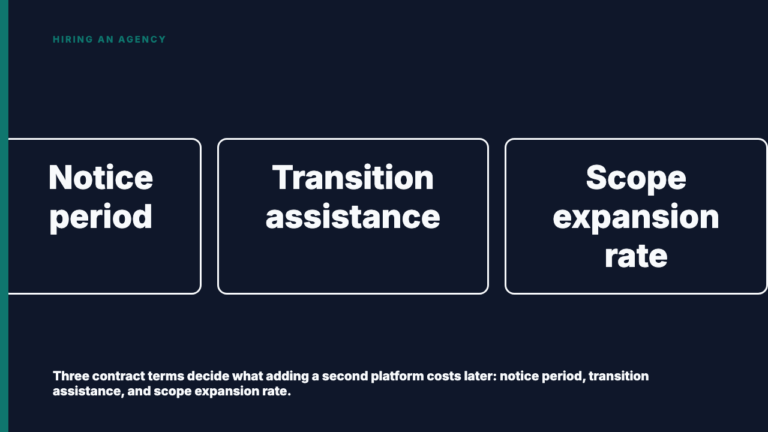
A first-time hirer reads for entry terms. You read for exit mechanics, because they set your room to act. Find the termination clause before anything else. Check the notice period, whether a kill fee is named, and whether termination for convenience is allowed at all. Do not assume what these usually say. Read yours. Then find the renewal date and whether renewal is automatic, because a contract six weeks from auto-renewal is a different problem from one with seven months left. Last, look for minimum commitment or exclusivity language, which may restrict bringing in a second agency even for evaluation.
The general checklist for how to read an agency scope of work before you sign it still applies. You just did not negotiate this one, so you are hunting for what was agreed and never enforced.
The 30-day audit, week by week
A framework we recommend, not a reported industry standard.
| Week | What you do |
|---|---|
| Week 1 | Collect the artifacts, read the contract and scope. No agency contact needed. |
| Week 2 | One introductory call, framed as continuity. Separately, check the last two reporting cycles against the scope: every deliverable delivered, every report on time. |
| Week 3 | Working session with the internal people who worked with the agency before you, agency not present, to surface friction that never made it into writing. |
| Week 4 | Write the decision memo, before any talk with the agency about renewal or termination. |
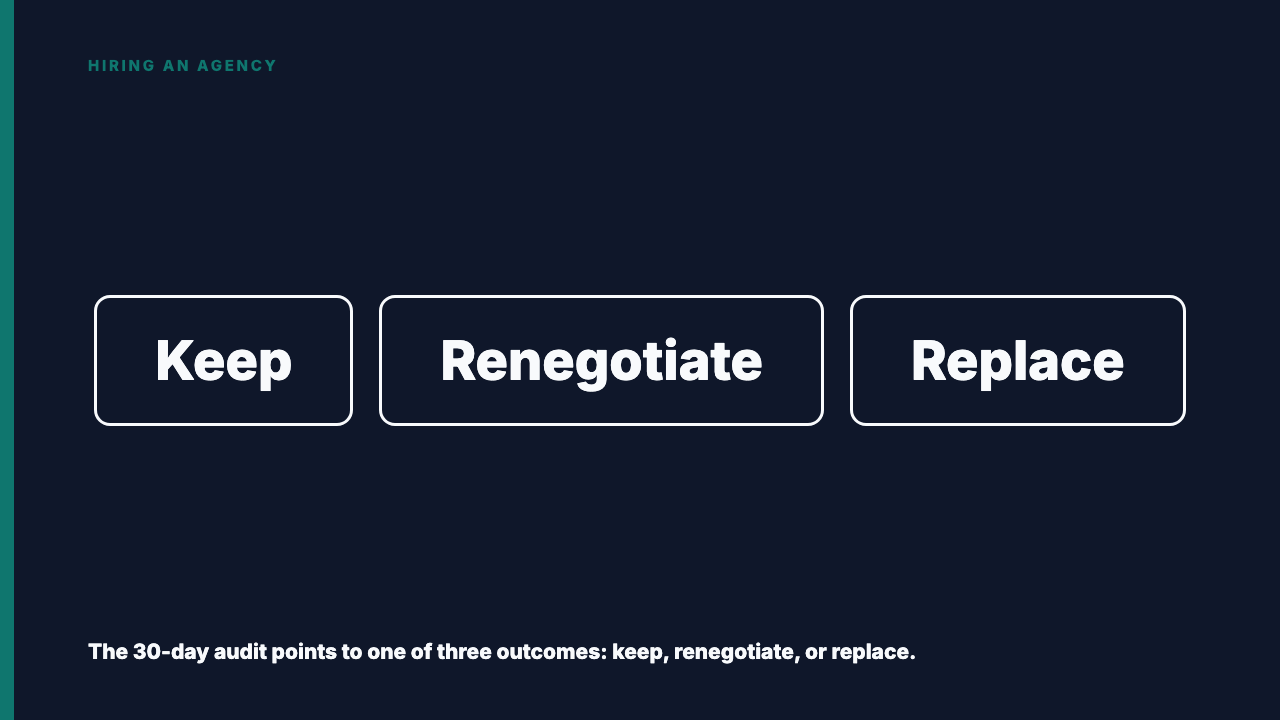
Signals that point toward keep, renegotiate, or replace
Three hypotheticals, illustrative only.
Picture a healthcare group where the invoices match the scope line for line and every report landed inside the contracted window. That points to keep, with a check-in cadence that suits you.
Now a retail brand where the agency has run a second platform and a paid campaign for months, none of it in the signed scope, no change order, the fee unmoved. That points to renegotiate, not replace: either the scope catches up to reality or the fee does.
Third, a hospitality client whose account has had three leads in eighteen months, no handover announced in advance, and reports that arrive whenever. That points to replace, because the agency cannot hold a team on your account. Read what account manager turnover usually signals first.
Not on this list: “I would have chosen someone else.” Preference is not a finding.
What NOT to do in the first 30 days, even if you’re right
Do not tell the agency they are being evaluated before the document review is done. The moment they know, reports improve and the senior person reappears on calls, contaminating your only clean sample: how they behaved when nobody new was watching.
Do not promise your team a replacement before the exit terms are confirmed: a notice period or kill fee can make it impossible no matter how right you are. And do not run the audit silently. Give your manager the timeline, since silence reads as inaction or as a decision already taken.
Writing the decision memo
Open with the recommendation in one sentence: keep, renegotiate these terms, or start a replacement search. Then support it with artifacts. “Section 4 requires a monthly performance report; two of the last three cycles have none on file” is a finding. “Reporting feels thin” is not. Cite the clause, the missing report, the staffing change. Close with the constraint: the notice period, the renewal date, and the last day you can decide before the contract decides for you.
If the audit says replace
Start the search before you serve notice, so you are choosing rather than scrambling. Browse vetted agencies in our directory of 80 agencies while the incumbent still works, and plan the handover with how to leave a social media agency without losing the history. Agencies can list your agency free.
FAQ
How long should I wait before making a decision about an agency I inherited?
Use the thirty-day audit, not an arbitrary waiting period. The ceiling is not comfort, it is two contract dates: the notice period you owe and the renewal date. Find both in week one and work backwards.
Is it unprofessional to request the full contract and email history from an agency I didn’t choose?
No. It is standard due diligence and any competent agency expects a new contact to ask for the file. If the request meets hesitation, partial delivery, or a suggestion that a call is easier than sending documents, record that. Reluctance is a data point.