When No Agency Specializes in Your Category, Do This
You have worked the directories, asked people you trust, and briefed a few names. Nothing came back that fits your category. Not a weak match, an absent one. The instinct is to keep searching, or to shelve hiring until a specialist appears. Both are ways of not deciding.
Why the search comes back empty
Agency specialization forms along one of two lines, and neither is your industry. The first is function or channel: paid social, influencer marketing, content and creative, social media management. This directory is organised that way too: its 80 listed agencies sit under functional headings, not industry ones. The second line is a large, well funded vertical. Claiming one credibly takes repeatable playbooks and staff who know that audience’s failure modes, which needs a category big enough to keep several clients at once and stable enough that last year’s playbook still works. Most categories are neither.
A genuinely new product category fails for a simpler reason. Nobody has run enough campaigns in it, for long enough, to produce a track record. That is a timing problem, not a research failure.
Confirm the shortlist is actually empty before acting on it
Two findings look identical from outside: no agency claims your exact vertical label, and no agency has adjacent, transferable experience. Only the second justifies changing your plan. A shop that has run social for three other regulated B2B categories may fit better than its self-description suggests, having lived through sign-off cycles and restricted claims language.
So run the check on shape, not label: search by the buyer behavior and channel mix your category requires. A long consideration cycle with a compliance step behaves like every other category with that shape, even when the products are unrelated. The baseline criteria still apply, so re-read how to choose a social media agency on specialties, proof, and fit with the industry filter off.
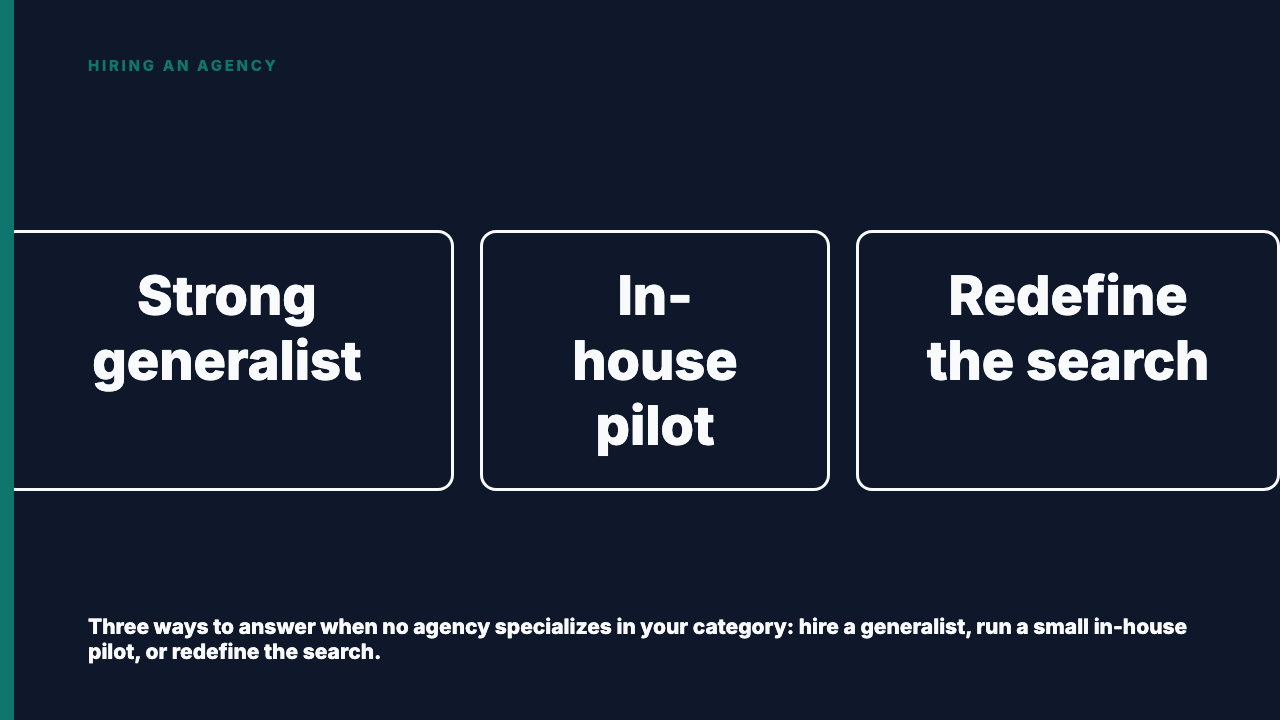
Option one: hire a strong generalist and price in the ramp
Be honest about what a generalist lacks on day one. No category playbook. No sense of which content format underperforms with your audience, knowledge usually bought by wasting budget. No point of view on your compliance boundaries or how your buyers decide. They learn it at your expense.
The acceptable version puts that in the scope, not on a call: a defined ramp period with a lower deliverable load or reduced fee at the front, and a learning agenda naming what the agency will find out, such as interviewing your customers. Build the first check-in around what they learned about the category, not how many posts shipped.
The bad version is a full price, full scope retainer signed as though the agency already knows the category. The ramp happens anyway, unbudgeted, and you pay specialist rates for a learning phase.
A generalist is not always a compromise. When a category is new enough that nobody has a playbook, cross-category pattern recognition is the most valuable asset available.
Option two: build a small in-house effort first
This is right under one condition: only someone inside the business understands the audience, the product, or the compliance boundaries well enough to direct an agency competently. If you cannot write a brief that lets an outsider succeed, hiring one is premature.
Small has to mean small. One person running the channels part time, for a fixed period with an end date, not a permanent team. The goal is to produce the brief: what the audience responds to, which claims survive review, which formats are worth an agency’s time.
A category with no agency track record has no internal playbook to borrow either, so your person learns from scratch too, on your payroll. This trades agency ramp cost for internal learning time; it relocates the learning curve, it does not remove it. The wider calculation sits in the general in-house versus agency versus hybrid decision.
Option three: redefine the category the search runs under
The method is mechanical. Write down the two or three things that make your category hard. A long consideration cycle. A technical audience that detects marketing language instantly. A compliance review step. An audience small enough that reach metrics mean nothing. Then find agencies that have solved those problems in any industry.
Picture a hypothetical brand selling a narrow industrial safety product. In the scenario, no industrial safety agency turns up; the category cannot support one. Drop the product, ask instead for agencies experienced at selling to technical buyers on long cycles through professional networks, and several credible names appear. None has touched safety equipment. All solved the actual problem, which was never the product but the buyer.
A short way to choose between the three
| Option | Choose it when | What it costs you |
|---|---|---|
| Strong generalist | Transferable channel and buyer experience exists, and budget absorbs a documented ramp | A slower start you must negotiate for |
| Small in-house pilot | The category needs internal knowledge no agency can acquire fast enough to brief itself | Internal time, and delay before agency work |
| Redefine the search | The shortage looks like a labeling problem, not a real supply gap | Little, beyond dropping the industry name |
These are not mutually exclusive over time. A short in-house pilot can exist to produce the brief a generalist agency later executes against.
What not to do while you decide
Do not wait for a specialist to appear. Specialists exist because brands in that category hired agencies and trained them, leaving behind people who know the territory. The expertise you are waiting for is manufactured by clients doing what you are hesitating to do. If everyone waits, it never arrives.
Start the search on shape, not label
Re-run the search on function and buyer type instead of industry: browse vetted agencies by the work they actually do. If you run an agency whose transferable experience keeps getting missed, list your agency free.
FAQ
Is it worth waiting for a specialist agency to emerge in my category?
No. Specialists emerge only after enough brands in a category have hired generalist agencies and trained them, so waiting removes you from the group that produces one.
How do I know if a generalist agency can actually handle a niche category?
Look at the shape of the buyer and sales process they have handled elsewhere, not whether your industry label appears in their client list. Ask about their longest sales cycle and how they handled a client with a legal review step.
Sources
- How to Choose a Social Media Agency: Specialties, Proof, and Fit, verified 2026-09-07.
- In-House, Agency, or Hybrid: How to Actually Decide, verified 2026-09-07.