What to Have Ready Before You Sign, Not After
Every input an agency needs on day one can be found, written or decided while the contract is still in redline. Do it afterwards and you pay retainer for it.
Readiness is free while the contract is in redline
The familiar pattern: the contract is signed, the kickoff call is booked, and the opening weeks go to hunting a logo file that is not a screenshot, deciding who may approve a caption, and chasing the former employee who still holds admin on an account.
That is a preparation gap, not a competence gap, and the reason to close it early is arithmetic. Each of those tasks is unpaid while you are negotiating and billed once you are not.
Name the one person who can say yes
The first item is a person, named in writing, who can approve creative without escalating and is reachable in the opening fortnight. Their duties and deputy are covered in the role you need to fill before an agency can work. The pre-signing question is narrower: does that seat exist at all?
Often it does not. Take the last piece of content your company published and ask who approved it. A committee, a chain of forwards, or nobody remembering all mean the authority was never assigned. Creating that seat is a pre-signing task, because it means asking whoever holds the informal veto to give it up.
Nor is the approver automatically whoever signed. Picture a retailer where the marketing director signs, approves the first content batch, then mentions that the founder likes to see anything customer facing. The founder is travelling, and the agency learns the real chain from a delay.
Brand guidelines: what “ready” actually looks like
Almost every brand says it has guidelines. What arrives is a deck with a logo and a tagline, which guarantees needless revisions. A usable set contains:
- Logo files an agency can use. Vector where it exists, transparent PNGs otherwise, horizontal, stacked and icon-only.
- Exact colour values. Hex codes, primaries and accents distinguished. “Our blue” is not a colour value.
- Typography. Typefaces, weights, and whether the agency is licensed to use them.
- A written tone of voice. How the brand speaks, and what it never says.
- Two or three examples each of on-brand and off-brand content. Almost nobody supplies this, and it saves the most time. “Warm but professional” is read differently by every writer alive. A post you liked beside one you did not is not.
What usually surfaces is that no document exists, only preferences in someone’s head. Writing a short one is then the task, and the fastest route runs backwards from the examples: sort ten published pieces into a good pile and a regrettable pile, then write the line that explains the sorting.
The asset library the agency will actually pull from
An agency reaches for what you already own before commissioning anything new. Gather it in one shared location sorted by type, not across personal drives and old emails:
- Existing photography, as high resolution originals rather than compressed reposts.
- Video footage, including unused material from past shoots, often the archive’s most valuable asset.
- Product shots, on white and in context.
- Past campaign creative, so nothing already said gets repeated.
- Any licensed stock you already hold usable rights to.
Clear the rights first, because it is the only item that depends on people outside the company, and an agency cannot verify reuse rights for you. Photography commissioned for a website was often licensed for exactly that, with social use outside the grant, so the contract has to be read rather than remembered. Anyone recognisable in your footage needs a model release covering social use, and staff who have left are the usual gap. Stock licences expire, so an asset cleared two years ago is not cleared today.
Chasing a signature from a photographer who has closed the studio takes real time, which is why it sits before signing. Say which shelf is off limits when you hand the library over.
Access can be decided before it is handed over
Before signing you should know which platforms are in scope, who holds admin today, and at what level the agency will be added. The mechanics, account ownership, role tiers and why a shared password is the wrong instrument belong to what you owe an agency in the first 30 days. You are drawing a map, and the map is where the surprises are.
The common one is that admin belongs to somebody who no longer works here, or a channel was opened on a personal profile and never moved. Recovering it through a platform’s support process, when nobody left can prove ownership, is slow. An unrecoverable channel changes the scope you are signing, not the schedule.
What belongs in the contract, not this checklist
Approval workflows, deliverable cadence and account ownership are contract questions: read the scope of work before you sign it separately. This checklist covers only what exists and who is named when the pen touches paper. The fifth item below sits on that line: the contract sets turnaround times, but before signing you should already have agreed internally who reviews first and who signs off last.
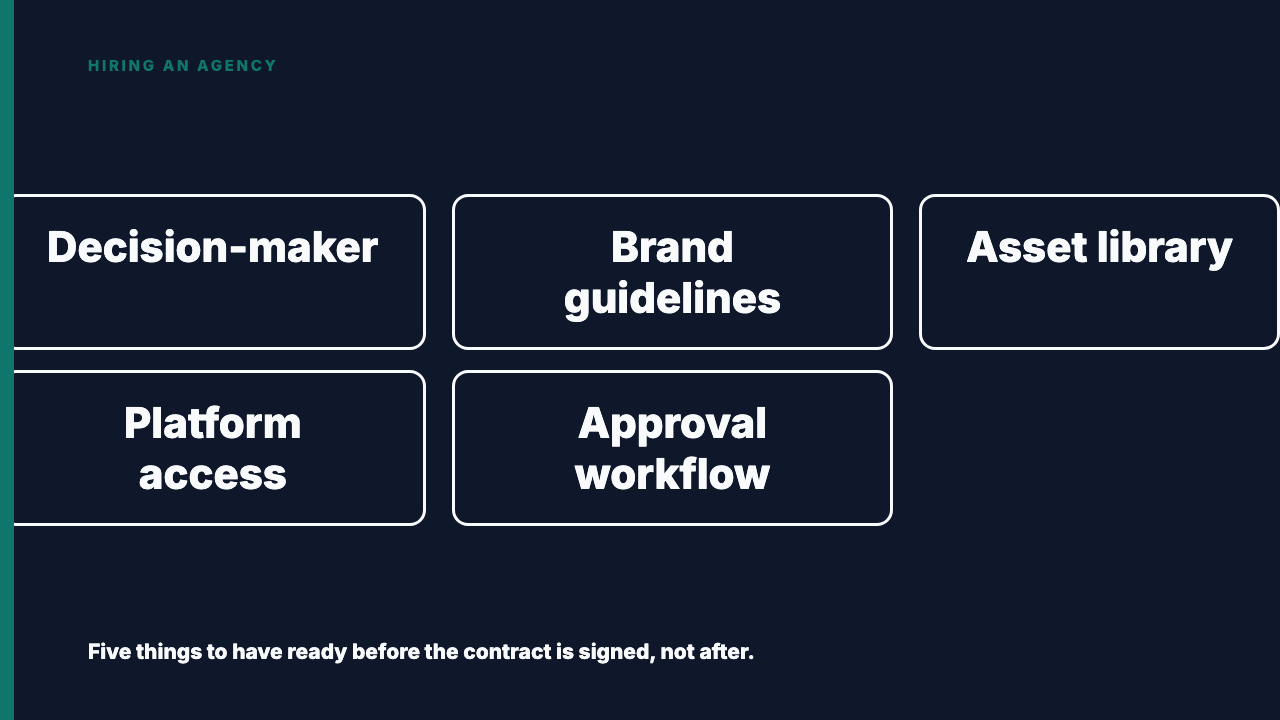
The pre-kickoff checklist
| Item | What ready looks like | Who usually owns it |
|---|---|---|
| Named decision-maker | Named in writing, approves without escalating, free in week one | Marketing lead, or the founder |
| Brand guidelines document | Logos, colours, type, tone of voice, on-brand and off-brand examples | Whoever commissioned the brand work |
| Organised asset library | One shared folder, sorted by type, reuse rights on paper | Whoever holds the archive |
| Platform access decisions | Platforms in scope listed, admin holders identified and reachable | Whoever administers them |
| Approval workflow agreed in principle | Who reviews first, who signs off last | The named decision-maker |
Still choosing who to sign with
If the shortlist is not settled, prepare these five while you evaluate. You can browse vetted agencies by specialism. Running an agency rather than hiring one? You can list your agency free.
FAQ
What is the single biggest cause of slow agency onboarding?
The absence of one named person with authority to approve work. Every decision escalates, every escalation waits on a calendar, and the opening weeks fill with queued approvals rather than published work.
How do I confirm I hold reuse rights to an asset?
Find the paperwork, not the memory. For commissioned photography and video, the contract or invoice granting the licence, checked for social use and for term. For anyone recognisable, a signed model release. For stock, a current licence. If none exists, treat the asset as unusable.