Can Your Social Media Agency Also Work With Your Competitor?
You found the specialist. They know your category without being taught it, and then you looked at their client page and saw a company you compete with directly. The instinct is to ask them to drop the competitor. That ask usually ends in a polite no and a lost shortlist candidate.
Why the answer is almost always no
The refusal is arithmetic, not evasion. An agency’s specialism is also its market, and the depth that makes it worth hiring came from keeping its client pool deliberately narrow. A category lockout does not ask it to turn down one competitor. It asks it to stop selling to most of the market it built itself to serve, in exchange for one retainer. The better the specialist, the more that costs.
Picture a small agency whose whole reputation is franchise restaurant groups. A regional chain asks for exclusivity, the agency declines, and it still wins the account by putting in writing that the strategist and account lead on the chain’s business will touch no other franchise dining client. That trade is available on most deals. The exclusivity one is not.
What “working with a competitor” actually means
Most buyers raise this before defining it, so the negotiation starts vague and stays there. At one end sits the direct competitor: same category, same customer, competing for the same purchase decision, which makes your positioning and offer calendar live intelligence. Next is the adjacent player, same audience but different category. A wedding venue and a florist share a buyer without either losing a sale to the other. Further out is the former client, a conflict that already ended.
The clause you need changes at each point. Direct overlap justifies named individuals and separate systems. Adjacent overlap justifies a disclosure obligation and little else, and pushing harder spends leverage you want for scope and notice periods. A lapsed conflict is a retention and deletion question, not a staffing one. Sorting that out early is part of the questions worth asking before you sign anything.
The clause you’re actually negotiating for
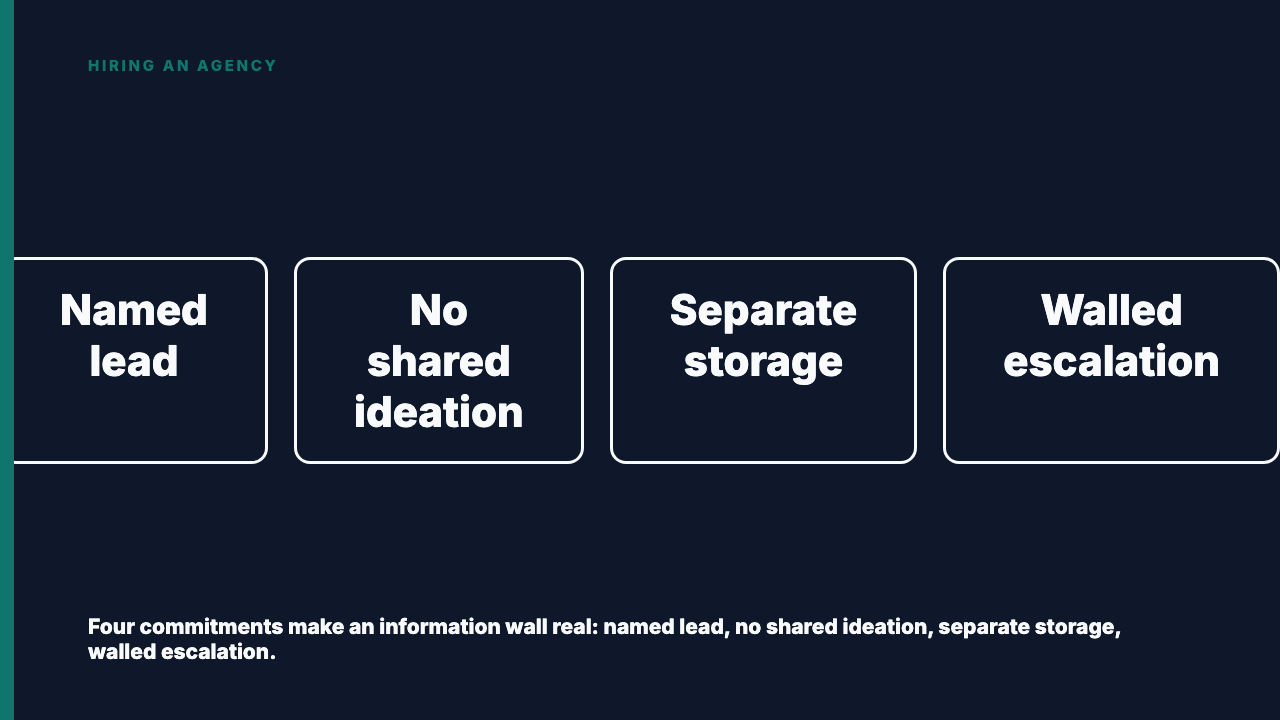
An information wall, sometimes called an ethical wall, is a long standing way professional services firms handle clients who compete. It means something only when written as specific commitments. Ask for these four by name, in the scope of work:
- A dedicated account lead and strategist. Not shared, not “primarily assigned”. The good version names two people and says neither works on the competing account. The bad version promises separate teams “where practicable”.
- No shared ideation. No brainstorms, strategy documents, content calendars or planning calls covering both accounts. The realistic leak is a creative review where eight accounts get discussed by the same six people, not a stolen file.
- Separate reporting and storage. Separate dashboards, drives and boards. A shared workspace with permissions as the only barrier is not a wall, it is a setting, and settings get widened by whoever covers a holiday.
- A walled senior escalation contact. Confirm the person you escalate to also sits outside the competing account. Agencies wall the day to day team and leave the director above both, which is where strategies converge.
What buyers ask for versus what agencies actually sign
| The ask | What agencies do with it |
|---|---|
| Hard exclusivity, full category lockout | Refused by most specialists, or accepted only at a retainer big enough to replace the market they give up. The counter is a number, not a principle. |
| Post-termination non-compete | Resisted. Where it survives it narrows to a short, defined window and a named list of companies rather than an open ended ban. |
| Information wall, named and written | The version most specialist agencies will sign, because it costs them process rather than market. |
When exclusivity is actually realistic to ask for
One situation makes the hard ask worth making. A genuinely boutique agency, a founder and a handful of staff on a short roster, is bound by capacity rather than market share, so one competitor’s worth of business is a real slice of it. The lockout costs them a prospect, not a category.
Be honest about what you buy. An agency able to grant real exclusivity has, by definition, worked across fewer versions of your category’s problem than one that cannot. Depth and exclusivity trade against each other, and which you want is better settled when choosing a specialist in the first place.
Signs the wall isn’t real
- The person who runs your weekly calls is credited publicly on a competitor’s case study, client list or team page. A wall that holds on paper but not in staffing is the common failure, and it is visible from outside.
- A tactic you tested shows up on a competitor’s account soon after, with no shared campaign or obvious trend behind it. Once is coincidence. A pattern is a room where both accounts get discussed.
- The agency cannot produce separate reporting access on request. Separation you cannot be shown is not separation.
How this plays out at the negotiating table
Take a hypothetical regional home services company vetting an agency that already names a rival on its site. The buyer does not open with exclusivity. They open with: name the lead and strategist in the scope of work, working on no other home services company, with no shared planning sessions, separate dashboards and drives, and a walled escalation contact.
The agency grants three of the four. It will not wall the escalation contact, because one operations director oversees delivery across the firm, so it offers instead that this person sees reporting but never strategy documents, plus written notice before it signs any new direct competitor. Any duration attached to that notice is negotiated on the deal, not an industry norm. Put the result in the scope of work, not an email, and read it alongside the broader contract checklist.
Start with agencies who answer the question
Ask about competing clients on the first call, and judge the answer as much as the fact. An agency that names the overlap unprompted is telling you how it operates. Browse vetted agencies to build that shortlist, or list your agency free if you run one.
FAQ
Can I legally require my social media agency not to work with competitors?
You can propose it, and a contract can say it. Whether the clause holds up depends on your jurisdiction and how broadly it is drafted, which is a question for your own counsel rather than something to assume. In practice most niche specialists refuse a full lockout or narrow it heavily, so enforceability rarely comes up.
What if my agency signs a competitor after we started working together?
Treat it as a check-in rather than an automatic breach, unless your contract already prohibits it outright, in which case read that clause first. Otherwise ask for the four commitments retroactively and in writing. An agency that agrees quickly and can show you the separation is fine. One that treats a reasonable request as an insult has told you what the next twelve months look like.