How to Leave a Social Media Agency Without Losing the History
You have decided to leave your social media agency. It still holds almost everything the next one needs, and all of it is one settings change away from gone.
The exit is a project, not an announcement
Leaving is a project with a required order of operations, and the conversation is the last step. That order is risk management, not courtesy: access removed early destroys the record the next agency needs.
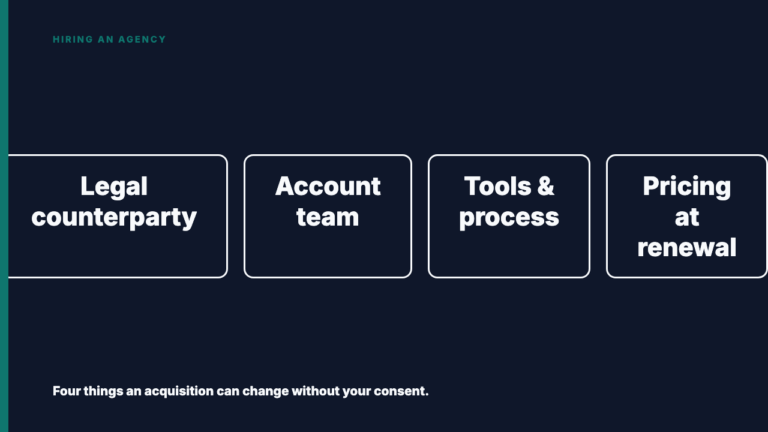
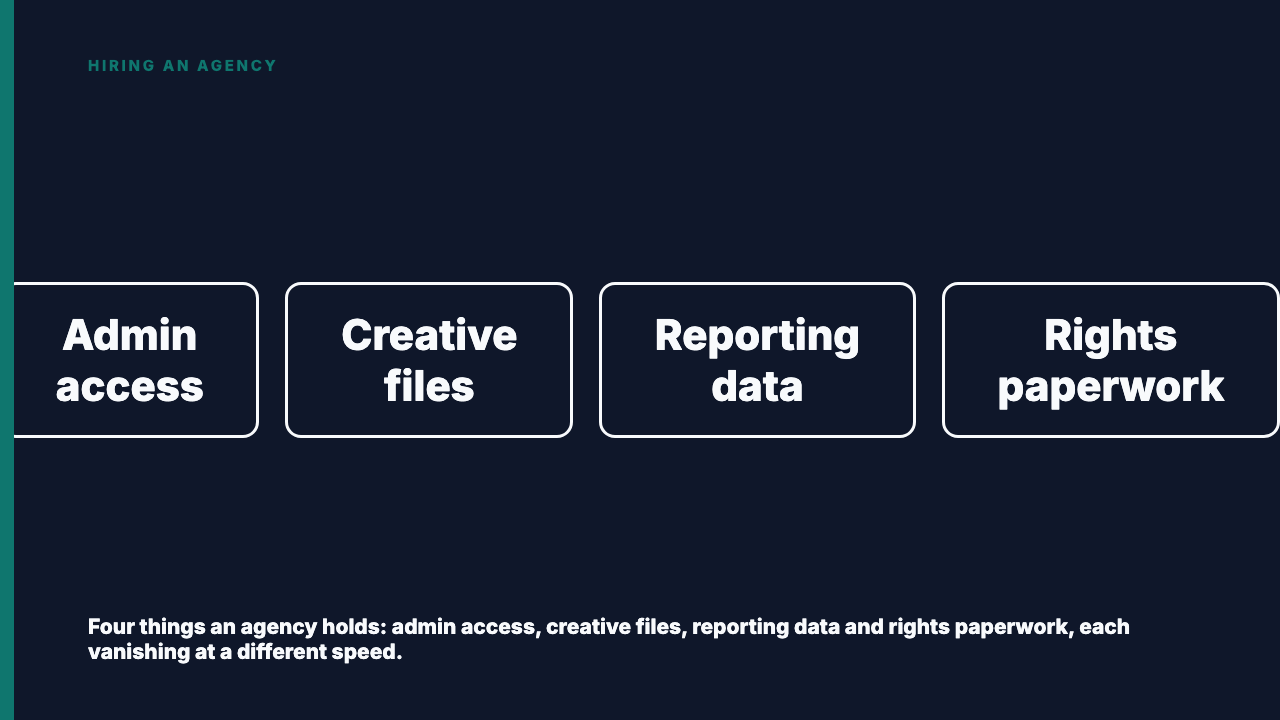
Four things vanish at different speeds once the agency knows: top level admin access, downgradable in a minute; raw creative files on a drive you cannot reach; reporting history locked in agency dashboards; and rights paperwork nobody sends after you stop paying.
This assumes the decision is made and covers the gap between it and the goodbye email, not whether to go. The preventative version is to decide account ownership before you sign.
Read your contract’s notice clause before you touch anything else
The contract sets your deadline math. Find three things: the notice period, your real runway; the required form of notice, usually written to a named contact, not a verbal heads up on a call; and whether termination is for convenience or only for cause, which changes the timeline and what is owed. These are the contract clauses that decide how this ends.
This step is research, not action: it sets your deadline, it does not mean you contact the agency yet.
No notice clause at all is information, not relief. Offboarding was never negotiated, so treat everything below as more urgent.
The admin records to take first, while the agency does not yet know
Access disappears fastest. Check ownership, not user lists.
- Meta Business Suite and Business Manager. Open your own settings and, on every Meta surface you use, confirm someone on your payroll holds the top level role, not just a place on the access list. Check each separately.
- Ad account billing. Whose card is on file? An agency card pulled mid handover freezes the ad account.
- Google Business Profile. A profile has one primary owner, and owners can add or remove users where managers cannot. Yours needs owner access.
- YouTube channel. Permissions are separate again. Confirm your own Google account reaches the channel, not an agency account.
- TikTok Business Center and LinkedIn Page admin. Each runs its own hierarchy. LinkedIn separates super admin, content admin and analyst roles. Hold the top one in house.
- Domain and pixel verifications. Left in the agency’s business account, these block a new agency from setting up tracking.
A hypothetical: what happens when notice comes first
This is illustrative, not a real incident. Picture a fitness chain switching agencies. It emails on Monday saying the relationship ends at quarter close. On Thursday the manager logs in for a year of ad performance and finds their role on the ad account quietly moved from admin to advertiser. They can see the campaigns. They cannot export.
Reordered, only the week changes: admin roles corrected, reporting exported, files copied, notice sent Friday. When access is trimmed on Monday nothing is lost, because there was nothing left to lose.
Creative files and reporting data disappear on different clocks
Creative splits in two. Published output is public and stays referenceable. Source material is not: raw footage, unused takes, layered PSD and AI files, Premiere or After Effects projects, the asset library built during the engagement. Your claim on it traces back to what the scope of work should have defined.
Reporting splits differently. Export native analytics yourself instead of waiting on the agency, because anything behind an agency-only login or an agency-built dashboard stops working the day access ends. Google offers Takeout across its products including YouTube. Ask separately for the agency’s compiled reports and commentary, because raw exports contain none of that.
Usage rights and paperwork to collect before you say goodbye
Content made under the engagement still runs on your channels. Whether it can keep running is paperwork, so ask for all four rows now.
| Content type | Paperwork that should exist | Question to ask |
|---|---|---|
| Influencer post | Influencer agreement with a usage rights grant | Perpetual or term limited, who is the licensee? |
| UGC ad creative | Creator release covering paid usage | Paid media as well as organic, survives termination? |
| Licensed stock, music, fonts | The license, ideally in the brand’s name | Bought on the agency’s account, transferable? |
| Agency-shot content | IP assignment or work made for hire, model releases | Ownership passes on payment, on termination, or never? |
Whether you can keep running an ad built on influencer content is a contract question, not a platform question. Put the documents in front of a lawyer rather than assuming rights revert or expire.
Serve notice and set the timeline last
Everything above is quiet and reversible. Telling the agency starts a clock you do not control, so it goes last. Serve notice through the exact channel the contract names, then talk about the handover date and transition support: a cooperative agency inside a paid notice period beats an adversarial one. This process is boring on purpose, and the boring version keeps your history intact.
Choosing who comes next
With your records secure, decide who takes over. You can browse vetted agencies, and agency owners can list your agency free.
FAQ
What if the agency refuses to hand over admin access?
Start with the contract: this is compliance before it is law. Many agreements cover return of data and credentials on termination, and quoting that clause is often enough. Without one, a lawyer’s letter setting out the ownership facts is the next step.
How much notice do I actually need to give?
Whatever your signed contract’s termination clause specifies, in the form it requires. There is no standard number of days across agency agreements. With no clause, give notice in writing anyway and fix the gap next time.
Should I keep paying the agency during the handover window?
If the contract requires payment through the notice period, pay on schedule. That is incentive design, not a guarantee of cooperation: an agency still being paid has a reason to answer export requests.
What if we never put anything in writing about who owns the accounts?
The handover gets slower and leans on goodwill. Work from the platform records, since whoever holds the top role today is the practical starting point, then close the gap by settling ownership before the next contract.
Sources
- Google Account Help: Download your Google data (2026-09-01).
- Google Business Profile Help: Owners and managers (2026-09-01).
- YouTube Help: Channel permissions (2026-09-01).
- LinkedIn Help: LinkedIn Page admin roles (2026-09-01).