How to Vet a New Agency With No References Yet
You like a newly founded social media agency. You asked for two client references and heard a polite explanation of why there are none yet. Walk away, or is there another way to learn whether this team will do what it says?
Why the standard advice stalls on a young agency
A reference call answers one question: will this team do what it says for a client like me. “Always check references” assumes the agency has a roster. A brand-new shop cannot satisfy that, so the choice is not references or nothing. If your agency does have clients to call, see how to run reference calls when an agency has them. This post covers the case where it does not.
A blanket “no references, no meeting” rule has a cost. It steers you toward incumbents whose rosters may say nothing about the people who will staff your account.
Work out which case you are in. A shop founded from scratch has nothing to show as a company, so everything rests on the founders. A spin-out, a team that left a larger agency, has a harder question: what is it allowed to say about its former employer’s clients? That depends on the founders’ own employment and confidentiality terms, so ask them, and notice how comfortably they answer.
Check the people, not the company
Ask each founder which accounts they personally ran at prior employers, in what role, and for how long. “We worked on the account” is not the same as “I ran the account day to day.”
A good answer names responsibilities, platforms and deliverables in their own words, with a clear line between what they did and what a team did. A bad answer is vague and collective, attached to a title you cannot check.
Verify it independently against public professional profiles. Where the founder agrees, call a former colleague or manager, not only people the founder nominates.
Know the limit: a past role at a big shop does not prove someone can run a small one, because the support around them is gone.
Substitute evidence you can actually collect
| Substitute | What it can show | What it cannot show |
|---|---|---|
| Founder prior-role verification | That the titles, employers and dates are real | How well they did the job |
| Work the founders point to from prior roles | What they claim to have contributed, and whether they can explain it | Who else shaped it, unless you ask |
| Informal references from former colleagues or the founders’ own past clients | How the founder behaved in a working relationship | How the new agency handles process or capacity |
| A live working session | How the team thinks and responds to your real problem | Whether they sustain it for months |
Agency work is a team output, so ask who did what. A founder with a real contribution explains it without inflating it. You are not judging whether the work is good, only whether the claim of authorship holds up.
Here is an illustrative scenario. A two-person spin-out offers a former colleague as a reference instead of a client. That person can say how a founder handled deadlines and pressure, and whether the founder’s account of their role matches what they saw. They cannot say how the new agency will treat your account, because they were never its client.
Also check the business exists. In the UK, the Companies House search finds a company by name and shows its incorporation date, with officers listed separately. In the US, businesses register with state authorities, and the SBA guide to registering a business explains how, so you can look the agency up with its state. Compare the formation date with the pitch. The Wayback Machine shows how a website presented itself over time, though a missing snapshot proves nothing.
Read how they handle the gap in their own story
The reaction to the gap is your best signal, and it is the same instinct as reading the red flags in an agency’s sales process.
The good version: the agency says up front that it has no client references, explains why, and offers alternatives before you ask. It does not present a former employer’s clients as its own.
The bad version: a portfolio of former employers’ work with no note on whose it was, defensiveness when asked, or a roster of “confidential clients” and nothing more specific.
Ask directly: “Which of the work you are showing did this team produce, and which came from previous employers?” Note how fast and how clearly they answer.
Who will actually do the work
In a small shop the pitch team and delivery team are often the same two or three people. The upside is that the founders you met are likely the ones on your account, which closes the gap in the pitch team is not always the team that runs your account.
The risk is capacity. Ask how many clients the founders have now, what happens if one is ill or leaves, and how they would take on a second account. Ask whether any delivery is outsourced, and to whom. Then ask whether they have any early clients at all, even one, and whether you may speak with them. “None yet” is a valid answer.
Shrink the first commitment instead of the standard
When evidence is thin, contract structure is your risk control.
- A short, paid first engagement with a defined deliverable and a review point before any retainer. See a paid pilot before a long retainer.
- A short initial term, and a termination right that does not trigger a kill fee.
- Account and asset ownership with your brand from day one.
- A runway question. How long a new agency can survive is fair to ask, and checking an agency’s financial stability before you sign covers the checks.
Refuse a long prepaid commitment, a large upfront payment, and exclusivity from a shop with no history.
When to walk away anyway
End the conversation if founder claims do not survive verification, if nobody can explain who authored the portfolio work, if they resist a small first engagement, or if they push you to sign long before any working session.
If your risk tolerance is low, for example a regulated category or a launch with no room to recover, an established agency is a reasonable choice. That is a decision about your exposure, not a verdict on new agencies. A roster only helps if the team that earned it staffs your account.
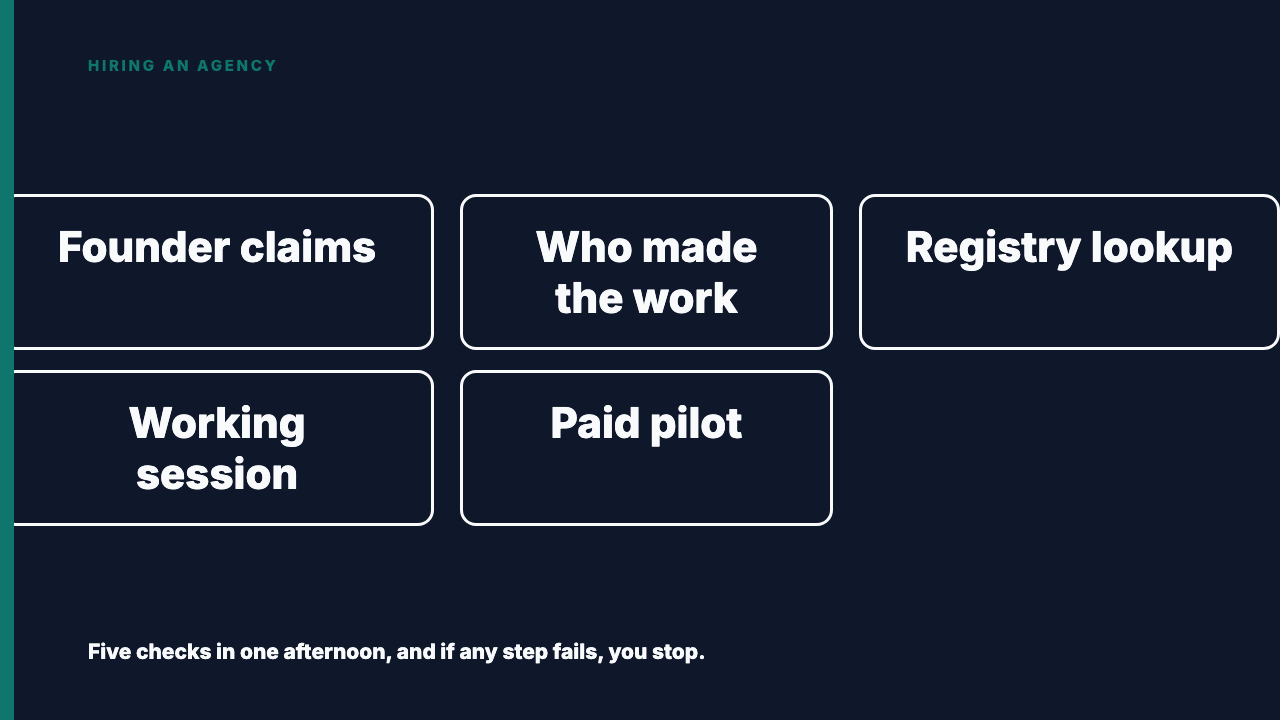
You can run the decision in an afternoon: check the founders’ claims, ask which work is theirs, look up the registration, run a working session on a real problem, then propose a short paid pilot. If any step fails, stop. If all hold, proceed on the small deal.
Next step
Browse vetted agencies at every stage, and if you run an agency, list your agency free.
FAQ
Can a founder’s old clients count as references?
They can speak to the founder’s individual work, which is useful, but not to the new agency’s processes or capacity. A spin-out may also be limited in what it can share about a former employer’s clients, so ask what the founders are free to say.
How can I check that a new agency actually exists as a business?
Look up the company on the relevant public register, such as Companies House in the UK or the state business registry in the US, and compare the formation date and named principals with what the pitch says.
Sources
- Companies House, Find and update company information, fetched 2026-09-24
- U.S. Small Business Administration, Register your business, fetched 2026-09-24 (the address redirects to the SBA’s launch your business page)
- Internet Archive Wayback Machine, fetched 2026-09-24