What Changes in Your Contract When the Agency Is Overseas
You have run the calls, seen the work, checked the references, and the agency you want is in another country. The contract is where it stops being normal, because the template you would hand a local agency carries assumptions a border breaks.
Why a cross-border agency contract can’t just be the domestic template
A domestic agency contract quietly assumes three things. That both parties deal in the same currency, so the invoiced number is what leaves your account. That if things fall apart badly enough to involve lawyers, everyone stands in the same court system under the same law. And that the default rules on who owns work product made by an outside contractor are the ones your counsel already has in their head. None of those hold automatically across a border, and a contract silent on them leaves the question open rather than settling it your way.
Picture a hypothetical retailer shortlisting three agencies. One comes in roughly thirty percent under the others and gets the nod. At contract review, the quote turns out to be denominated in the agency’s home currency, so the discount is smaller than it looked and moves monthly. And the ownership clause grants usage rights to delivered assets, which is not the same as owning them. Neither is bad faith. Both are just an agency’s own paper.
Currency and who absorbs exchange-rate movement
There are three honest ways to handle billing currency. Name one. Bill in your home currency, and the agency absorbs exchange-rate movement, usually pricing a cushion into the retainer. Bill in theirs, and you absorb it, so your monthly cost drifts. Or peg the retainer to a stated rate with a review window, say a recalculation every six or twelve months against a named reference rate. Leaving it unstated does not mean nobody carries the risk. It means whatever your bank applies on the transfer date becomes the answer, and nobody negotiated that.
A fair clause has three parts: the currency named in plain words rather than a symbol, a named rate source such as the rate published by a specified reference on the invoice date, and a trigger letting either party request renegotiation if the rate moves outside a stated band. The bad version is an invoice reading “amount due: $12,000” when several countries use a dollar sign, or a contract that names the amount and says nothing about who eats a swing. For how the retainer itself should be built, read how agency fee structures actually work.
Governing law and where a dispute actually gets resolved
A contract silent on governing law does not quietly default to your country’s law and your courts. Which law applies, and which court or arbitral body may hear the matter, is what cross-border disputes settle before anyone argues the disagreement, and it does not reliably land on the home team’s side. “We’ll figure it out” means spending money to establish where you may spend money.
Brands take one of two routes. Name a single country’s law and a specific court as the forum, accepting that one party travels if things go wrong. Or specify arbitration, naming both the arbitral body and the seat. Arbitration is common across borders partly because an award is generally easier to enforce abroad than a foreign court judgment, and because it tends to move faster. That is why the clause is popular, not a guarantee.
This is the one clause worth paying a lawyer to read, and the one people skip because it will probably never matter. It causes no pain until there is a dispute, by which point you negotiate from a weaker position than at signature.
What to specify before you sign
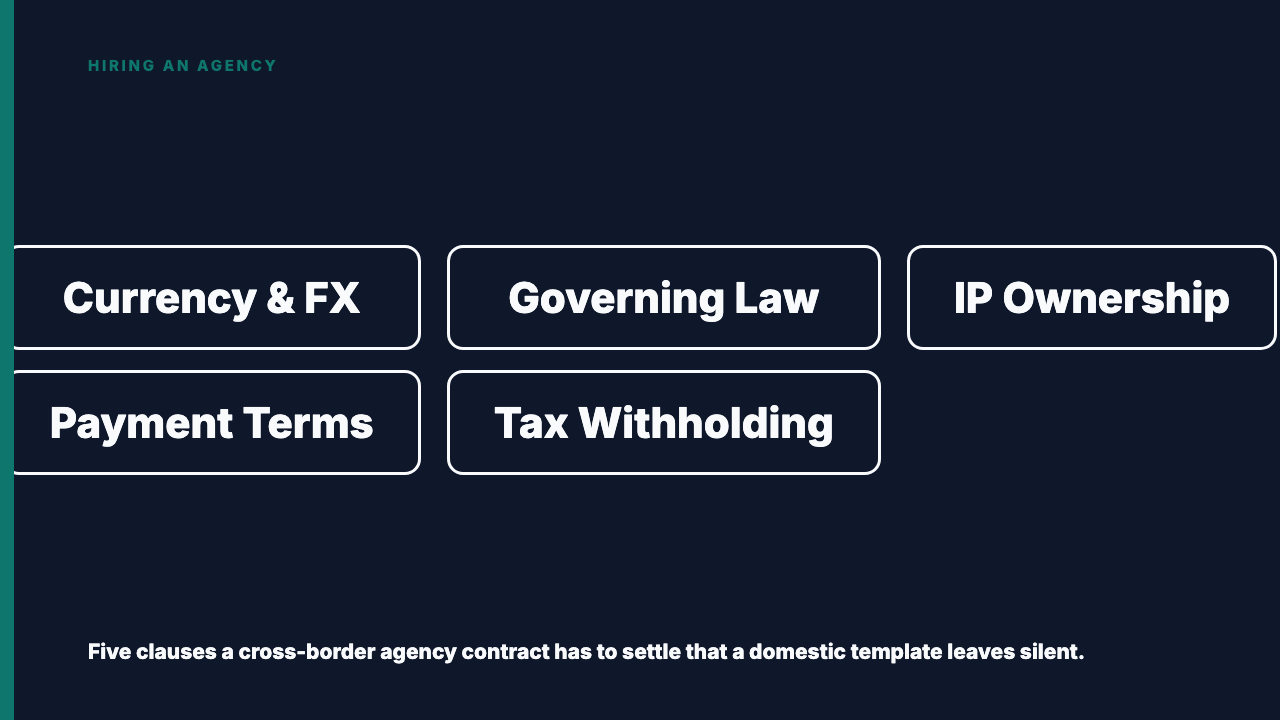
- Billing currency and FX responsibility. State the currency in words, name the rate source, and say which party absorbs movement between invoices. Do not let the quote’s formatting imply it.
- Governing law and forum. Name the law that governs the agreement and the forum that resolves disputes, either a named court or a named arbitration body with a stated seat. Silence here is a decision you did not make.
- Content and IP ownership. Default rules on who owns contractor-created work vary by country, and work-for-hire presumptions are not universal, so the contract must do the assigning itself: photography and video, editable design files, copy, templates built for your account, and admin access to the accounts and ad accounts. See who owns your social accounts when an agency runs them.
- Payment method and timing. International transfers carry fees, can sit in processor holds, and take longer to land than domestic payments. Name the payment rail, say who covers transfer and intermediary fees, and set the payment window on arrival of funds.
- Tax and withholding. Whether either party must withhold tax on a cross-border payment depends on both jurisdictions and sometimes a treaty between them. That is a five-minute question for whoever handles your taxes, asked before signature rather than after.
What doesn’t actually need to change
The rest of the contract is the rest of the contract. Scope of work, deliverable counts, revision rounds, reporting cadence, approval workflow, termination notice: none behave differently because the agency sits in another time zone. Weak there is weak domestically too, covered in what to check in a social media agency contract and how to read a scope of work before you sign it. An overseas agency is not inherently riskier or weaker. Currency, jurisdiction, ownership and payment mechanics are the delta, all four solvable with paragraphs. Treating location as the risk means paying more for a shorter shortlist.
Start from a vetted shortlist
You can browse vetted agencies by niche and location before you get near a redline. If you run an agency and want brands doing this diligence to find you, list your agency free.
FAQ
Should the contract be billed in my currency or the agency’s?
Either works. Billing in yours pushes exchange-rate risk onto the agency, usually via a higher retainer. Billing in theirs leaves the movement with you. The danger is not the choice, it is leaving it unstated, so your bank’s rate on the transfer date becomes the answer.
Does my country’s law automatically apply if the agency is overseas?
No. A contract silent on governing law leaves that open rather than defaulting in your favour, and resolving it becomes its own expensive argument before the real dispute starts. Two practical fixes: name a governing law plus a specific court as the forum, or specify arbitration with a named body and seat. Have a lawyer review whichever you pick.