What Recourse You Actually Have When an Agency Goes Off-Brand
A post goes up with a lockup you retired last year and a caption that sounds like another company wrote it. The contract promises on brand work, and stops.
The clause you assumed was already in there
Brand adherence looks like it lives in three places and lives in none. The scope of work commits the agency to volume and format, say twelve posts and four videos a month, not to matching your guidelines. The approval workflow commits both sides to a process, and a followed process is not a met standard. Professional standards boilerplate promises nothing measurable.
A standard with no stated consequence is a preference, not an obligation. You hold a request the agency can decline for free, or an escalation straight to termination, nothing in between.
Off-brand is three problems, not one
A compliance error is a claim your business cannot support, or a missing paid partnership disclosure. A guideline breach is the wrong lockup, off-palette colour, a broken voice rule, a prohibited crop. The third is a judgement call you dislike.
Only the first two are measurable against a document. The third belongs in the brief and in your approval process. Compliance errors get their own rung, because responsibility does not transfer with the work. The FTC’s endorsement guidance says enforcement focus is usually on advertisers or their agencies. If the guideline file is outdated, silent on social, or was never handed over, the failure is upstream.
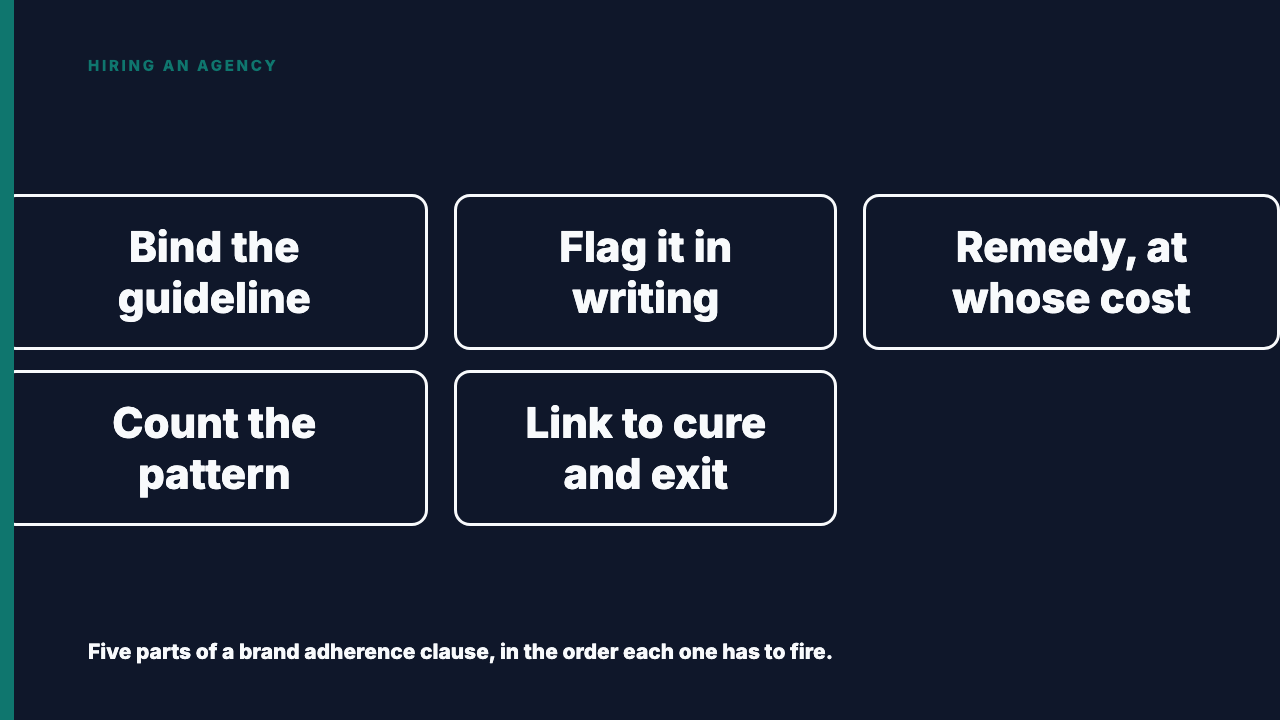
Bind the standard to a dated document
Acceptable: guidelines named, versioned, dated, attached as a numbered exhibit, superseded only by a written update. Bad: work shall be consistent with the Client’s brand and tone, which gives you nothing to hold a post against.
A brand book written for print and web is silent on caption voice and video end cards, so the exhibit needs social coverage: emoji and hashtag use, the logo on an end card, permitted crops, and what the agency cannot alter unasked. Your side: a current file, no retroactive breach when guidelines change, and a named payer for work in flight, which a change order settles.
Documented control beats goodwill: section 1055 says a related company’s use, one the owner controls as to nature and quality, inures to the owner’s benefit provided the mark is not used to deceive the public. Statutory text, not a prediction.
The remedy ladder, and who pays
Four rungs, in severity order. Every window is a number you set and the agency accepts.
| Rung | What you demand | Who pays | If the window is missed |
|---|---|---|---|
| Correct in place | Copy edited on the live post | Agency, in the retainer | Escalates to replace and repost |
| Replace and repost | New asset up, original removed | Agency, if measurable against the exhibit | Escalates to removal |
| Remove inside your window | Post deleted, written confirmation | Agency, plus your lost post history | Escalates to a credit |
| Rework or fee credit | Rebuilt deliverable or a credit | Agency, same test | Credit stands, flag counts toward the threshold |
Handle paid amplification explicitly, the rung with real money in it. If spend sat behind the post, say whether the media cost is refunded, reallocated, or absorbed by you, and who decides.
Deletion is not neutral. It destroys the post’s comments, saves and engagement history for good, and on some platforms a published image or video cannot be edited after posting, leaving removal as the only correction. Check what your own accounts allow.
When an incident becomes a pattern
A counting rule has three components:
- A defined window, months or a contract quarter.
- A defined number of upheld flags inside it, agreed in negotiation.
- A named decider on whether a flag is upheld, so the threshold cannot be argued away incident by incident.
Crossing it triggers, in order: a remediation plan with dates, a senior reviewer at the agency’s cost, fee credit, then the existing cure period. Without the rule, brand failure is a complaint, and complaints do not start a cure period. With it, it is a documented breach the termination language in an agency contract can act on. You owe flags in writing, citing a numbered section, inside a stated window.
The same Tuesday, both ways
Picture a hypothetical regional gym group whose agency posts a video with a retired lockup on the end card and a caption breaking two voice rules. With the clause, the lead flags it citing Exhibit B, section 4.2. The window runs, a rung is chosen, and the fix, its cost and the date enter the flag log, counting toward the threshold.
Without it, the lead gets an apology and a production quote. What remains is asking nicely, withholding payment you may have no right to withhold, or threatening termination. Withholding can hand the agency the breach argument you wanted to make.
Already signed? Ask for a side letter naming the guideline exhibit, the flag route, the remedy ladder and the counting rule, nothing else reopened. Trade a longer notice period, in the week after an incident.
Before the next contract
Raise brand adherence while you are still negotiating: browse vetted agencies among the 80 profiles in the directory, and list your agency free if you run one.
FAQ
Is publishing off-brand content a breach of contract?
Only if the contract defines the standard and the consequence. One incident against a named guideline exhibit is usually a curable performance issue. Repeated upheld flags are what a well drafted clause escalates into breach.
Can I require the agency to delete the post?
Yes, if removal is a named rung with a stated response window. Otherwise it is a request the agency can decline. Deletion takes the post’s comments and engagement history with it, so check what your platforms allow.
Who pays to remake the asset?
Whoever the clause names. If the failure is measurable against the guideline file the agency was handed, the agency pays. If it was missing, outdated or silent, you pay, and you fix the file, not the contract.
What if the guidelines never covered social media?
Then no remedy language means anything yet: there is nothing to measure against. Add the social cases first, caption voice, permitted crops, end card treatment. That is your homework, not your counsel’s.
Should this sit in the contract or in the approval workflow?
Both, doing different jobs. Your approval process prevents the problem before publishing. The clause is recourse once something clears approval and goes out anyway.
Sources
- 15 U.S.C. 1055, related company use, fetched 2026-09-08.
- 15 U.S.C. 1127, definitions, fetched 2026-09-08.
- FTC, Endorsement Guides: What People Are Asking, fetched 2026-09-08.