The Cure Period: What to Add Before You Fire an Agency
Two reporting cycles in, the work lands late, the monthly call is mostly apology, and nothing the agency has done violates anything you signed. You want a fix or you want out, and the contract gives you neither.
Disappointing is not the same claim as breach
Termination for cause is an accusation, not a mood. You have to point at a promise in the document and show the agency failed to keep it. Cornell’s Legal Information Institute puts it plainly: a breach occurs when a party fails to perform their promised obligations. Underwhelming results across two reporting cycles is not one. What counts as breach is narrower: missed deadlines written as obligations rather than intentions, non-payment, confidentiality violations, misuse of your intellectual property, or subcontracting the contract forbids.
You are not trapped. Most agreements carry a second exit, the one clients actually use: termination for convenience. It needs no proof of fault, only the specified notice, a served notice period, and often a fee. For cause is cheaper and harder, for convenience easier and costlier. A cure period sits between them.
What a cure period actually is
A cure period is a written mechanism, not a posture. One side names a specific problem in writing, a defined window opens, and if it is not fixed before the window closes, a stated consequence follows. It turns a grievance into a deadline.
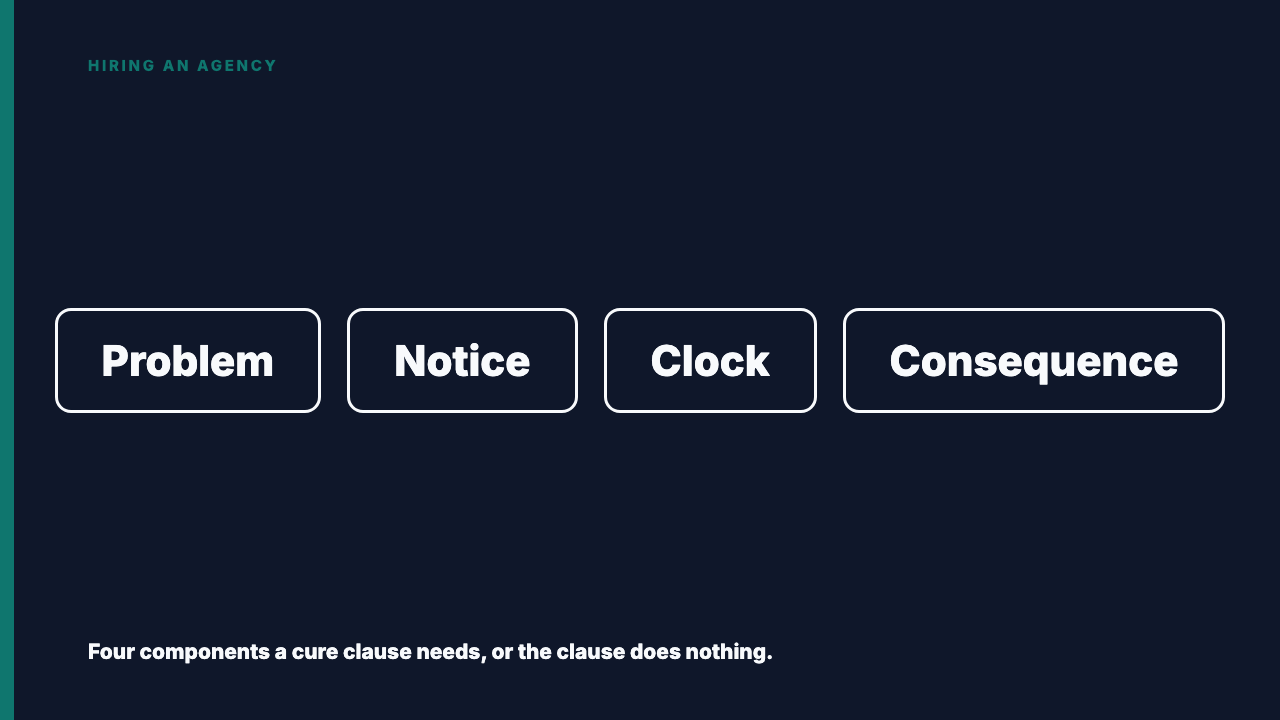
Four components have to be present or the clause does nothing: a precise, measurable definition of the problem tied to language already in the agreement; a written notice that starts the clock; a fixed number of days, not a standard of reasonableness; and an explicit consequence when the window closes unmet. No authoritative source sets a standard cure period length, so any number in a template is somebody’s habit rather than a rule. Match it to the repair.
What the clause looks like in practice
Illustrative language, written for this article and not from any real contract. The fifteen day window is an example, not a recommendation.
If Agency fails to deliver the monthly performance report specified in Section 4.2 of the Scope of Work by the fifth business day in two consecutive months, Client may issue a written Cure Notice identifying the deficiency. Agency shall cure it within fifteen (15) days of that notice. If it remains uncured, Client may terminate this Agreement immediately upon written notice, without payment of the early termination fee in Section 9.1.
The load-bearing part is the cross-reference. It points at Section 4.2 by name instead of restating a vague performance standard, so nobody has to agree the work was disappointing. Real clause language belongs in front of your lawyer first.
What a cure notice has to name
- The specific failure, quantified against the baseline in the agreement. Not “reporting has been inconsistent,” but: the Section 4.2 report was due on the fifth business day and arrived on the fourteenth.
- The date the notice is sent and the date the clock starts. Often the same date, but say so, and use the delivery method the notice provisions require.
- The exact calendar date the cure period ends. Write the date, not the number of days. Counting disputes are how a cure notice gets defanged.
- What happens the day after. Stated as fact, not hope. “Client may terminate under Section 8.3 without the fee in Section 9.1,” not “we may need to reconsider.”
Negotiate it before you sign, not after you are stuck
Asking for a cure clause during negotiation costs you almost nothing: no history to defend, and the request reads as diligence rather than distrust. Raise it alongside the questions worth asking before you sign. Asking after two bad quarters is an accusation with a document attached, and the agency knows your alternative is an expensive exit, so it can refuse or dilute the clause until it has no end date. Two cycles into disappointment, make the next renewal your leverage point and use the interim to build the written record a cure notice needs anyway.
A pointer into vague language is worthless. If your scope says the agency will “manage social media channels and provide regular reporting,” there is nothing to name a violation against. Start with what to check in a social media agency contract and reading the scope of work before you sign it.
A working cure clause versus a decorative one
| Component | Working | Decorative |
|---|---|---|
| Problem | A measurable failure against a numbered SOW or KPI section | “Failure to perform satisfactorily” |
| Clock | A fixed number of days from a dated written notice | “A reasonable period” |
| Consequence | Client may terminate without further notice and without the early exit fee | Remedy “at Agency’s discretion,” or nothing stated |
The tell: read the clause aloud and name the exact day the client regains leverage. If you cannot, it is decorative.
If your current contract has no cure clause at all
You can still send a written performance notice. No clause is needed to put a concern in writing, and the dated record is the point: a note naming a specific miss against a specific commitment beats months of polite comments on a call if the relationship ends in a dispute.
Some agencies will agree to a side letter adding cure language mid-term if you ask, though none are obliged to. If yours will not, two options remain: ride out the term documenting everything, or use the exit the termination clause already gives you, priced against another two cycles of the same.
Start the next search with this settled
Fix this language before you have anyone to use it against. Starting a search? Browse vetted agencies and raise the cure clause in the first contract conversation, when asking costs nothing. Already run an agency? You can list your agency free.
FAQ
Is a cure period the same thing as a probation period?
Different mechanisms. A probation period is a blanket early window written in from day one. A cure period is triggered later by a specific named problem and runs for a fixed window tied to fixing it. Judge a clause by its trigger, window and consequence, not its label.
How long should a cure period be?
No authoritative source sets a standard length, so treat any number presented as typical with suspicion. Match the window to the problem: a reporting failure or an unresponsive account lead can be cured quickly because the fix is operational, while a strategic direction problem needs longer to show whether it worked.
Sources
- Legal Information Institute, Cornell Law School, “breach of contract”, fetched 7 September 2026.