A Founder’s Personal Brand Is a Different Agency Hire
The scope of work in front of you lists company social media management and, right below it, executive thought leadership for the founder, under one monthly fee. It reads like two flavours of one service. It is not. One line item covers an asset the company owns outright, the other an account belonging to a person who could resign in March.
Two accounts, two owners, one retainer
One question settles this. If the person left tomorrow, could the company keep posting from that account?
For the company page, yes. Admin roles are assignable, the departing employee is removed the afternoon they hand in their laptop, and nothing about the asset changes. For the founder’s personal LinkedIn or Instagram, no. The login belongs to the individual, the follower relationships were formed with the individual, and the account travels with them.
Platform terms back this up. LinkedIn’s User Agreement, effective November 3, 2025, states in section 2.2 that members are account holders, that you will not share your account with anyone else, and that you agree not to share or transfer your account or any part of it. Its introduction adds that you enter that contract with LinkedIn personally even when using the service on behalf of a company. Who funds the content does not change who holds it.
So why does one retainer keep bundling them? Because it is one sales conversation, not because the work or the risk is the same. In my experience most agencies unbundle when asked.
What a bundled scope of work usually gets wrong
Picture a mid sized software company signing a retainer with two deliverables. Social media management, twelve posts per month across company channels. Executive thought leadership, eight posts per month on the founder’s LinkedIn. One fee covers both, and nothing else distinguishes them.
Now look for who owns the drafts. Not there. Who approves the founder’s posts, and how fast. Not there. What happens if the retainer ends on the fourteenth with four founder posts drafted and unpublished. Silent. Every unstated assumption favours whoever wrote the document.
The approval workflow is where the mismatch shows first. Brand copy going out under the company name deserves a real review step, because a bad sentence there is a company statement. A founder’s first person post does not survive that treatment. Route it through marketing review, legal sign off and a Tuesday approvals meeting, and posts land four days late in a voice sanded down by three reviewers. Read how to read a scope of work before you sign it next to this one.
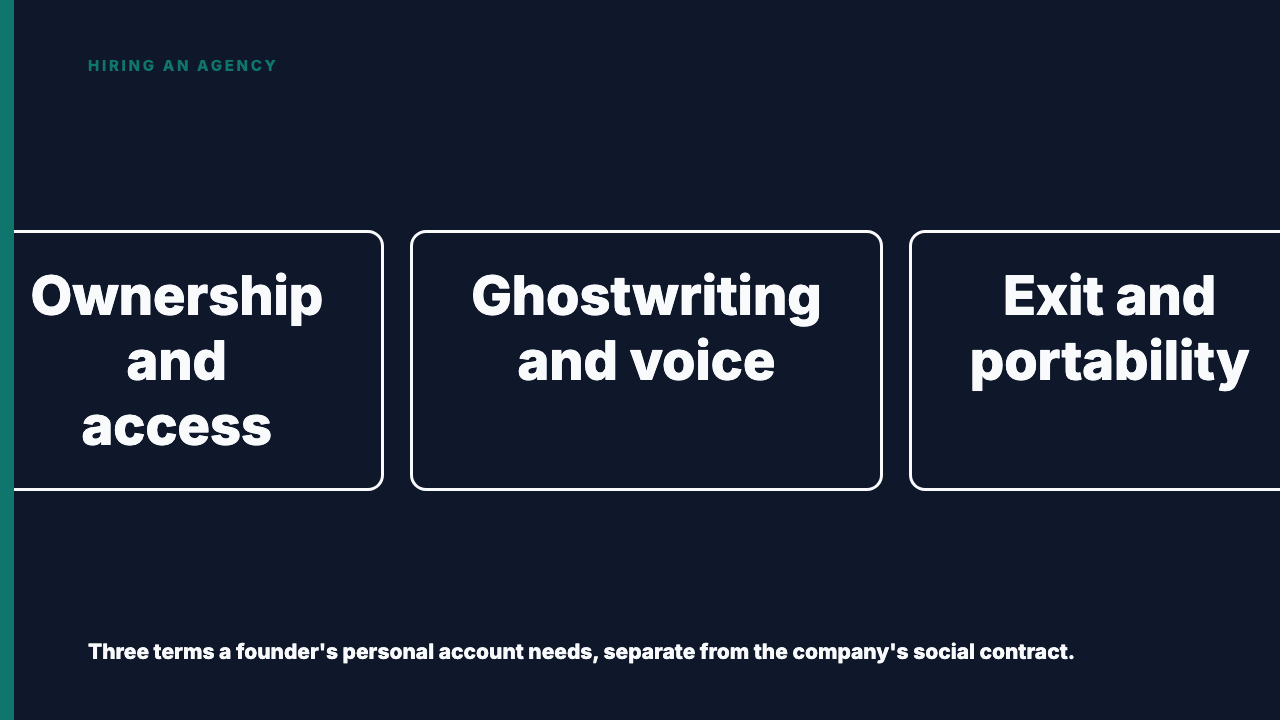
The three terms that need their own language
- Ownership and access. Name who holds the login and, more importantly, who holds two factor recovery, because whoever controls recovery controls the account. The acceptable version states in writing that the individual retains login control and recovery throughout, with the agency working through delegated access while the company pays for content. The bad version lets an agency staffer set up the credentials with no documented handback, leaving the founder one departing account manager away from being locked out of their own account.
- Ghostwriting disclosure and voice ownership. Someone will build a voice guide, talking points and months of drafts in the executive’s name. The acceptable version grants the executive a perpetual licence to keep using all of it after the contract ends. The bad version classifies it as agency work product, so the person whose opinions are on every page loses their own documented voice the day they switch providers.
- Exit and portability. The acceptable version makes the personal account a separately terminable line item with its own notice period, and says what happens if the executive leaves mid term: either they assume it personally, or it ends on stated notice with drafts released. The bad version ties both to one master termination clause, so a founder’s departure strands their own account mid cycle.
These sit underneath what to check in a social media agency contract, and the exit term is a variant of how to leave a social media agency without losing the history.
Where the same agency can still do both, but not the same way
None of this argues against hiring one agency for both. One team running the company channels and the founder’s account is common, gives you shared context and no duplicated briefing, and is not a red flag by itself.
The distinguishing question is structural. Does the agency propose two scopes, two sets of approval terms and two exit clauses inside one master agreement, or one scope with two bullet points? An agency that has done this before offers the split unprompted, because it has already sat through the call where a founder resigned and nobody knew whose drafts those were. One that resists usually just has a single template.
Questions to put to the agency before you sign
- Who holds the login credentials and two factor recovery for the executive’s personal account, and what is the handback process if we end the engagement?
- If the executive leaves the company, does their personal account contract end with the company contract, transfer to them, or survive on its own notice?
- Do we retain the ghostwritten drafts, talking points and voice guide if we switch agencies?
- Is the approval workflow for the executive’s posts identical to the brand’s, and if so, why should it be?
Ask these in the contract conversation, not the discovery call. The answers change once a proposal is on the table.
Get a shortlist that scopes it this way
If you are still choosing who to hand this to, browse vetted agencies and put those four questions to each one. If you run an agency that already scopes executive work separately, you can list your agency free.
What this does not settle
All of the above is a contracting decision. Whether the resulting posts sound genuinely like the executive or read as agency written is a craft question this piece does not answer. Get the contract right first, because that is the part you cannot renegotiate later. For the same ownership question applied to company channels, see who owns your social accounts when an agency runs them.
FAQ
Can one agency manage both the company’s social accounts and the founder’s personal brand?
Yes, and it is common. The problem is not one agency doing both, it is one scope of work treating both as the same deliverable with the same ownership terms, approval workflow and exit clause. Ask for two scopes inside one master agreement and most of the risk disappears.
Who owns a founder’s LinkedIn account if the company pays an agency to manage it?
The individual whose name and login created the account controls it, regardless of who pays for the content. LinkedIn’s User Agreement treats members as account holders and prohibits sharing or transferring an account. Your contract should state this explicitly rather than leave it implied.
Sources
- LinkedIn User Agreement, effective November 3, 2025. Fetched 2026-09-07.