The Conflict Clause That Doesn’t Cover Your Account Manager
You asked for a conflict-of-interest clause and you got one. It says the Agency will not serve a direct competitor during the term. That clause binds a company. The person running your channels may not be bound at all.
The Clause You Have Only Protects You From the Company
Your contract is between your business and an agency entity, so its obligations land on that entity, not on the people who staff the work.
The principle is privity: an agreement creates a legal relationship between the parties to it, and those parties are the ones bound. Your account manager did not sign your MSA. If you have not worked through the company-level conflict-of-interest clause, start there. The gap is not a bad clause but one working as written, at a level of abstraction that misses the individual.
A Hypothetical: The Account Manager With Two Logins
Picture a regional fitness studio chain that signs an agency. The conflict clause is solid and the agency honours it, with no other fitness client.
The account manager assigned to the chain is not salaried. She is a freelance specialist the agency brings in for this category. Her other days belong to her own clients, and one is a competing chain in two of the same metros.
Nothing has been breached. The Agency has no competing client, and the competing work sits with someone who is not a party to the agreement. Yet one person holds the content calendar, promotional timing and paid targeting logic for two direct rivals. This is illustrative, not a real case.
Why the Agency’s Clause Cannot Reach That Person
An independent contractor is distinguished from an employee precisely by the absence of the hiring party’s right of control over the work, and contractors characteristically bring specialised skills to many clients at once. Serving multiple buyers is not misconduct.
An agency has levers over its own employees through internal conduct and outside-employment policy. It has none over a freelancer absent a specific term in the contract it signed with them. And even where a policy covers employees, it protects the agency’s roster in general: it asks whether outside work is a problem for the agency, not for your position. Treat the account manager assigned to your business as a distinct point of exposure.
What an Individual-Level Clause Actually Looks Like
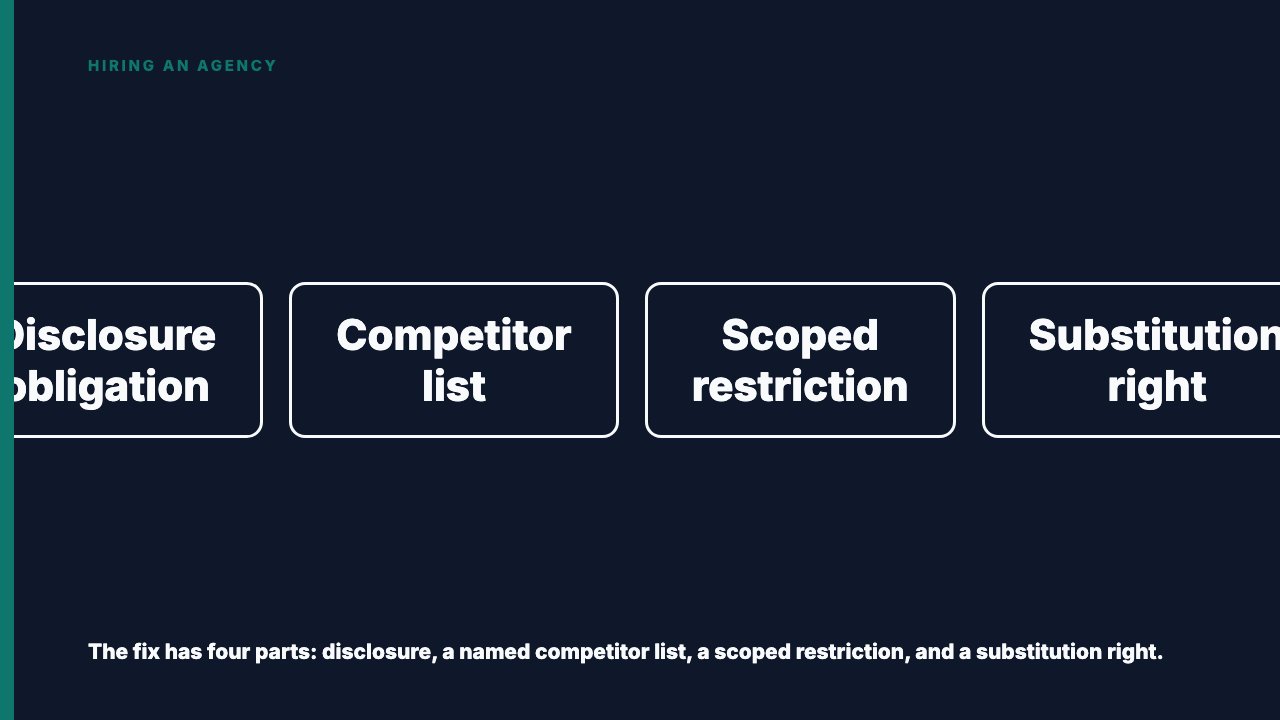
What you want is a disclosure and restriction term that names individuals, not just the entity. Four parts:
- A disclosure obligation. At assignment and on any staffing change, the agency names who is on your account and whether each is an employee or an engaged contractor, then confirms whether any takes paid work from a brand on an agreed competitor list.
- A defined competitor list. Named brands, agreed at kickoff, revisited on a schedule. “Any business in our industry” is unreasonable to ask a freelancer to accept. A short list of real rivals is not.
- A restriction scoped to those limits. Only individuals assigned to your account, only brands on the list, only for the term. Not a blanket ban on outside work, which no good freelancer accepts.
- A substitution right. If a conflict surfaces mid-engagement, you can request a different person without that counting as a breach or triggering a fee.
The version to push back on has a tell: the clause’s grammatical subject. If every sentence says “the Agency” or “the Consultant,” check the definitions. Where the Agency means the corporate entity, a freelancer invoicing it sits outside the clause by construction.
Why Agencies Push Back on This
The resistance is usually genuine rather than evasive. Agencies staff accounts with a mix of salaried people and freelance specialists because the skills you want sit with people who work across several clients, sometimes several agencies. Attach an exclusivity condition and the pool willing to take the assignment shrinks.
The second objection is administrative. Tracking what every assigned contractor does with the rest of their week is ongoing work nobody priced into your retainer. Narrow the ask rather than dropping it. Disclosure costs far less than policing, and it is most of the value.
Where This Clause Belongs and When to Ask for It
Raise it during contract negotiation, alongside everything else you are marking up. Raise it after staffing is set and it changes character, because you are asking about a named person already doing the work. It belongs on the same pass as what else to check in the contract.
Proportionality matters as much as timing. Ask for it where competitive sensitivity is real: categories with few direct rivals, launches with timing you cannot afford to leak, paid strategies where your targeting logic is worth something to a rival. Where competition is diffuse, it is friction you are buying for nothing.
What to Ask Before You Sign
Put these to the agency while the contract is open. Pair them with the disqualifying answers to listen for:
- Who will be assigned to our account, and for each of them, employee or engaged contractor?
- Does your conflict clause bind individual assigned staff, or only the agency as a company?
- If an assigned person takes paid work from a brand on our competitor list, will you tell us proactively?
- Can we request a different person mid-engagement if a conflict surfaces, and does that cost us anything?
- What do your contractor agreements say about client conflicts today?
Find an Agency Worth Negotiating With
A clause is only as good as the agency you hand it to. If you are still building a shortlist, browse vetted agencies. If you run an agency and want buyers who ask questions like these, list your agency free.
FAQ
If my agency contract already bans conflicts of interest, am I covered against an individual employee moonlighting for a competitor?
Not by default. The clause binds the agency as the contracting party, and someone who never signed it is not a party to it. Coverage reaches assigned staff only where the clause names them. Read the definitions section, because that is where scope is set.
Does this apply to full-time employees the same way it applies to freelancers?
No. An agency can direct its own employees through internal conduct policy, so an employee working for a rival is something it has standing to address internally. An independent contractor is defined in part by the absence of that control, so a specific contract term is the only mechanism available.
Sources
- Privity, Legal Information Institute, Cornell Law School, fetched 7 September 2026.
- Independent contractor, Legal Information Institute, Cornell Law School, fetched 7 September 2026.