What Happens to Your Agency Contract When You Get Acquired
Somewhere in your agency contract is a sentence about what happens when one of the two companies changes hands. If your company is the one being acquired, that sentence is about you, not the agency. Most brands find it three weeks after close, when the new parent asks why there are two agencies on retainer.
The clause everyone checks, and the one almost no one does
Buyers of agency services have gotten good at asking what happens if their agency gets acquired. That is a separate clause. Your company being acquired, or merging into a larger group, is governed by different language in the same document: an assignment clause, a change-of-control clause, or both. Assignment answers whether the contract can move to a different legal entity. Change-of-control answers whether a shift in who owns you triggers rights for either side.
Nobody will raise this for you. If your agency finds out at announcement, it has leverage and you have a timeline. Reading the clause is the brand’s job, and it belongs before the deal is public.
What an assignment clause in a services contract actually says
Assignment is the transfer of contract rights to another party, and absent language saying otherwise it carries the duties with them, according to the Legal Information Institute’s reference on the term.
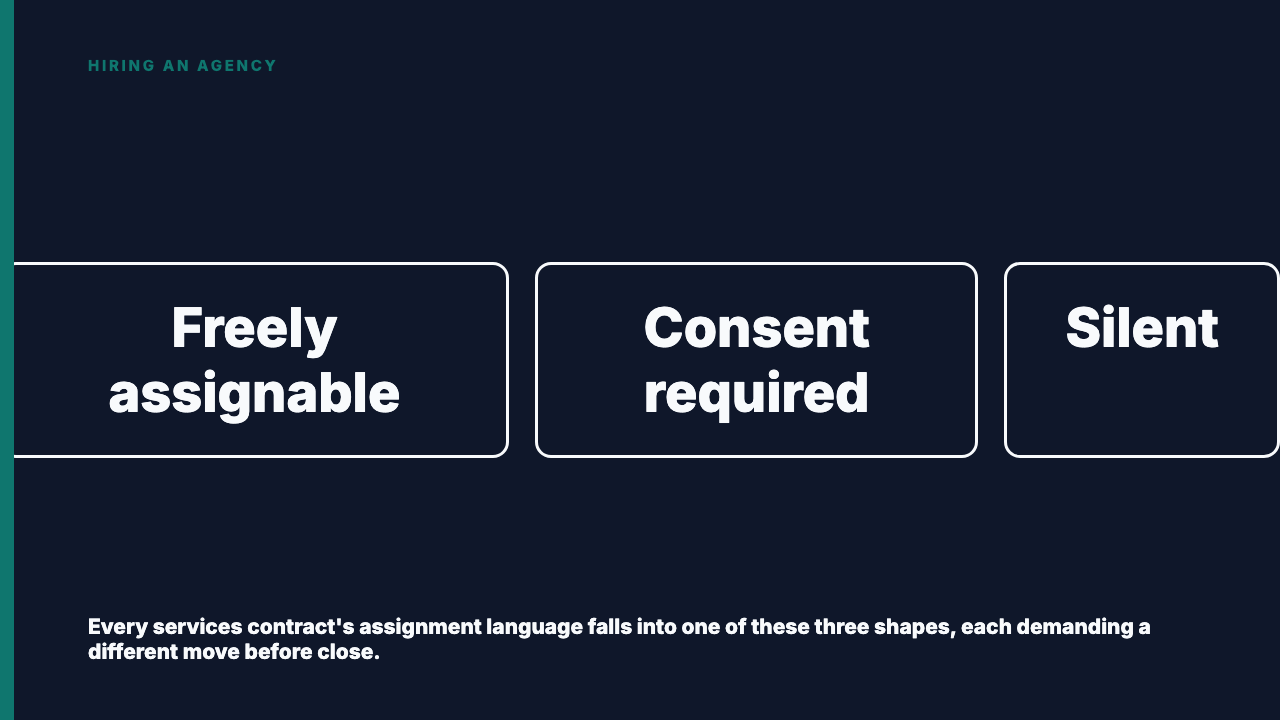
In a services agreement the clause takes one of three shapes. Freely assignable, often through a carve-out for assignment “to a successor in interest by merger or acquisition of substantially all assets.” Assignable only with the other party’s prior written consent. Or silent, the shape people misread. Silent does not mean the contract transfers cleanly, and it does not mean it collapses. It means the document does not answer the question, so the answer comes from general contract law under the governing law named in the agreement.
That is general contract mechanics, not legal advice. If an acquisition is on the table, have counsel read your actual clause.
Three ways this becomes a real problem after the deal closes
All three scenarios below are illustrative, not real companies.
Picture a restaurant group acquired by a national operator that has used one agency for four years. The acquired group has eighteen months left on its own retainer, and nobody surfaced it during diligence. The parent’s marketing lead inherits a second agency and a second invoice, with no mandate to fix either.
Picture a skincare brand bought by a larger consumer goods parent. Its contract lets the agency reopen commercial terms when the client changes ownership, and it uses that right, because a deeper-pocketed parent changes the account’s value. The brand counted on continuity and gets a renegotiation.
Picture a software company whose scope was built for one product line and one marketing manager as the approval path. After the merger there are three product lines, two brand identities, and a committee. The contract transferred fine. It just describes work that no longer fits, and every request is a change order.
Why this falls through the cracks during due diligence
Vendor contracts are not skipped. Reviewing material vendor and services agreements, marketing retainers included, is standard in legal due diligence. The problem is ranking. A retainer at five or ten thousand dollars a month, terminable on ninety days’ notice, reads as immaterial next to a facility lease or a supply contract worth a third of revenue, so it gets logged and waved through unread.
Which is why it needs an owner on your side. A named internal owner for the agency relationship knows where the signed PDF lives. That person should read the assignment language and summarise it for diligence before the request list arrives. For the rest of the document, start with what to check in a social media agency contract.
What the clause tells you to do next
| What your contract says | What to do before close |
|---|---|
| Assignment requires prior written consent. It does not move to the successor entity on its own. | Get the agency’s written sign-off before or at close, on a named date, not as a surprise after the deal is public. |
| Assignment permitted to a successor by merger or acquisition. The paperwork follows you automatically. | Decide whether to run two agencies through a defined transition or start consolidating. What the contract permits is not what the combined company should do. |
| No assignment or change-of-control language. Silent, which is not the same as no consequence. | Have counsel read the wording before assuming either outcome, and flag it to the deal team as open. |
What not to do in the first 90 days after the deal
The first overcorrection is cutting the redundant agency immediately. Termination is its own clause with its own notice period, and many agreements carry a kill fee that survives a change of ownership. Read those terms first, then plan the handover, because leaving an agency without losing the history takes longer than the notice period.
The second is assuming the parent’s incumbent agency can absorb the acquired brand. It may be excellent for the parent and wrong for a category it has never worked in. A transfer inside your own corporate group is still a new engagement, and deserves the vetting any outside hire would get.
The third is the one that actually happens: nothing. Both agencies keep posting, both invoices keep clearing, and the decision waits for a reorganisation that keeps slipping. Nobody chose that. Settle who owns your social accounts early, because access decides whether consolidation is a decision or a negotiation.
If you end up hiring instead of consolidating
Sometimes neither existing agency fits the combined company. If so, browse vetted agencies by specialty and location rather than defaulting to whichever contract survived. If you run an agency, list your agency free.
FAQ
Does my agency contract automatically transfer to the new parent company after an acquisition?
It depends on the assignment and change-of-control language in your document, not on a general rule. Contracts tend to be freely assignable to a successor, assignable only with written consent, or silent. If yours is silent, the answer comes from the governing law and the rest of the agreement, so have counsel read it.
Can our social media agency cancel the contract just because we were acquired?
Only if the agreement grants that right. Some contracts include change-of-control language letting a party terminate or reopen terms when the counterparty changes ownership, and many say nothing about it. Absent that language, the ordinary termination clause, notice period, and any kill fee still govern.
Sources
- Legal Information Institute, Wex: assignment, fetched 7 September 2026.