Negotiate the Exit Before You Sign the Agency Contract
You are three weeks from signing with a social media agency, negotiating the fee, comparing deliverable counts. Nobody is talking about how the relationship ends. That is the moment to fix, because the exit terms you never discuss now are the terms you will not get later, when you actually need them.
Why leverage runs backward on this
Negotiating leverage does not stay flat over the life of an agency relationship. It peaks the day before you sign and decays from there. Before signature, the agency is competing for your account and will agree to terms it would never volunteer once the contract is booked revenue. A transition clause requested at that stage reads as ordinary due diligence. The same request months into a strained relationship reads as an accusation.
Once signed, the agency’s incentive to make a future exit easy drops, and keeps dropping the worse the relationship gets. Whatever cooperation happens then is voluntary, not contractual. That creates a specific failure mode: a brand that only thinks about offboarding once it already wants out, by which point there is no leverage left, only a favor to ask for.
What a transition-out clause actually needs to say
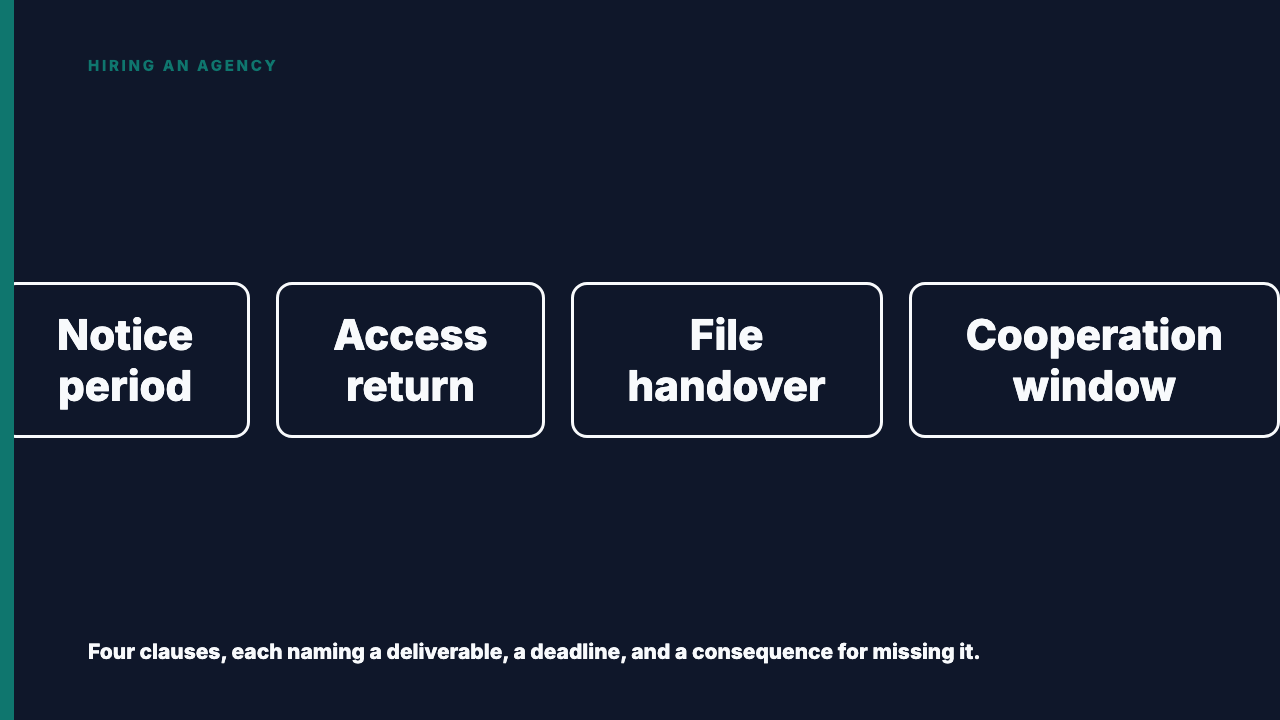
A transition-out clause is not a paragraph promising general cooperation. It is a short list of contractual commitments that obligate the agency to do concrete things by concrete dates.
- A defined notice period. Vague: “reasonable notice.” Specific: a stated number of days’ written notice, proposed by you and agreed in the contract, starting the transition clock. Not an industry standard, just a number you propose and the agency counters or accepts.
- A credential and account-access return process. Vague: “return all client property.” Specific: an access-revocation checklist covering every platform, tool, and login, due within a fixed number of business days of the termination date.
- A file and asset handover format. Vague: “provide relevant files upon request.” Specific: a named format, a deadline tied to the termination date, and a definition of complete, so a partial export cannot pass as compliance.
- A fixed cooperation window. Vague: “reasonably assist with the transition.” Specific: a stated number of hours or days of availability for the incoming team’s questions, during a defined window after handoff.
The version worth having names a deliverable, a deadline, and a consequence if missed, whether that is a payment holdback or simply an enforceable breach. A clause with no consequence attached is a suggestion wearing a contract’s clothing.
The credentials and account-access problem specifically
Access deserves its own line item because it is not one thing. It is a scattered set of permissions the agency likely set up, not you: admin roles on each platform’s business manager, ad account access, scheduling tool logins, any analytics or listening dashboard, and any profile or business account created in the agency’s own name during onboarding rather than yours.
That last category is where brands get burned. An agency that registered a business manager under its own organization, or added your ad accounts as a client rather than an owner, has made itself the landlord of assets you assumed you owned. A generic “return all client materials” clause does not force anyone through that list item by item. That gap is where handovers stall.
A hypothetical worth walking through
Picture two fictional brands hiring the same kind of agency around the same time. Larkfield Outfitters insisted on a transition-out clause before signing: a notice period, a named handover deliverable, a short cooperation window. The account director did not blink, calling it standard. Eighteen months later, when Larkfield moved the work in-house, the handover ran on schedule and the agency answered follow-up questions inside the agreed window.
Bellmont Goods signed a contract with a single line about “reasonable cooperation upon termination.” Two years in, after a dispute over a missed deadline, Bellmont gave notice. The agency was slow to respond, and an analytics subscription registered in its own name lapsed with Bellmont’s historical data on it before anyone exported a copy. Nothing had technically been broken, because the contract had never specified enough to break. The difference was not the quality of the work. It was one clause, negotiated at the moment it had real weight.
How to raise this without sounding like you’re already planning to leave
The framing that avoids sending the wrong signal works because it is true: present the request as standard procurement and business continuity practice, the kind of clause you would want in any vendor contract governing shared systems and access, not something specific to this agency.
What matters more than your framing is the agency’s reaction. A well-run agency treats the request as routine, sometimes with similar language already on hand, and that unbothered reaction is useful information. A defensive one, hedging or pushing to keep the language vague, tells you something too: either it has not thought about offboarding, or it has and prefers not to be pinned down. Better to learn that before you sign than after.
Get this in writing before you need it
None of this replaces vetting the agency itself. Once you have a shortlist, browse vetted agencies and bring this checklist into whichever conversation gets furthest. If you run an agency and this is already how you operate, list your agency free and make it part of your pitch.
Where this fits against the rest of the contract
This piece is about writing transition-out terms into the contract while you still have leverage, before any dispute or notice. It is not about executing an exit already underway.
For the adjacent term governing how and when the relationship can end, see the site’s post on the termination clause. For the mechanics once you are already in the exit process, see how to leave a social media agency without losing the history. For the ownership question behind the access section above, see who owns your social accounts when an agency runs them. And for the fuller checklist, see what to check in a social media agency contract.
FAQ
Isn’t asking about the exit before signing a bad signal to send an agency?
Not when framed as standard procurement and continuity planning rather than a comment on this specific agency. What is genuinely useful is watching the reaction: a matter-of-fact response is a good sign, and a defensive one tells you something worth knowing before you sign.
What if the agency refuses to agree to transition terms upfront?
Treat a flat refusal as meaningful information, not a negotiating hiccup. An agency unwilling to commit to an access-return process before it has your business is unlikely to become more cooperative once it has your business and is losing it. That is a legitimate reason to keep pushing, or to weigh other agencies willing to agree.
Sources
- https://partnerinsocial.com/blog/firing-a-social-media-agency-termination-clause/ (fetched 2026-09-23)
- https://partnerinsocial.com/blog/leaving-a-social-media-agency-handover/ (fetched 2026-09-23)
- https://partnerinsocial.com/blog/who-owns-your-social-accounts-agency/ (fetched 2026-09-23)
- https://partnerinsocial.com/blog/social-media-agency-contracts/ (fetched 2026-09-23)