The Specialist Wins Until You Need a Second Platform
You need one platform covered properly, and the shortlist has split in two: the shop that does almost nothing else, and the team that covers everything. On today’s need the specialist usually wins. But if a second platform sits in next year’s plan, that choice sets the price of the expansion.
The specialist’s real advantage, and where it stops mattering
A platform specialist is fluent in a way a generalist cannot be. They notice when a format is being pushed and when it is quietly demoted, and which posting behaviours its community reads as native rather than as an ad in costume. A generalist spreads that attention across five platforms, competent everywhere and deep on maybe one, so on a single platform brief the gap shows.
The edge stops mattering the moment you need one coherent story across channels rather than excellence on a single one.
Why “we’ll add a platform later” undercounts the real cost
That is a deferred invoice, larger than most buyers estimate. Expanding or switching at the second platform point buys a fresh onboarding and ramp period, real work that falls partly on you, as the site’s account of the first thirty days with an agency sets out. Brand voice calibration restarts from zero with a new team. You may pay two agencies at once, because a clean handover needs the outgoing team under contract while the incoming one ramps, which is part of what a clean handover actually requires. Then you administer a second vendor relationship.
These costs are real even when the specialist did excellent work, so paying them later is not evidence the specialist was the wrong first hire.
Two honest paths when the second platform arrives
Option one: run two specialists in parallel.
- Good: channel ownership divided in writing, so each agency knows which platform it owns. One named person inside your business coordinates both and owns cross platform consistency. Reporting is consolidated, not duplicated.
- Bad: two agencies working from briefs they each wrote themselves, clashing on cadence and messaging, with nobody internally accountable for consistency.
Option two: graduate to a full service agency.
- Good: the incumbent absorbs the new platform under a scope expansion clause agreed at signing, at a known rate, or hands off against a documented transition with account access, archives and history transferred on a defined timeline. You pay one onboarding that year, not two.
- Bad: a forced switch mid term with no scope expansion clause and no transition assistance, so you pay a new agency’s full onboarding while still paying out notice on the old contract.
Build the channel view before you sign anything
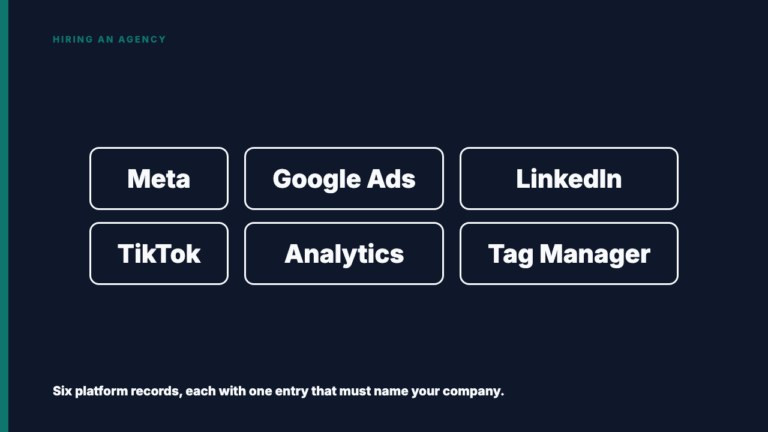
Picture a hypothetical home goods brand that needs TikTok covered today and nothing else. A specialist and a full service team reach the final round, and the specialist is better and cheaper on today’s need.
Now add a fact missing from that brief: a retail expansion roughly a year out, needing a second channel. The question changes from who is better at TikTok to what month thirteen costs under each option. The specialist may still win, but now the brand knows to ask about expansion, at what rate, and what happens if it cannot.
Before evaluating any agency, write down the second platform you are considering and its rough timing, even unfinalised. “Probably YouTube, probably Q3 next year” is enough to change how you read a contract.
What to ask a specialist agency about its multi-platform limits
- Have you added a second platform for an existing client mid contract, and what happened?
- Does your contract include a scope expansion clause, and at what rate?
- Do you subcontract or partner for platforms outside your specialty, and would we contract with you or them?
- If you cannot take the second platform on, what does your handoff look like?
- Are there platforms you will not take on? Some specialists will not work outside their focus at all and would rather you brought in a separate vendor.
This sits alongside vetting an agency for a specific platform specialty and the general framework for choosing a social media agency.
The contract terms that make switching later cheaper
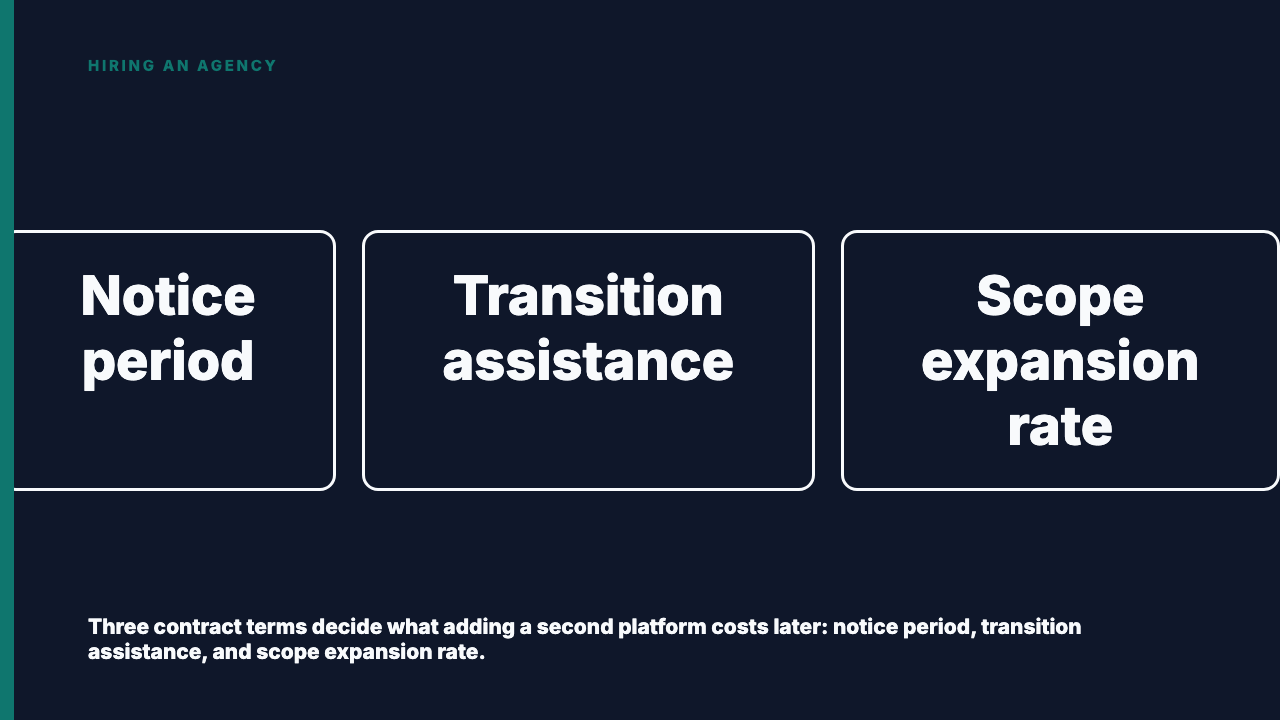
Three terms do most of the work, cheap at signing and expensive later. A defined notice period decides whether an overlap with a second agency is a month or a quarter. A transition assistance clause obliges the outgoing agency to transfer accounts, files and performance history on a stated timeline, not after final invoices clear. Pre agreed rates for scope expansion make adding a platform an amendment rather than a renegotiation from zero. For the wider set of clauses to read before you sign, including term length, notice and asset ownership, see what to check in a social media agency contract.
Start from a shortlist built against your channel plan
Our directory lists 80 vetted agencies, searchable by niche and location. Browse vetted agencies and build your shortlist against your channel plan, not today’s gap. Run an agency? You can list your agency free.
FAQ
Is a platform specialist always the better first hire?
Usually yes for a single, well defined platform need, because depth on one channel beats shallow coverage across several. But that only holds if you have also thought about the second platform. Choosing purely on today’s output is a bet that your channel plan will not change.
What if I don’t know yet whether I’ll need a second platform?
The uncertainty does not change the exercise. Write down the platform you are most likely to add and a rough timeframe, both guesses if need be, then ask every specialist candidate how they would handle that scenario before you sign.
Can one agency just learn a new platform when I need it?
Sometimes, and it varies enough that you have to ask rather than assume. Some specialists will expand, some partner or subcontract, and some decline outright. None of that is visible from a website, so ask on the vetting call and treat vagueness as a no.
Is running two specialist agencies at once ever the right call?
Yes, when two platforms carry roughly equal weight and someone inside your business has the time and authority to coordinate both. Without that internal owner it goes badly, because two agencies with no shared brief drift on cadence and messaging.
Sources
- What to check in a social media agency contract. Fetched 2026-09-06.
- Your first 30 days with a social media agency. Fetched 2026-09-06.
- How to leave a social media agency without losing the history. Fetched 2026-09-06.