How to Run a Social Media Agency RFP Without Wasting Time
Procurement says the agency hire needs a formal RFP, and the template you were handed was built for software. Fifty fields on incorporation date, financial stability, disaster recovery. None tell you whether this agency does good work.
Why the standard RFP template fails a creative hire
A software RFP works because software has fixed, verifiable specifications. Uptime is a number, and what you buy does not change depending on who gets assigned to your account. An agency does. What predicts fit is judgment, chemistry and actual work samples, none of which fit in a form field.
So the long template fails predictably. Agencies with enough demand to be selective either decline or hand it to the most junior person available, who fills it in formulaically. You end up scoring proposal writing rather than the work. A long RFP does not produce more information. It produces more boilerplate.
What a documented process actually requires, and what it doesn’t
Three instruments get blurred together. An RFI is a light early screen asking whether a vendor is the right category and scale. An RFP is the formal written request for a proposal against a defined scope. An RFQ asks price only, against a scope so tight that price is the last variable. Most brands hiring one social media agency need only the RFP.
A defensible process needs less than the template implies: the same scope sent to every agency, the same deadline, and the same scoring criteria, written down before the first response arrives. That is the paper trail; the rest is inertia from another kind of purchase.
The two or three questions that actually predict fit
- Who, by role and seniority, works on this account day to day, and what share of their week does it get? Not the org chart: real people, their level, their allocation. This is the line between the team that pitches you and the team that runs your account.
- What happens in the first thirty days, before anything publishes? A good answer describes audits, access transfers, voice work, an approval path. A weak one has a content calendar landing in week one, before anyone has learned your business.
- If we called three clients who left, what would each say about why? Agencies that answer specifically tell you where their limits are. Agencies that answer smoothly tell you nothing.
These beat the template’s twenty because they cannot be answered without committing to something checkable. “Describe your process” costs an agency nothing. Naming the person who will run the account costs them the ability to swap them out quietly. The RFP’s only job is to surface these answers formally; the depth is in the questions that actually disqualify an agency.
What belongs in writing versus what belongs on a call
Anything checkable goes in writing, to be compared side by side: scope acceptance, fee structure, team composition by role, reference contacts. Anything requiring judgment or reaction belongs live, because a written answer there is prepared, not real. That covers pushing back on a bad brief, handling a crisis post, and talking about a campaign that failed. Ask “describe your creative process” in a document and you get the paragraph every agency has ready to paste. Ask it live, follow with “walk me through the last time that process broke,” and you get an actual answer.
A shorter RFP structure that still holds up as a documented process
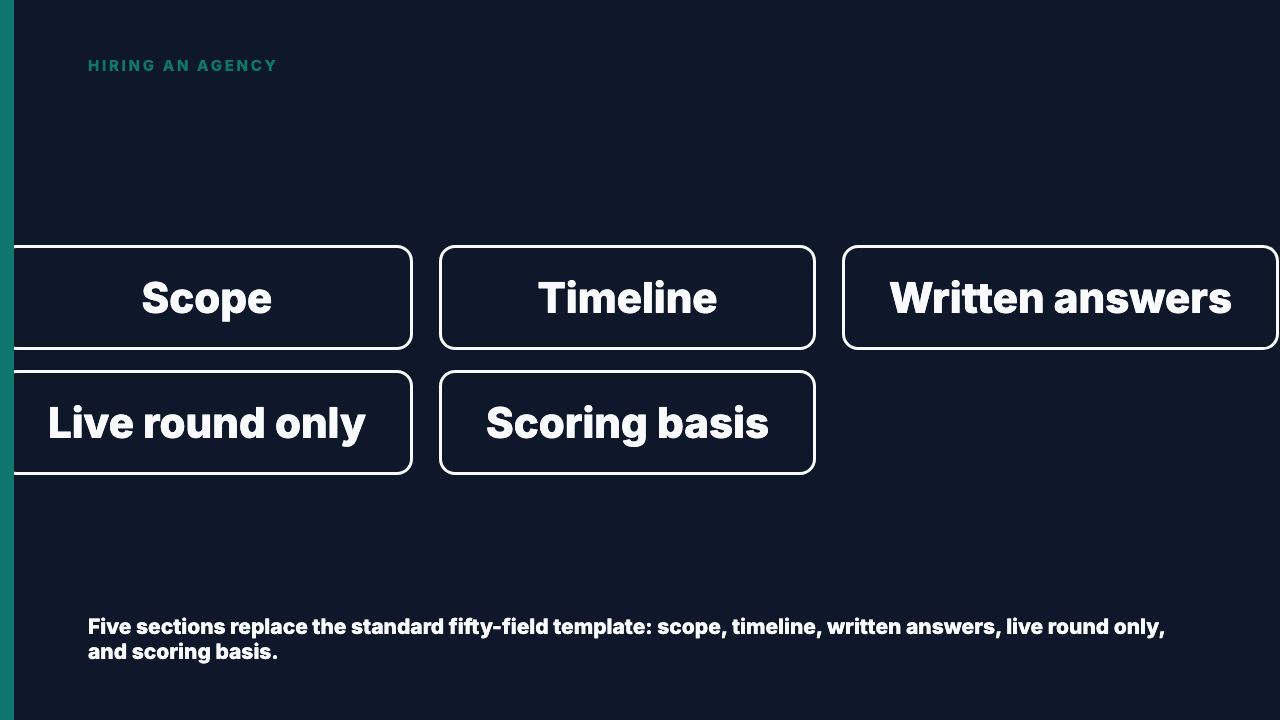
| Section | What goes in it |
|---|---|
| Scope | Channels, deliverable cadence, who approves, and an explicit list of what is out of scope. Paid media, overnight community management and video production are what go unstated and become change orders. |
| Timeline | Submission deadline, shortlist date, live round dates, decision date. We suggest at least two full working weeks to respond, this site’s recommendation rather than a documented standard. |
| Written answers | Team structure by role and allocation, fee structure and what triggers extra cost, three reference contacts including one former client, one relevant work example. |
| Live round only | The three fit questions above. Say in the document that they come live, so nobody prepares a script. |
| Scoring basis | Criteria and weights, shared with every agency in advance. Published weights make weak responses self select out. |
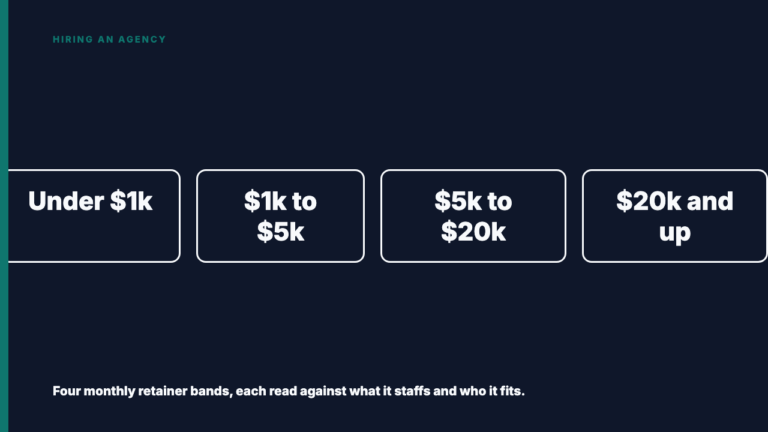
Make the budget call explicitly. State a real range, or state plainly that none will be given and agencies should propose against the scope. Ambiguity is what produces proposals too spread out to compare. If you are choosing a range, start from the four budget bands agencies price against.
A hypothetical walkthrough: two versions of the same RFP
Picture a mid size retailer, entirely hypothetical, hiring for organic social. Version one is the standard fifty field template, with a scope line reading “manage our social media presence.” Four agencies are invited, one declines, and the three responses are interchangeable.
Version two is the two page structure above. Five agencies respond, and the answers differ enough to argue about, because the ask was proportionate to the decision.
What to do with the responses once they come in
Use the written responses for one purpose: building a shortlist of two or three. They are never the decision, because each response is the version an agency chose to present. Score against the criteria you set before submissions opened, then move to the live round and reference calls, which do the work paperwork cannot. Those are covered in what to ask on a reference call, and which to refuse.
Find agencies worth sending it to
An RFP only works if the invite list is good. Our directory lists 80 vetted agencies by specialism and location. Browse vetted agencies, or if you run one, list your agency free.
FAQ
Do you need a formal RFP to hire a social media agency?
Most brands do not. An RFP is warranted when internal procurement policy requires a documented, comparable, defensible process. Without it, an RFP adds weeks and filters toward agencies good at paperwork. Use how to choose a social media agency without a formal process instead.
Should you tell agencies your budget in the RFP?
Make a clear choice either way. State a range, or state plainly that no range will be given and agencies should propose against the scope. Leaving it unaddressed produces submissions that vary by multiples for the same work.
How many agencies should you send an RFP to?
Enough to get real variation in approach, few enough that a live round with each finalist stays feasible, narrowing to two or three carried into live conversations. That is this site’s recommended practice, not a documented industry norm.