Before You Fire Your Agency, Check Whether the Problem Is You
You have a half-written termination email open, and a quarter of frustration behind it. Before it goes out, it is worth asking a blunt question: how much of this did you cause?
The email you are about to send
Here is an illustrative scenario, not a real case. A brand owner spends a quarter watching posting dates slip. They start drafting the email that ends the retainer. Then someone pulls the thread history. Every draft arrived on the agreed day. Each one then sat in an inbox for nine days before anyone replied. The approval queue missed the dates, not the agency.
That is the thesis of this post. Firing over a problem you caused just transfers it to the next agency, which will hit the same wall. Staying over a problem the agency caused wastes another quarter. The skill is sorting the two before you act.
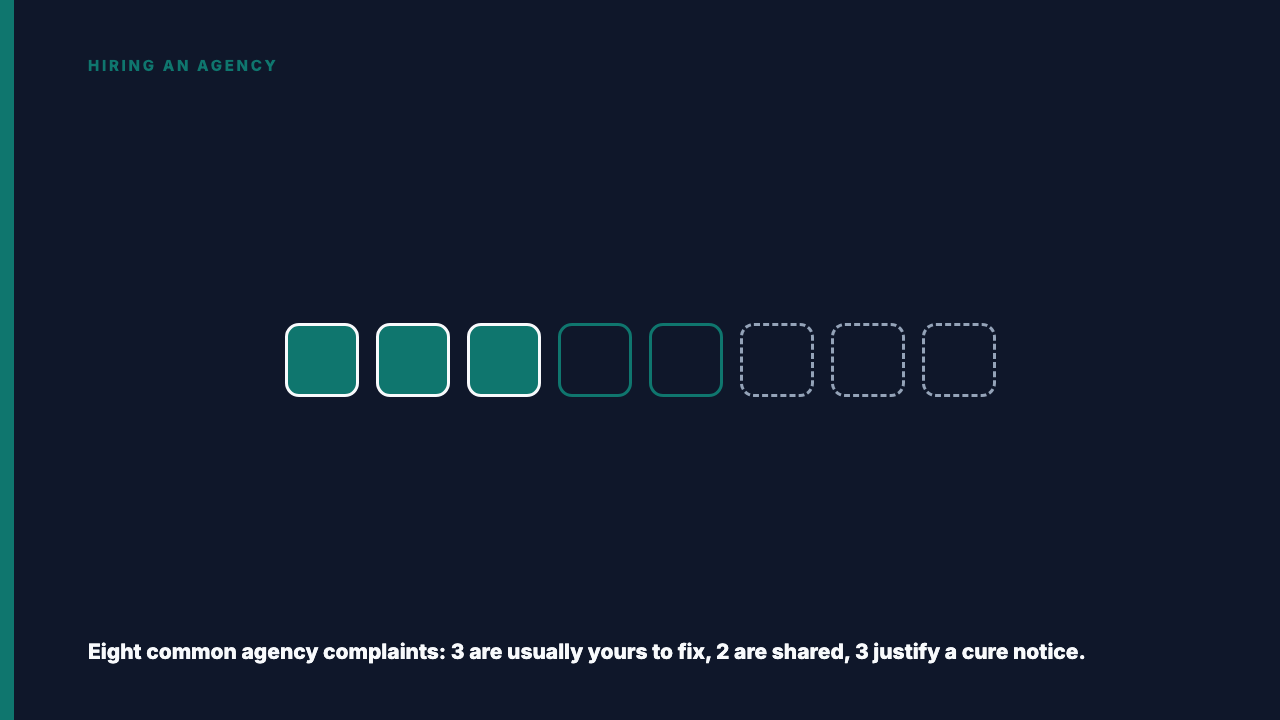
The rule is simple: fix each complaint on the side of whoever controls the cause. Below are eight common complaints in three groups. Three are usually yours to fix, three are the agency’s, and two are shared.
Three complaints that are usually yours to fix
Complaint 1: “They keep missing posting dates.” The test is whether the agency’s draft arrived on time and then sat waiting for sign-off. The good version is a logged turnaround on your side: when work was sent, when it came back, who held it. The bad version is no record at all, just a feeling that everything is late. Our post on your approval process makes the case that slow and contradictory approvals are a common driver of this, so I will not restate it here. Verdict: this does not justify a cure notice, and sending one will likely produce a paper trail that shows your own delays.
Complaint 2: “The revisions never end.” The test is whether more than one person on your side gives feedback, and whether those people contradict each other. One person wants punchier copy, another wants it safer, and the agency revises toward a moving target. The fix is one named decider and one consolidated round of feedback per draft. Verdict: no cure notice.
Complaint 3: “They are missing our targets.” The test is whether the target changed after the contract was signed, or was never written down. Separate a target the agency agreed to, in writing, from one you privately hoped for. Our post on KPI clauses shows what a written target looks like. Verdict: if the target moved or lived only in your head, no cure notice.
Three complaints that justify a cure notice
- Complaint 4: “We are not getting the deliverables we pay for.” Compare delivered volume and formats to the scope of work, line by line. If the shortfall is documented and your approvals were on time, this is a breach, not a preference.
- Complaint 5: “Reports are late, unclear, or nobody explains them.” The acceptable version is the agreed cadence plus a plain explanation of what moved and why. The unacceptable version is a dashboard export with no commentary. Our post on communication cadence covers what to agree up front.
- Complaint 6: “The team we hired is not the team working on us.” Compare staff changes and slow replies against whatever the contract or pitch committed to. This is only actionable if the commitment was written down.
These three are where a cure notice is the right tool. For the mechanism, see the cure period post, which describes it as a written notice naming a specific problem, a defined window to fix it, and a stated consequence if it is not fixed. If the window passes without a fix, the termination clause post covers what happens next.
Two complaints where the fault is shared
Some failures have two authors. The work is separating the contributions honestly.
Complaint 7: “The content feels generic or off brand.” Check the brief first. A good brief is written and contains the audience, voice examples, and off-limits topics. A bad brief is a two line onboarding email and a logo folder. If your brief was thin, that part is yours, because the agency filled the gaps with safe guesses. If a solid brief was ignored, that part is the agency’s.
Complaint 8: “Results have gone flat.” Ask two things. First, is the agency past its ramp period? The opening months are loaded with one-off work, and the slowdown afterwards is often normal, as described in what normal looks like after the ramp period. Second, have your own inputs slowed: product news, access to people, timely approvals?
For any shared complaint, use a two question test. What did I give them? And what did they do with it? If the first answer is “not much,” start there. If you gave plenty and got little back, the agency owns it.
The diagnostic in one table
| Complaint | First thing to check | Who owns the fix | What to do |
|---|---|---|---|
| 1. Missing posting dates | Your logged approval turnaround | Buyer | Change your process |
| 2. Endless revisions | How many people give feedback, and whether they conflict | Buyer | Change your process |
| 3. Missing targets | Whether the target was written, agreed and unchanged | Buyer | Change your process |
| 4. Deliverables short | Scope of work against what was delivered | Agency | Send a cure notice |
| 5. Reports late or unexplained | Agreed cadence and commentary | Agency | Send a cure notice |
| 6. Wrong team on the account | Written staffing commitments | Agency | Send a cure notice |
| 7. Generic or off brand | The written brief | Shared | Both |
| 8. Flat results | Ramp period status and your own inputs | Shared | Both |
The role that sits behind most of the buyer-side failures
Complaints 1 to 3 usually share a root. Nobody on the brand side is named as the agency’s day to day contact. Approvals, feedback and goals all drift because no one owns them.
Here is a concrete check. Can you name the one person who answers the agency within a working day? If you cannot, fix that before any notice goes out. Our post on a named internal owner explains the role.
What to do this week before you send anything
Start by writing down every complaint you have, in plain sentences. Sort them with the table. Fix the buyer-side ones for one defined stretch, long enough for a few posting cycles. Put the agency-side ones in writing, tied to the scope of work and contract language. Then decide.
The decision rule is this. If the agency-side complaints persist after your side is clean, termination is honest. If they vanish, the agency was not the problem, and you just saved yourself a painful search.
One fair note to close. Some relationships are simply a poor fit even when nobody is at fault. That is a legitimate reason to leave. Handle it through the contract’s normal exit terms, with the notice period served.
Next step
If the diagnosis points to a genuine fit problem, Browse vetted agencies and shortlist with a clean process on your side this time. If you run an agency, you can list your agency free.
FAQ
How do I know if my agency is the problem or I am?
Check each complaint against what you can document: your approval turnaround, the written brief, whether targets changed, and the scope of work. Your side fixes the first three, and documented contract shortfalls belong to the agency.
Which complaints justify a cure notice?
Documented deliverable shortfalls, reporting failures against an agreed cadence, and team changes that contradict written commitments. The cure period post explains how the notice works.
Sources
- The Cure Period: What to Add Before You Fire an Agency, fetched 2026-09-30
- Your approval process is shaping the work more than your brief is, fetched 2026-09-30
- What Normal Looks Like Once the Agency’s Ramp Period Ends, fetched 2026-09-30
- How to Fire a Social Media Agency Without a Surprise Kill Fee, fetched 2026-09-30