Hiring a Social Agency for a Franchise or Multi-Location Brand
You are signing one social media agency contract for a brand you do not fully control. Most of the accounts belong to independent owners who never sat in the pitch, and every hard part comes from that gap.
The buyer for this contract is not one person
There are two buyers. The franchisor’s marketing director signs the master agreement and is measured on brand consistency. The franchisee runs the page daily, had no vote on the vendor, and may still hold a contractual right to weigh in on it, depending on the franchise agreement.
Which is why an agency excellent for one brand can fail here. The skill being hired is coordination across dozens of stakeholders, not content quality: approvals that do not stall, and the same guardrail explained forty times.
What corporate should never hand to a location
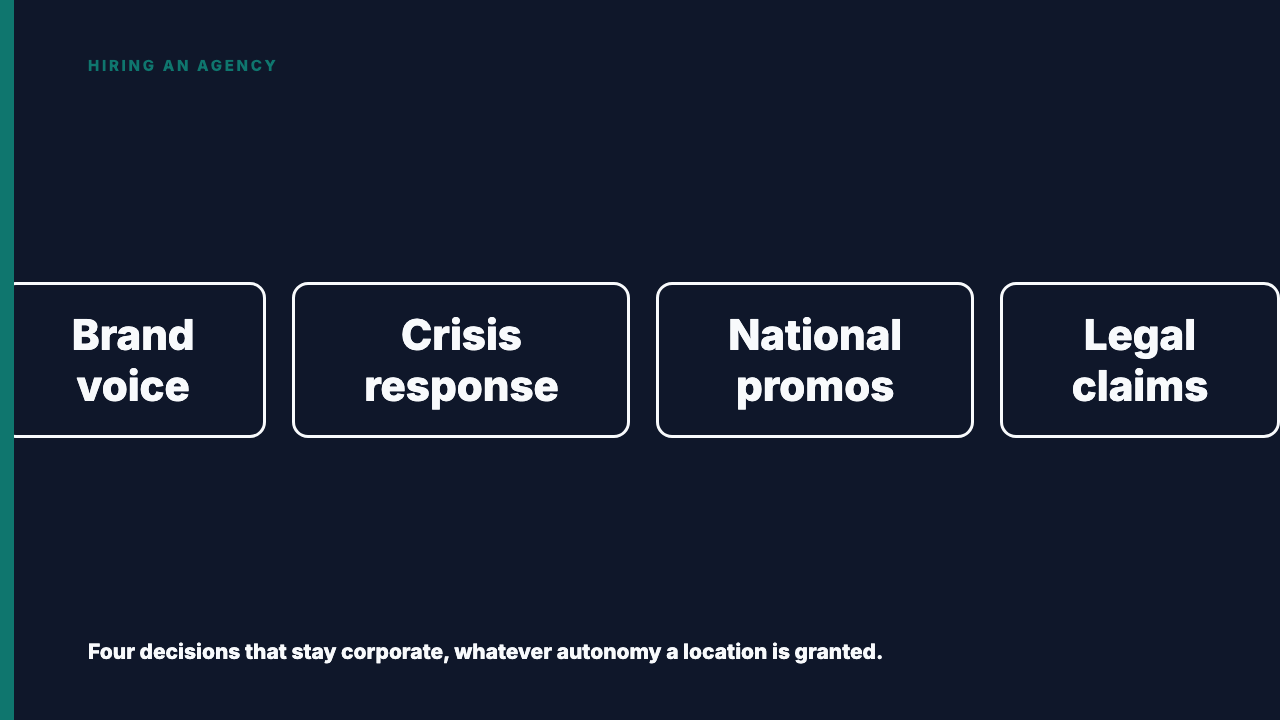
Four decisions stay central however much autonomy you grant:
- Brand voice, visual identity, and messaging guardrails. Tone, logo treatment, claim language, what the brand never says.
- Crisis response. Who is authorized to post, pause spend, or take a page dark during an incident.
- National promotions and the campaign calendar, go-live dates included.
- Any claim touching legal review. Pricing, health and safety language, contests.
In a hypothetical fast-casual system, a location posts a two-for-one the same week corporate runs a national bundle at a different price.
What a location legitimately keeps control of
Centralizing everything is the other failure:
- Local events and hyperlocal offers, a school fundraiser, a road closure, a slow Tuesday.
- Community replies. Whoever knows the regular complaining about the parking lot should answer, or brief the agency.
- Visibility of the owner and staff where that is how the location sells.
Frame it as a trade: franchisees give up brand control in exchange for keeping their local voice. A contract that erases both loses the network.
The account access problem nobody budgets time for
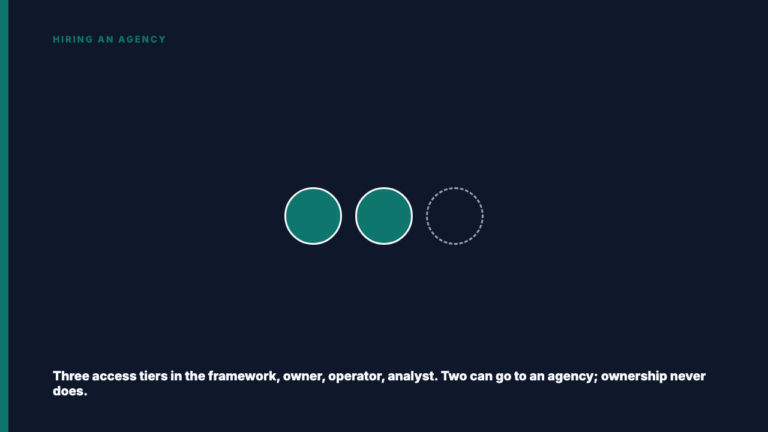
Somebody administers every page, and the roster changes. The durable structure is a corporate-owned parent business account, commonly called Business Manager or a business portfolio, owning the pages as assets and granting the agency and each local owner roles beneath it, not franchisees adding the agency from a personal profile. [EVIDENCE NEEDED: Meta documentation of that access model, which this site could not read].
A franchisee who built the page on a personal profile, added the agency as a favour, then left takes the page, its followers and its archive. Asset ownership and termination handling are contract questions, not IT tickets, and belong in the agreement before launch.
Structuring the contract: one agreement, not fifty
Take a hypothetical fifty-location quick-service franchise. Corporate signs one master services agreement covering brand content and platform management. Locations wanting dedicated local posting or paid promotion opt into a local add-on rider under it, at the same rate card and guardrails, so corporate keeps quality and rate control without blocking local spend. See what to check in a social media agency contract first.
The version that breaks it: a franchisee signs a side agreement directly with the agency, or a different vendor, at a different rate with no obligation to follow brand guardrails.
Pricing across a network is not one number times the location count
Ask which of three shapes a proposal is, knowing how retainer, percentage of spend, and performance fees work.
| Structure | Covers | Fits when |
|---|---|---|
| Flat tiered corporate retainer | Brand content and central strategy, whatever the count | Locations are similar, local activity light |
| Retainer plus per-location fee | A fee on top for dedicated local posting or community management | Appetite varies, opt-in should be real |
| Hybrid: central production, local spend | Content produced centrally, paid amplification spent locally | Paid social is the point, budgets differ |
Be suspicious of a single blended per-location price: it usually means every location gets the same shallow service.
An agency built for one brand cannot always run fifty accounts
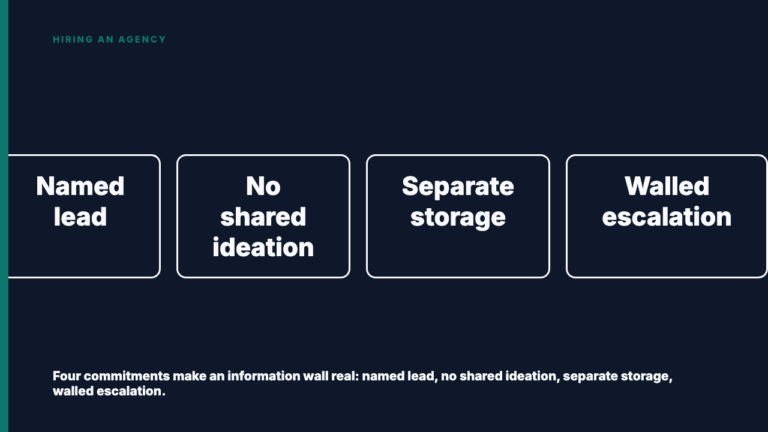
Running dozens of semi-autonomous accounts under one brand is an operations problem as much as a creative one. Ask for a named account structure: a dedicated lead on the corporate relationship, a pod or rotation handling local execution, not one team stretched across every location. It is the clearest case for why agency size should be its own selection criteria, and it assumes the internal role an agency relationship needs before it can work is filled.
Franchisee buy-in is won before the contract, not after
The most common failure is a network-wide mandate on day one. Pilot instead, on a small subset of locations for a defined period. Skip that and owners who never agreed to the vendor keep running their accounts in parallel, leaving corporate governing two systems. Franchisees hand over their pages because they watched the pilot work, not because a memo said to.
Where to start looking
Our directory lists 80 agencies by service focus and location. Browse vetted agencies, or list your agency free.
FAQ
Can a franchisee opt out and hire a different agency for their own location?
It depends entirely on the franchise agreement; there is no universal norm. Two arrangements to check yours against: marketing control reserved to the franchisor, with every brand-facing channel running through approved vendors, which makes a side hire a breach; or the franchisor controlling brand assets and mandatory contributions while leaving discretionary local marketing to the owner.
Who should own admin access to a franchise location’s page?
Corporate should, as the asset owner in a parent business account, with the agency and the local owner granted roles beneath it, the structure described in the access section above. That is why the page survives a change of franchisee.
Should a franchise brand use one account for the whole network or one per location?
There is no universal right answer, only a tradeoff. One national account centralizes control and keeps governance simple but cannot carry hyperlocal posts or replies about one store’s parking lot. One per location buys that relevance and multiplies the access problem above across the network.
Does a franchisor typically pay for the agency out of a marketing fund?
Many franchise systems collect mandatory advertising contributions into a franchisor-administered fund, separate from local discretionary spend. The FTC’s Franchise Rule Compliance Guide covers the disclosure: recurring advertising fees appear in the Item 6 fee table, and Item 11 requires franchisors to disclose how advertising funds were spent, alongside the role of any advertising council or cooperative.
Sources
- Federal Trade Commission, Franchise Rule Compliance Guide, fetched 7 September 2026.
- The same guide, full PDF, Items 6 and 11, fetched 7 September 2026.