Can Your Agency Call You a Client in Their Own Pitch Deck?
Deep in an agency contract, past the fees and the termination terms, you hit two sentences about the agency’s right to reference the engagement in its own marketing. It reads like filler. It is one of the few clauses that gives the agency something valuable and you nothing.
The clause reads like boilerplate. It is not.
It sits in the general provisions near the end, beside confidentiality, intellectual property, and assignment, titled “Publicity,” “References,” or folded untitled into a longer “Use of Work” paragraph. Some version appears in a great many vendor and agency agreements as ordinary practice, and standard is why nobody negotiates it.
A broad version grants more than it sounds. Wording like “Agency may use, reference, and publicize the engagement, Client’s name, and the results of the Services in its marketing materials” lets the agency name you, describe the work, and quote how the account performed, to anyone, without asking.
What “reference the account” can actually cover
A broad clause does not distinguish between:
- Your name and logo on a client list, a logo wall or a capabilities deck slide.
- A general description of the work, such as organic social and paid amplification for a mid-market brand.
- Specific performance figures and screenshots, your monthly numbers and dashboards, as a named case study.
- Your account as a live example in a new business pitch, in front of a prospect who can be anyone, including a direct competitor.
Brands agree to the first item. They have signed the fourth. The wording rarely separates them, so one right to reference collapses the whole range.
A hypothetical: the pitch meeting you were never in
Picture your own company, fourteen months into a good agency relationship, when that agency pitches a competitor two states over. Slide eleven is a case study: your brand named, your scope described, your performance charted. None of it breaks the contract. Two months later you renew against an agency that won business off your results, having learned neither that the reference happened nor what was shown.
Why agencies want this clause, and why the ask is not unreasonable
An agency’s growth runs on proof, and proof means named clients a prospect can verify. A total ban is unusual in a service business, and an agency will refuse it or price it into your retainer. The fight is who approves what, when, and in how much detail.
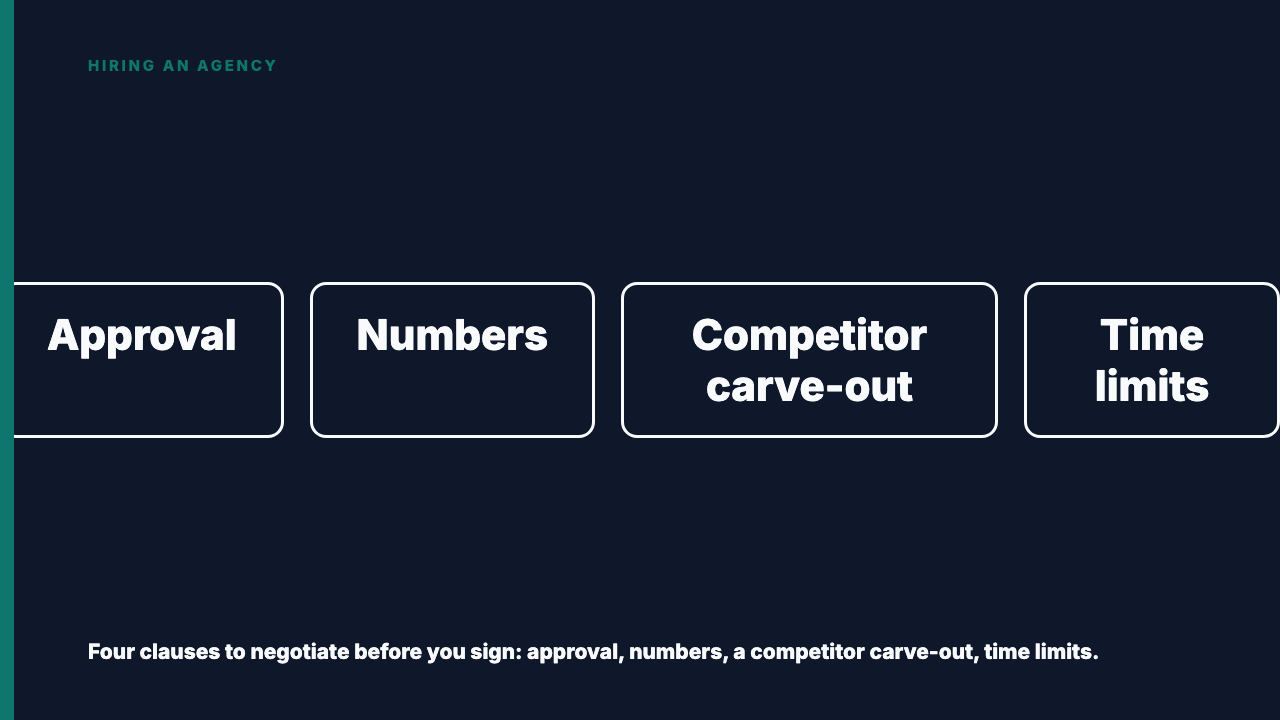
The four things to negotiate before you sign
- Approval per instance, not once forever. Anything beyond name and logo needs written sign-off each time, or per campaign, with a response window such as deemed approval if you do not reply in ten business days.
- Separate the numbers from the name. Performance figures, screenshots, and account-specific results need explicit permission, written as its own sentence apart from the general grant.
- A competitor carve-out. No reference to your account, named or anonymized in a way that identifies you, in a pitch to a direct competitor, with competitor defined by category and geography inside the clause.
- Time limits and reversibility. Publicity rights end when the contract does, and you can withdraw consent in writing for future use, with a defined grace period to pull existing decks and pages.
What the acceptable version looks like versus the risky one
| Fine to sign | Push back before signing |
|---|---|
| Names you on a client list, nothing further without another step. | Grants a general right to use, reference, and publicize the engagement and results. |
| Written approval before any case study, campaign detail, or metric goes external. | Signature as blanket consent for every future use and audience. |
| Ends with the agreement, with a window to remove existing material. | Survives termination indefinitely via a quiet survival clause. |
For the rest of the document: what to check in a social media agency contract and reading an agency scope of work before you sign.
This is not the same clause as who owns the creative work
Publicity and ownership get conflated constantly. A publicity clause governs whether the agency can talk about you externally. An ownership clause governs who uses the photos, videos, and copy after the contract ends. A contract can get one right and the other badly wrong, so check both.
If the clause is already broad and you are mid-contract
Most commercial contracts can be amended by mutual written agreement mid-term unless the document says otherwise, so find the amendment provision. Narrowing a publicity clause does not reopen fees, scope, or term, and it fits on a one-page side letter that names the original clause and replaces it.
Then ask directly whether the account has already been referenced anywhere, and what was shown. A broad clause does not require them to have told you. Note that the team that pitches you is not the team that runs your account, so the deck builders may never have met your account lead.
Before you sign with anyone
This clause is easier to negotiate with alternatives on the table, so browse vetted agencies and compare contract posture. If you run an agency, you can list your agency free.
FAQ
Is it normal for an agency contract to include a publicity or reference clause at all?
Yes, expect one. Agencies build new business on referenceable clients, so an agreement with no publicity provision is the exception. The problem is not the clause, it is a clause with no limit on scope, detail, audience, or duration. Negotiate the four limits above.
Can I ask for a total ban on any reference to my account?
You can, but expect friction. Referenceable work is how a service business grows, so a full gag tends to be refused or priced into the retainer. The approval-based version above gets you most of that control with less resistance.
What if I already signed a contract with a broad publicity clause?
Ask for an amendment. Mutual written changes mid-term are ordinary, and a one-page side letter replacing the publicity clause does not touch fees or scope. First ask whether your account has already appeared in a pitch or a case study, since nothing obliged the agency to tell you.
Does a non-disclosure agreement already cover this?
Not reliably. An NDA restricts disclosure of confidential information, while a publicity clause permits disclosure of the relationship and often the results for marketing. Both can sit in one contract and point in opposite directions, so read them side by side before signature.