Vetting a Social Media Agency When You Sell B2B
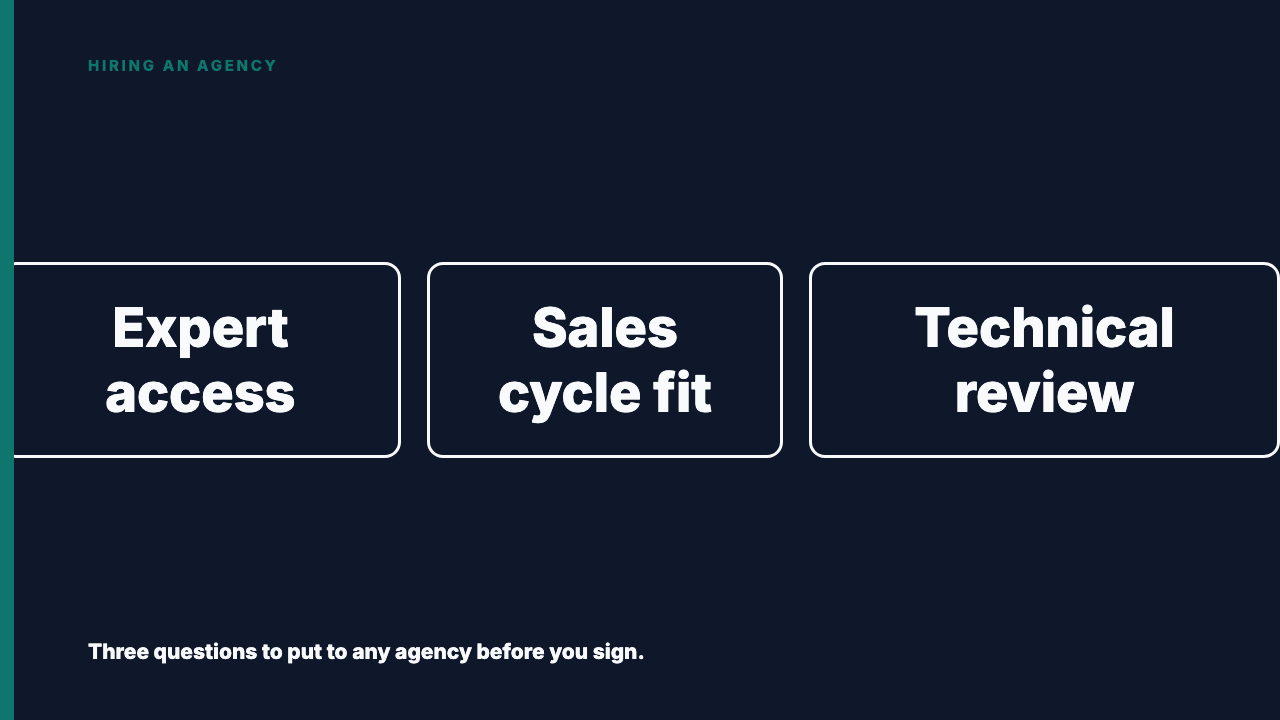
You sell software, services or industrial equipment, and every agency that pitches you shows a portfolio of consumer brands. The work looks polished and the numbers are big, but none of it tells you whether the agency can serve a buyer who is a committee deciding over many months. Here are three questions to put to any such agency, and what a workable answer sounds like next to a consumer pitch dressed up for B2B. They are the editor’s vetting view, not a published framework.
Why a consumer portfolio is the wrong proof for your hire
Picture the deck. Twenty slides on a consumer launch, reach in the millions, a reel that travelled, then one slide that says “we also do B2B” with three logos and no detail. Most B2B marketing leads have sat through it.
The agency’s craft may be entirely real. The question is not whether it is good. It is whether its model fits a purchase that involves several people over many months, where the audience is a buying committee and not a crowd. Reach, creative volume and follower growth prove a model built for crowds.
Make one metric swap in the first meeting. Ask what the agency would treat as a good month when the audience is a few thousand relevant people, not a few million. If the answer is still a reach figure, you have learned what you needed. For the separate question of niche expertise, see the specialist versus generalist agency guide.
Question one: who will they actually talk to inside your company?
B2B content is credible only when it carries something a specialist knows: an engineer, a services lead, a product manager. A generalist writer cannot invent that.
| Ask | Workable answer | Consumer-agency answer |
|---|---|---|
| How do you get expert input? | A standing interview slot, a question list sent in advance, a named person on your side. | “We’ll research it.” Or “just send us your blog posts.” |
| What if the expert cancels? | A stated plan: reschedule, swap experts, or run a post needing no new input. | No plan. The calendar slips quietly. |
A hypothetical: a manufacturing firm’s agency never gets a call with an application engineer, and three months in the feed is generic factory-floor imagery. Nobody on the buying committee learns anything. The contract never said who would provide what.
The buyer owes something in return. Before signing, name the internal experts, agree a realistic number of hours per month with each, and put it in the scope of work.
Question two: can they work to a sales cycle that runs for months?
A consumer account is judged fast: a post lands and the response is visible that afternoon. A B2B account is judged on whether a handful of the right accounts engage, and whether sales says prospects mention the content. B2B sales cycles generally run longer and involve more decision makers than typical consumer purchases, so the signal is slow by design.
Ask: “What will you report in the first 90 days?” A good answer names leading indicators tied to named target accounts, a plan to compare notes with sales, and honesty that revenue will not show yet. A bad answer promises leads in weeks, or hands over a dashboard of impressions.
Watch for the quiet fallback. When slow signal makes a client nervous, some agencies raise volume. In the monthly report it looks like more posts and a bigger reach chart, with less text about which accounts engaged. If the report grows on activity and shrinks on accounts, the agency is managing your anxiety, not your pipeline.
Your side matters too. The agency cannot see closed deals unless you tell it, so decide in advance what sales will feed back, how often, and who sends it.
Question three: who reviews the work, and how fast?
B2B posts often need a technical accuracy check and sometimes a legal or compliance read, so turnaround is days, not hours. Ask the agency three things. How many review rounds does its calendar assume? What does it do when a reviewer rewrites a claim? Has it worked with an approver outside marketing?
The bad version: the agency publishes on a schedule built for one-person sign-off, your product reviewer takes four days, dates slip, and the monthly call includes a remark about “client delays”. The good version: review lead time is built into the calendar, and a fallback post that needs no review keeps the schedule moving.
For the detail, read how your own approval process shapes the work. If your review is formal and heavy, see hiring an agency when you have a compliance team.
Reading the pitch for B2B literacy
Tells that the agency understands a buying committee:
- It asks who the buyers and influencers are.
- It asks what sales hears from prospects.
- It treats employee and expert voices as assets.
- It knows a post for a prospect differs from one for a recruiter or partner.
Red flags:
- Vanity-metric benchmarks from consumer brands.
- A content mix identical to the consumer deck.
- No questions about your sales process.
Ask for a sample plan for a brand like yours, built from your own website and sales material. If it comes back generic, treat that as the answer.
What to put in the scope of work
Write down three things: the named internal experts and their monthly hours, the review lead time and who holds it, and the agreed 90 day indicators. If the agency cannot agree to any of them, treat that as information about fit, not as a negotiating position. To test a consumer-background agency cheaply, buy a paid pilot before a long retainer.
Next step
Browse vetted agencies and filter by the service you need. If you run an agency, list your agency free.
FAQ
Can an agency with only consumer clients work for a B2B company?
Sometimes, but the burden of proof shifts to the agency. Look for evidence of how it would handle expert access, a long sales cycle and technical review, not a B2B logo slide. A paid pilot is the fairest test.
What should a B2B social media agency report in the first 90 days?
Leading indicators tied to named target accounts, content shipped against the plan, review turnaround times, and what sales has heard. Not revenue, and not impressions alone.