Hiring a Social Media Agency When You Have a Compliance Team
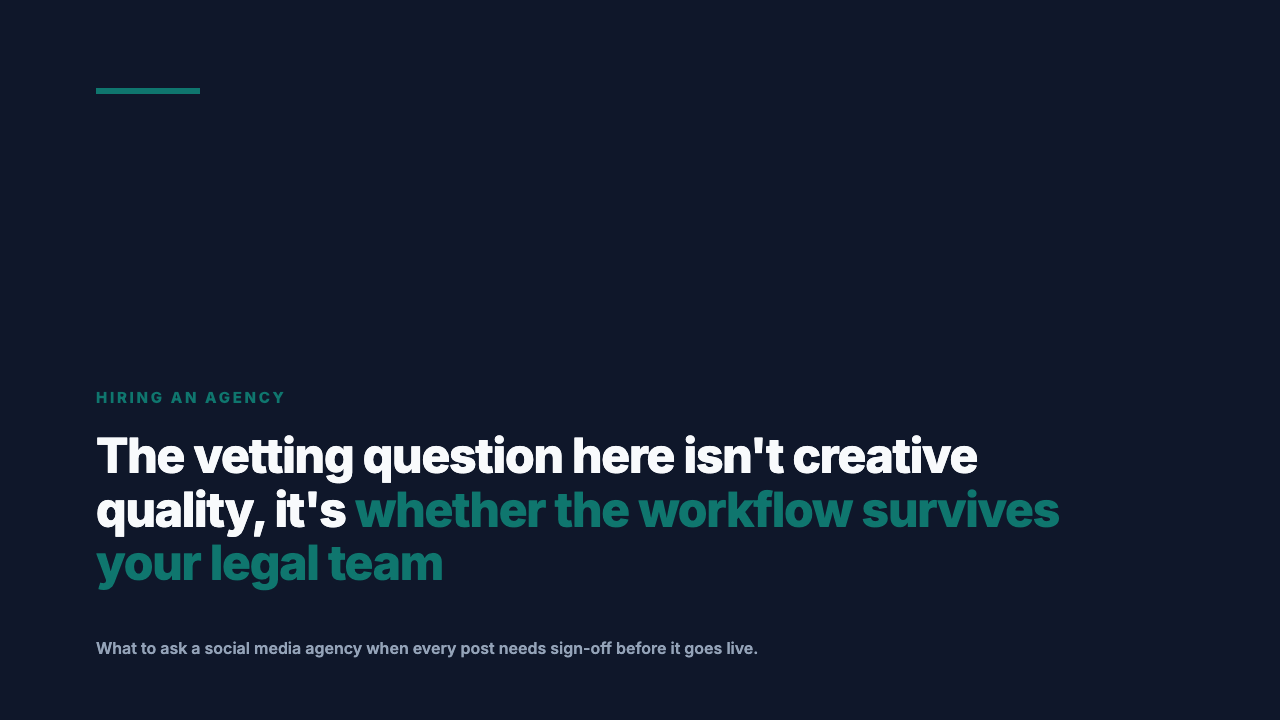
Every post you publish has to clear a named reviewer first. You sit through a deck of creative work, sign, then learn in week three that the agency assumes it can write on Tuesday and post on Wednesday. That mismatch was visible before you signed.
Why a normal agency workflow breaks in a regulated account
The default agency workflow approves at the calendar level: you sign off on a month of themes, and each post after that is production rather than a decision. Copy and creative get finished close to the publish date, and often the account manager is the only person reading the final version.
Your requirement is different in kind: a named reviewer signs off on the exact copy, the exact creative and the exact link before it publishes. Asking the agency to work faster is the wrong fix. The constraint is sequencing, not speed. Review cannot begin until the asset is frozen, so work has to be finished days ahead and held untouched while someone else reads it. Most agency workflows have no concept of a frozen asset.
What to ask before you shortlist anyone
Four questions, each with a wrong answer you can hear immediately.
- Describe a past client where every post needed a third-party sign-off, and what industry they were in. Listen for who the reviewer was and how long they took. An agency that has done this describes a person with a job. One that has not talks about being detail-oriented.
- How many business days before the publish date do you deliver finished assets for review? Ask for a number. “We’re flexible” is a non-answer. An agency that has run this workflow has a standard lead time because it had to build one.
- When a reviewer sends something back with changes, what happens to it? The good answer is a named person edits and resubmits the same day. The bad answer is a production queue behind everything in flight, which is how a two line change costs four days.
- Has a client’s compliance team ever rejected a finished post outright, and what happened next? Anyone who has worked this way has a story, and an agency that says it never happened has not.
The proposal test: does the calendar assume compliance exists
In a sample proposal, count the dates on each piece of content. An agency that has never worked under a review layer shows two, draft delivered and post published, often a day apart, with no reviewer step at all. A workable proposal shows four: draft delivery, review window, revision window, publish date. Watch too for same-day reactive posting sold as a core deliverable. That and a mandatory sign-off are close to mutually exclusive, and the conflict belongs in the first call, not week three.
Building the review window into the contract, not just the conversation
Verbal agreements hold until the first crunch. Put the number in the scope of work: the standard lead time in business days between asset delivery and the scheduled publish date. Then write down what happens when review runs long. Either the post slips, or a named person can publish without full sign-off, and that name and those conditions belong in writing. “We’ll figure it out as we go” is the sentence quoted back at you when something goes live unreviewed, so settle it alongside what to check in a social media agency contract. None of this is legal or compliance advice.
What good and bad look like in practice
Picture two agencies on the same regulated account, both competent. The first delivers a batch of finished posts eight business days ahead of the publish date. Compliance has a standing three day review window. Revisions go back into the same batch rather than a new thread, and nothing is scheduled until it carries a documented sign-off.
The second sends “this week’s content” the morning it is meant to post. Compliance is looped in by forwarded email with no defined turnaround, and the account manager’s answer to the delay is to ask if this one can just go out while sign-off catches up. That is not a failure of effort. It is a default process applied unchanged to an account it was never built for, which is why your approval process shapes the work more than your brief does.
Where this changes what you should be comparing agencies on
A strong portfolio from an agency with no experience inside a review layer is no evidence it can hire or train for a constraint it has never operated under. Weight the reference call and the process questions above the creative pitch, treating them as a specialized cut of the broader questions to ask a social media agency, and the answers that disqualify. Creative quality still matters. It is the second filter, applied only to the shortlist that passed the first.
Screening with this in mind
Browse vetted agencies and put the process questions straight into your outreach. If you run an agency that has operated inside a mandatory review step, you can list your agency free.
FAQ
Should I tell an agency about the compliance requirement before or after the first call?
Before, in the outreach message itself. Agencies that cannot staff for a mandatory review step self-select out, saving both sides a pitch that was never going to close.
Is a smaller or boutique agency automatically a worse fit for a reviewed workflow?
No. Size is not the variable, prior experience inside a mandatory review step is. A small agency that has run one beats a large one that has not, so decide it on the reference call and the process questions, not headcount.
What if no agency we talk to has direct experience in our exact regulated industry?
Cross-industry review experience counts, because the mechanism is the same wherever the reviewer sits: freeze the asset early, route it to a named reviewer, hold the publish date until sign-off exists. An agency that has done that for a hospital system, a bank or a law firm has the muscle you need.
Does this mean we should avoid agencies that talk about trend-jacking or real-time content?
No, but probe it. Ask how they would adapt that capability to a mandatory sign-off, since a same-day trend response and a review step are close to mutually exclusive. An agency that has not thought about that tension has not thought about your account.
Sources
- Client-side content approval workflow, fetched 2026-09-06.
- Social media agency contracts, fetched 2026-09-06.
- Questions to ask a social media agency, fetched 2026-09-06.