Should a Pre-Revenue Startup Hire a Social Media Agency?
You have funding, no marketing hire, and a growing feeling that you should be visible on social. An agency looks like the fastest way to make that feeling go away. Before you sign anything, ask whether you have a time problem or a readiness problem, because an agency only solves one of them.
The founder who has no time is not the same as the company that is ready
Picture a hypothetical founder of a small software startup. Six weeks ago the product was for freelancers. Last week she pitched mid-sized teams. She is busy and sensible, and she asks an agency to “handle social” while she ships. Nobody in that conversation can say who the posts are for, because she cannot say yet.
An agency executes against a stable positioning. If the brief changes monthly, the agency is not building anything, it is being paid to chase you. Outsourced hours fix a scheduling problem, not a missing customer, offer and voice. Note also that most pages on this subject are written by agencies that want the retainer, so weigh their yes accordingly.
What an early company actually ends up buying
The bad version: a monthly calendar of generic posts in a voice the agency invented because nobody gave it one, approved in batches by a founder who has no time to read closely, and measured on follower growth because nothing else was defined.
The good version of the same spend starts with a brief an agency can be held to. It names one customer in a sentence, states the offer as it will stand for the next quarter, lists what the company will and will not say, and defines a good outcome in terms other than followers.
The hidden cost is rework. Every pivot invalidates the strategy deck and the content bank, and the retainer keeps billing through the rebuild. Even a ready company needs someone on its own side who owns the relationship, and a founder with no time is rarely that person. Read about the role you need to fill before an agency can work.
A readiness test to run before you talk to any agency
- Can you name the one customer you are writing to, in a single sentence?
- Has your core offer stayed the same for a full quarter?
- Is there a named person who can approve work within one working day?
- Do you know what a good outcome from social looks like, in terms other than followers?
- Can you say how you want to sound, and what you refuse to say?
- Could you commit a fixed budget for the whole engagement without anxiety?
My rule of thumb, which is judgment and not a statistic: three or more “no” answers means wait. One or two means proceed, but only with a narrow, short scope.
While you wait, post imperfectly yourself, or have an early hire do it. The point is to learn which message lands before you pay anyone to scale it.
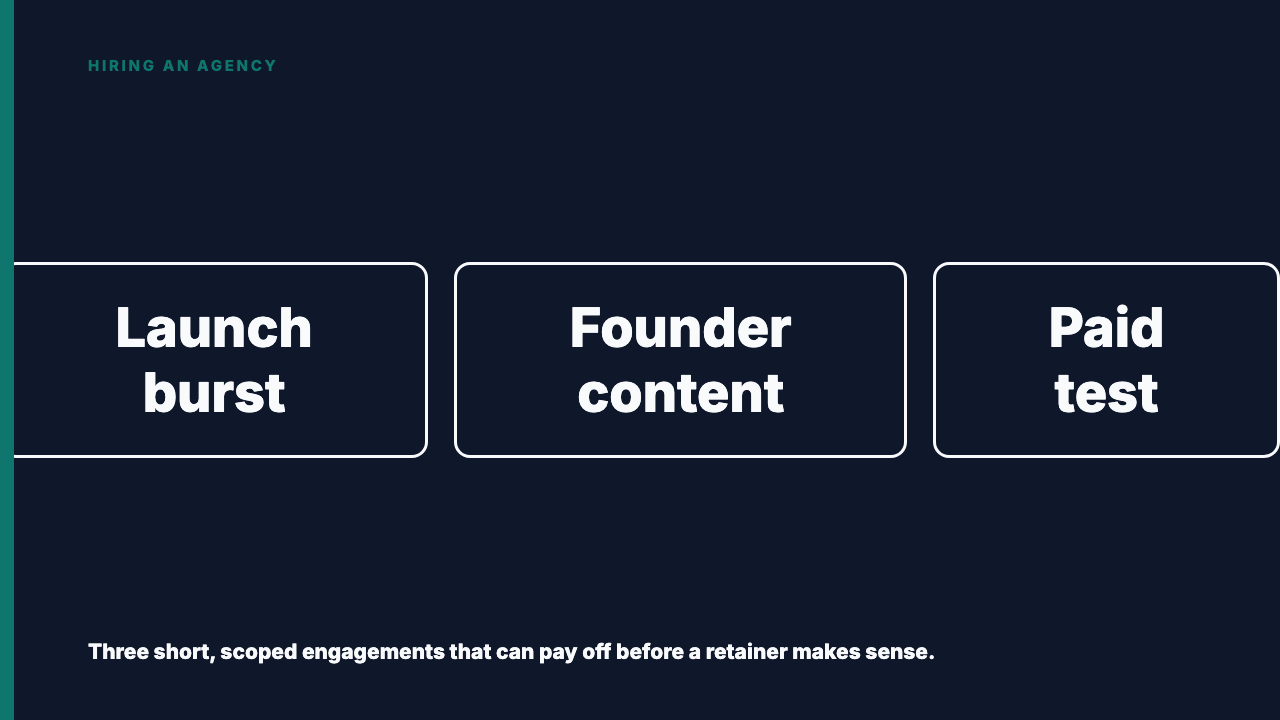
Three cases where a short agency engagement does make sense
The launch burst. A fixed-length push around a launch, with listed deliverables and an end date. A launch is bounded, so unsettled long-term positioning matters less. Refuse any auto-renewing term. If creators or sponsored posts are involved, the FTC’s influencer guidance says material connections must be disclosed. Done well: “We launch on the fourteenth, you run three weeks around it, and the contract ends the day after.”
Founder content. An agency or editor helps a founder turn their own ideas into posts, and the founder stays the source. Ask for interview-based drafting and founder approval of everything. Refuse ghostwriting a persona the founder does not hold. The deeper distinction is in a founder’s personal brand is a different agency hire. Done well: “I record a call each fortnight, your editor drafts from it, and nothing posts until I have read it.”
A paid test. A small, capped, time-boxed paid social experiment built around a written question. The founder owns the ad account and caps spend in writing. The deliverable is a learning, not a result. Done well: “We spend a fixed amount over two weeks to learn whether this audience responds to this offer, and you hand me the raw data at the end.”
How to scope it so it stays short
| Term | Scoped project | Retainer |
|---|---|---|
| Deliverables | Listed and fixed | Described as ongoing activity |
| End date | Written into the agreement | Open or a long initial term |
| Exit | Written, with clear terms | Implied or buried |
| Renewal | None, new agreement needed | May auto-renew |
| Agency contact | A named account owner | Whoever is free that month |
The natural first step is to buy a paid pilot before a twelve month retainer. For the contract mechanics, see why hiring an agency for one campaign is a different deal than hiring one for the year.
Do not skip one term even on a small job: you own the handles and the ad account, and you can export content and analytics at the end. That is my recommended practice, not a platform rule. The ad account ownership piece covers it.
What a good agency says when you tell them you are early
A good agency tells you to narrow the scope, shorten the term, or come back in a quarter, even though that costs them the retainer. A bad one lights up: instant enthusiasm, a twelve month proposal, and a deck that never asks what has changed in your product recently.
Provoke the honest answer. Ask, “Given where we are, what would you not do for us yet?” A good agency answers specifically. Then ask, “What would need to change before a longer term made sense?” If the reply is about your company rather than their pricing tier, you may have found someone worth a small job.
When the answer flips to yes
The line is crossed when positioning has held steady, a named person on your side owns the relationship, you have a defined goal that is not follower count, and you can commit a budget for a full quarter without anxiety. That is my judgment, not a formula. The next decision is in-house, agency or hybrid.
Next step
Browse vetted agencies once your brief is written, or if you run an agency yourself, list your agency free.
FAQ
Should a startup hire a social media agency before it has customers?
Usually not for an ongoing retainer, because there is no stable audience or message to execute against. Run the readiness test, and if you must buy something, choose one of the three narrow exceptions with a fixed end date.
What is the cheapest sensible way for an early startup to work with an agency?
A short, fixed-scope engagement with an end date, ideally a paid pilot, rather than a retainer.
Sources
- FTC, Disclosures 101 for Social Media Influencers, fetched 2026-10-05