How to Ask Your Agency for a New Account Manager
Your agency’s work is acceptable, but dealing with your account manager has become the worst part of your week. A short, specific email can fix it without ending the contract.
Most agency problems are one person problem
Here is an illustrative scenario, not a real client. A brand’s posts go out on schedule, but every question takes three days to answer, and when the brand flags a mistake, the reply opens with an explanation of why it was not really a mistake. The work is fine. The person between the brand and the work is the failure point. Buyers in this spot frame it as tolerate or terminate, so they sit on it.
The mismatch usually takes one of three forms. Slow is a message that sits for days and gets a reply answering half of it. Defensive is a reply that leads with justification before any acknowledgement. Too junior for the brief is a contact who has to “check with the team” on every strategic question. A swap request is a third option between tolerating and terminating, and it works best early.
Decide whether this is a swap problem first
Spend an afternoon running these tests against your own inbox.
- Does the same issue recur across different kinds of request? Slow across design, reporting and budget queries points at the person. Slow on one type points at the process.
- Does their seniority match the proposal? If the pitch promised a strategic lead and you deal with someone who relays messages, you have a documented gap. See how many people are actually working on your account.
- Have you given written feedback already?
- Are your own approvals the bottleneck? If drafts sit with you for a week, that is the cause.
If the last answer is yes, stop. A swap will reproduce the problem with a new face. Fix your briefing and approvals first.
Write down specific reasons before you ask
Vague dissatisfaction invites a defensive reply. Specific reasons invite a solution. Keep to two or three, dated, and tied to the agreed scope or cadence. Point to what you agreed on how often you should hear from your agency.
| Weak version | Strong version |
|---|---|
| We just don’t click. | Three of the last four briefs came back needing the same correction, and I raised it in writing each time. |
| They are always slow. | Response times have exceeded the cadence we agreed at kickoff in each of the last three weeks. |
Describe behaviours and outcomes, never character. The agency will relay your message, and the account manager will probably read it. A verdict on them as a person gives the agency a reason to defend them.
Who to ask, and how to word it
Send the request to the account manager’s own manager or the agency lead. Not to the account manager, and not in a group thread. Email first so there is a record, then follow with a call.
Here is a hypothetical script you can adapt:
We value your team’s work and want this relationship to last. The day-to-day working fit with our current contact is not right. Over the last month, response times have exceeded the cadence we agreed, and three of four briefs needed the same correction after we gave written feedback. We would like to ask for a different day-to-day contact, along with a written handover and a named senior person accountable for the account. Could we speak this week about timing?
It asks for a change of contact, not a change of agency. Avoid anything that sounds like an ultimatum, such as “if this does not improve”, or a performance review of an individual.
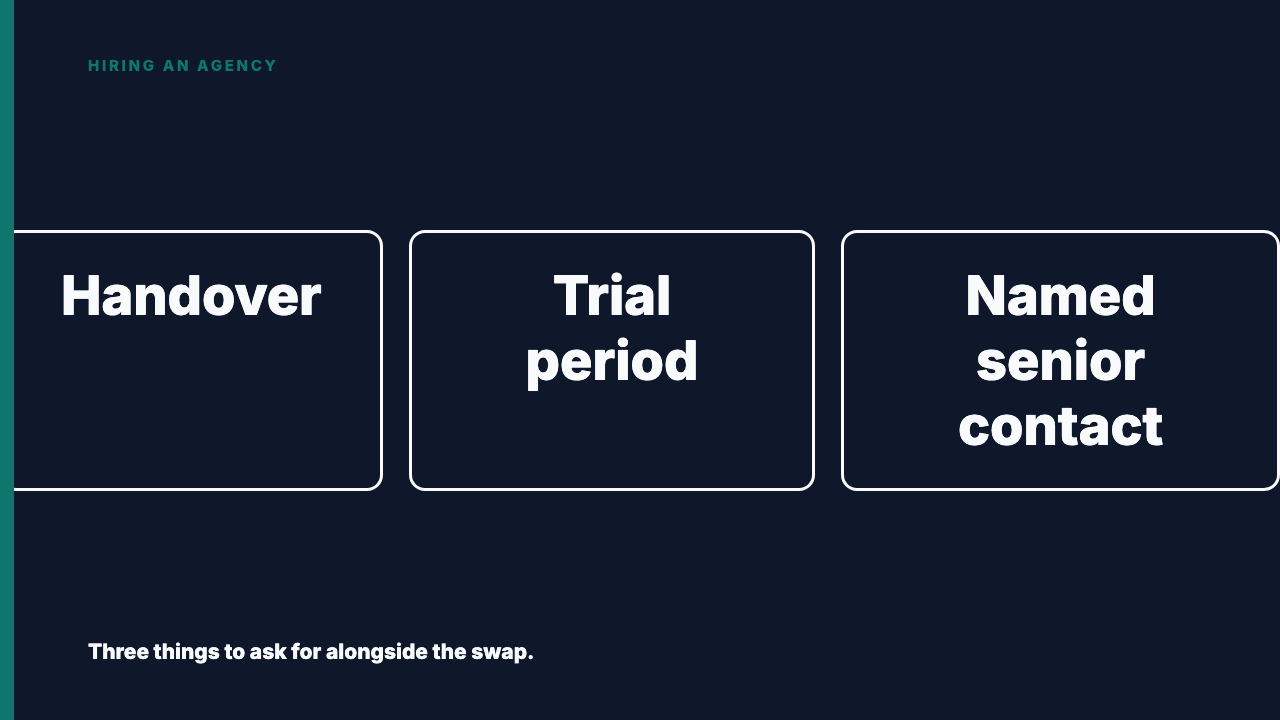
The three things to ask for in return
A swap alone often resets the relationship to zero. The new person knows nothing and you re-explain everything.
First, a handover: a written briefing from the outgoing contact covering brand voice decisions, approval history, open requests and known sensitivities, plus a short joint call. A thin handover is a forwarded inbox. A useful one is a page or two on what you reject, who signs off, and what is in flight. If the contact leaves on their own instead, that is a different situation, covered in what happens when your account manager quits.
Second, a trial period. Propose a defined window, for example six weeks, and name two or three things to review at the end, such as response times and recurring corrections. Six weeks is only an illustration, your proposal and not an industry norm.
Third, a named senior contact: one person above the new account manager who is accountable if things slip, named in writing. Buyers forget this one most often, and it is usually the easiest of the three for an agency to agree to.
What a good response and a bad response look like
- Good: it acknowledges your reasons without arguing, proposes a named replacement and a timeline, and offers the handover before you ask.
- Bad: it defends the individual, offers vague “more oversight” instead of a swap, goes quiet, or asks you to wait until after the next campaign.
If the agency refuses, escalate once to the agency lead, then treat the refusal as a signal. The next step is the cure period.
Ask early, and put it in the contract next time
Waiting until the relationship has soured turns a staffing request into a grievance. A swap in the first months reads as calibration.
For your next agreement, consider a clause or kickoff understanding that either side may request a change of day-to-day contact, and who the named senior contact is. Take that to a lawyer, and check your current scope of work or MSA for key-personnel or staffing language first, since contracts may restrict, permit or ignore changes. If you now realise you should have vetted differently, Browse vetted agencies, or if you run an agency, list your agency free.
FAQ
Can I request a different account manager without ending the contract?
In practice yes, since staffing is the agency’s to assign and many will accommodate a reasoned request. Your contract may or may not address it, so check your scope of work or MSA wording.
What if the agency says the account manager is the best they have?
Ask what the plan is to fix the specific behaviours, request the named senior contact as a minimum, and set a short review date. If nothing changes, that is information about the agency.