What to Vet Differently When Hiring an Influencer Marketing Agency
Your shortlist has two or three general social media agencies on it and one influencer specialist, and you are about to run all of them through the same evaluation. Creative samples, posting cadence, reporting dashboards. That tells you almost nothing about the specialist, because what an influencer agency sells is not on the list.
Why the generalist checklist does not transfer
A general social media agency controls its output end to end. It writes the caption, sources the asset, schedules the post, and answers for the result.
An influencer agency has no such chain. It brokers and manages a relationship with a third party who owns the account, owns the audience, and controls their own behaviour. The creator can miss a deadline, take a competing deal, or refuse a revision, none of which the agency controls.
So its real skill is vetting, negotiation, and risk management, not production. Creative samples measure the creator’s work, not the agency’s, so they test the wrong thing.
Network access: what to actually ask
Every influencer agency claims a network. The gap between standing relationships and a database subscription is the whole question. Ask: of the creators you would propose for this campaign, in my niche and my follower range, how many have you worked with before, and how many would be sourced fresh? An agency with real access answers without hesitating, and the first number is not zero.
The bad answer sounds like capability but is really tooling: the agency cannot name one relationship that predates a single campaign, and describes its database and filters instead. Price that agency as a management layer.
The good answer is unrehearsed, specific creator behaviour recalled without looking anything up. This one is reliable on deadlines but pushes back on scripted lines. That texture only comes from having paid these people before, which is really a question of whether your agency subcontracts the work.
The creator vetting process, not just the creator list
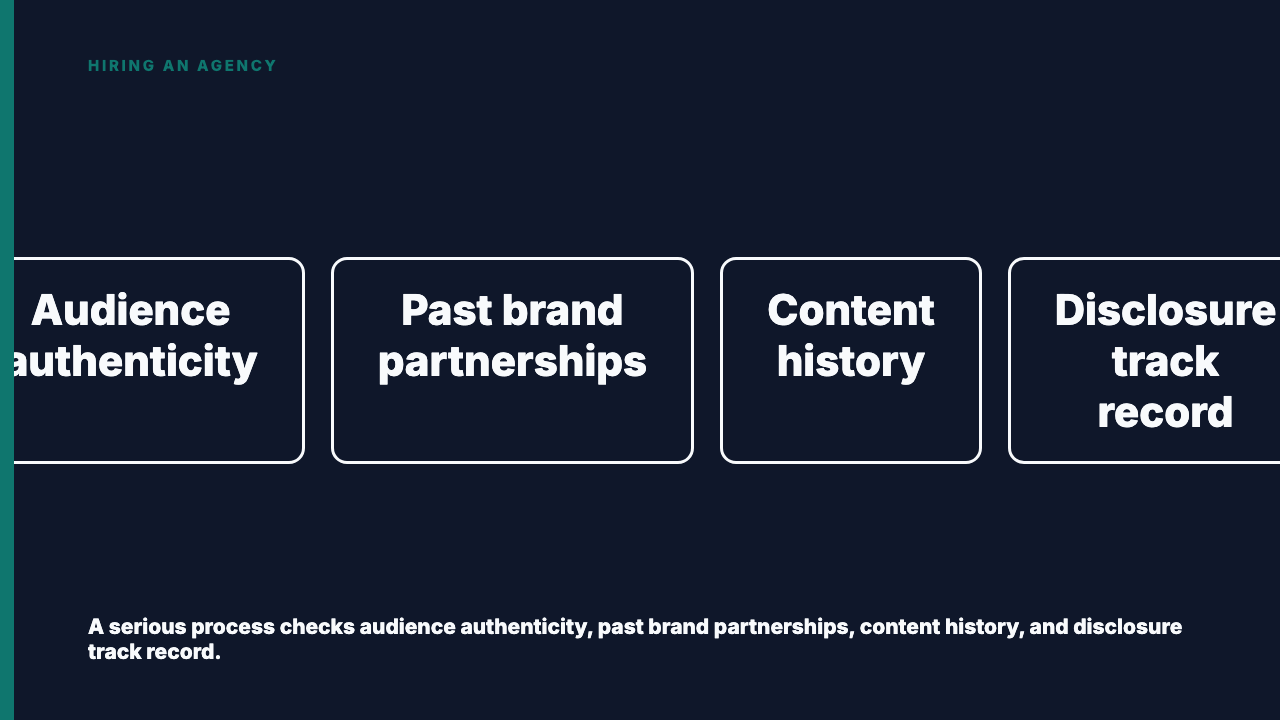
Ask the agency to walk you through, step by step, what it checks before a creator’s name reaches you. Not the rate card, the screening. A serious process covers:
- Audience authenticity. Standard practice looks for signs an audience is inflated or artificially engaged: follower growth arriving in blocks rather than steadily, comment patterns repeating across unrelated posts, audience geography that does not match your market.
- Past brand partnerships. Who has this creator worked with in the last twelve months, and does any of it conflict with you?
- Content history and brand safety. Someone has scrolled back through the archive, not just the recent grid.
- Disclosure track record. Do their past sponsored posts carry a clear disclosure, or read as organic enthusiasm with a discount code attached?
If the answer to “how do you vet” is follower count and average engagement rate, that is not vetting. Both numbers are visible to anyone with the app open and easy to manipulate.
Disclosure compliance is the agency’s job, not the creator’s
Many brands assume an undisclosed sponsored post is the creator’s problem. It is not. FTC staff guidance on the endorsement guides says advertisers need reasonable programs to train and monitor members of their network, and that enforcement focus usually falls on advertisers or their ad agencies and public relations firms rather than the individual endorser. An intermediary that hires and directs endorsers can be liable too.
So ask what the process is. Does the agency supply creators with disclosure language and placement guidance for each platform and format, or send one line in an email and hope? The FTC’s influencer guidance is concrete: a disclosure has to be hard to miss, and shorthand like “sp” or “spon” is not good enough.
Then the one that matters most. Do you review content before it posts, or after? Pre-publication review, where the agency sees the draft caption and the disclosure placement and can send it back, is the difference between a process and a hope. Watch for the agency that calls disclosure the creator’s own legal responsibility, points at a contract clause, and reviews nothing itself.
A short scenario: two agencies, two answers
Picture a regional skincare brand asking two hypothetical agencies the same three questions. Neither is a real company.
The generalist with an influencer service page describes a platform with millions of creators, filterable by niche and geography. On vetting, it checks engagement rate. On disclosure, it says the creator agreement requires compliance.
The specialist names four creators it has paid before in the beauty category and says which two it would recommend. On vetting it describes a sequence: authenticity screen, twelve month conflict audit, archive review, disclosure history. On disclosure, draft captions reach the account lead before anything goes live.
Where this fits if you are also comparing generalist agencies
None of this replaces ordinary agency vetting. Everything in the general criteria for choosing a social media agency still applies, along with the disqualifying questions to ask any social media agency and what to check in the contract itself. Fee structure, scope, account ownership, notice periods: the influencer criteria are additive, not a substitute.
Choose the specialist when creator work is a significant, ongoing part of the strategy rather than a one-off add-on. One seasonal activation with three creators is something a competent generalist can manage. A rolling programme with repeat creators and a monthly compliance surface is a different job.
Start from a shortlist that already exists
Our directory lists 14 agencies in the Influencer Marketing niche, so you can build a shortlist without a cold search. Browse vetted agencies to see who works in your category, and if you run one, you can list your agency free.
FAQ
Is an influencer marketing agency the same as an influencer marketplace platform?
No. A marketplace platform is a searchable database an agency or a brand can query, and querying it is not a skill worth outsourcing. An agency’s value is the layer on top: vetting, negotiation that sets a defensible rate, and relationships that existed before the campaign.
Whose responsibility is it if a sponsored post is not disclosed properly?
Practically, yours. The brand carries real exposure regardless of who published the content, and FTC staff guidance describes advertisers and the agencies they hire as the usual focus of enforcement. That is why the thing to vet is the agency’s own disclosure review process, not an individual creator’s history.
Sources
- FTC, The FTC’s Endorsement Guides: What People Are Asking. Fetched 2026-09-01.
- FTC, Disclosures 101 for Social Media Influencers. Fetched 2026-09-01.