Is Software Bundled Into Your Agency Retainer, or Billed Extra?
Two proposals sit in front of you at similar monthly totals, and neither mentions software. The agency will still use scheduling software to publish your posts, reporting software to build your deck, and maybe listening software to track mentions. Whether that licensing sits inside the number you are comparing, or arrives later as its own charge, is a question almost no proposal answers on its own.
Why this cost hides in the first place
Agencies handle their tool stack one of two ways. The first treats it as an operating cost absorbed into the retainer margin, the way payroll is. You never see it, and the agency has quietly priced it into your fee. The second carries it as a pass-through outside the retainer, billed on top of the fee or reimbursed after the agency pays. Both are legitimate. They produce different invoices.
The choice rarely reaches you because a proposal is organized around headcount, channels, and deliverables, not software. Licensing is an input to producing deliverables rather than a deliverable itself, so the decision gets made inside the agency’s operations and never surfaces in the sales document. The cost is real regardless. These tools are licensed as subscriptions, monthly or annual, priced by seat or workspace, and somebody renews them whether or not they appear on your invoice.
Where the gap actually shows up
Picture two hypothetical proposals at roughly the same retainer. You pick one and sign. Three months in, an invoice carries a new line labeled “platform fee”, with no explanation and no counterpart anywhere in the document you signed.
Now imagine you had signed the other. No new line ever appears. Instead the monthly reporting turns out to be a platform export with short commentary attached, when the pitch showed something richer. Nothing was added to your bill because the tool cost was absorbed by cutting scope instead of billing for it.
Two symptoms, then: a surprise invoice line, or a quietly reduced deliverable. The second is harder to catch, because there is nothing to point at.
Bundled versus itemized: what each one actually means
- Bundled. The cost is absorbed into the flat retainer. The agency holds the software account in its own name, pays the vendor, and you never see a separate charge.
- Itemized. The cost appears as its own line, charged to you directly or reimbursed to the agency after it pays. The account may run under the agency’s name or yours.
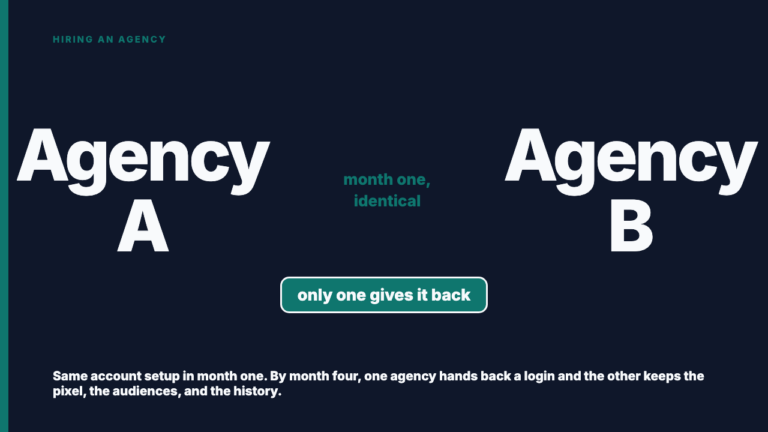
- Who keeps the history at exit. If the account is the agency’s, your reporting history and content archive sit in a workspace you have no login to, and access ends when the relationship does. If the license is in your name, you keep the history and the departing agency loses access.
- Who absorbs a vendor price rise. Bundled, a mid-term increase is the agency’s problem. Itemized, it reaches you.
The direct question to ask before signing
Put it to every agency in these words: “Is software licensing included in this retainer, or will it appear as a separate charge, and if separate, whose account does it run under?” It forces a specific answer instead of a reassuring one.
Then get the answer into the document. A verbal assurance is worth nothing, and not because salespeople lie. The person answering is rarely the person who issues invoices, and they are describing the arrangement they believe is standard, from memory. When a pass-through line shows up later, there is no record of what was said. So read the scope of work closely before you sign, and treat licensing as one more line alongside what else to check in the contract.
What to put in the scope of work
- Name the categories, not the vendors. Scheduling and publishing software, reporting and analytics software, social listening software. Categories keep the clause intact when the agency switches products, which it eventually will.
- State the billing treatment per category. Included in the retainer, or billed separately, and if separately at what cadence: monthly, annually in advance, or on renewal of the subscription.
- State who holds the license. Common practice is for an agency to service several clients from one workspace under its own administrative ownership, so if you want the license in your name you have to ask. Confirm it rather than assume it.
- State what happens to data at exit. What you receive if the contract ends or the agency changes tool stack: exported reporting history, the content calendar and scheduled queue, and by when. Monthly reports arriving is not the same as the full history being handed over at the end.
For a baseline of what a retainer covers, see the four budget bands a retainer usually falls into.
The mid-contract upgrade request is a renegotiation, not an expense
At some point an email may ask you to approve a plan upgrade for better reporting, or announce a new platform fee starting next cycle. Read it for what it usually is: the software cost that was under-quoted at signing, arriving late, dressed as an administrative approval rather than a price change.
Handle it as a change order against the signed scope, not a routine pass-through, and check what the document already says about licensing first. If the scope says the cost is included, the request asks you to pay twice, and the answer is no until the agency explains what changed. If the scope is silent, fix that now: the price of your approval is a written amendment covering every category, not only today’s upgrade.
Where to start
Still building a shortlist? The directory lists 80 vetted agencies. Browse vetted agencies, and put the licensing question in the same call as the questions with answers that disqualify an agency. Agencies can list your agency free.
FAQ
Is it normal for a social media agency to bill software costs separately?
Yes, and it is equally normal to bundle it. Itemizing is not overcharging, and bundling is not generosity. The problem is never itemization, it is not knowing which model you are buying until after you sign. Judge the disclosure, not the structure.
Do I need to know exactly which tools my agency uses?
Far less than you think. The product matters much less than whether its cost sits inside or outside your retainer, and whose account it runs under. Get those two answers in writing and the vendor name becomes an operational detail the agency is entitled to change.
Sources
- How to Read an Agency Scope of Work Before You Sign It, fetched 2026-09-07.