Your Agency Will Outlast the Person Who Hired It
The contract has ten months left, invoices are approved on time, and the one person who knows why the agency stopped proposing a certain kind of campaign is leaving. The judgment goes with them.
The risk that never makes it into the contract
When the agency loses the person running your account it reassigns the work, since several people there know the account. Expect a dip, which is what happens when the agency’s account manager quits. Lose your person and the account loses its only informed reader.
Most agreements name a client point of contact for notices and approvals while imposing no obligation on you to keep that role staffed. Check yours rather than assuming: notices, approval authority, renewal. What to check in the contract has the list.
The good version of the internal owner role takes one paragraph in the scope of work: a named primary and a named deputy, both on the approval workflow and the report distribution from day one. The bad version: one person approves everything, gets the only copy of the report, and knows alone why the last three ideas were rejected.
What actually walks out with them
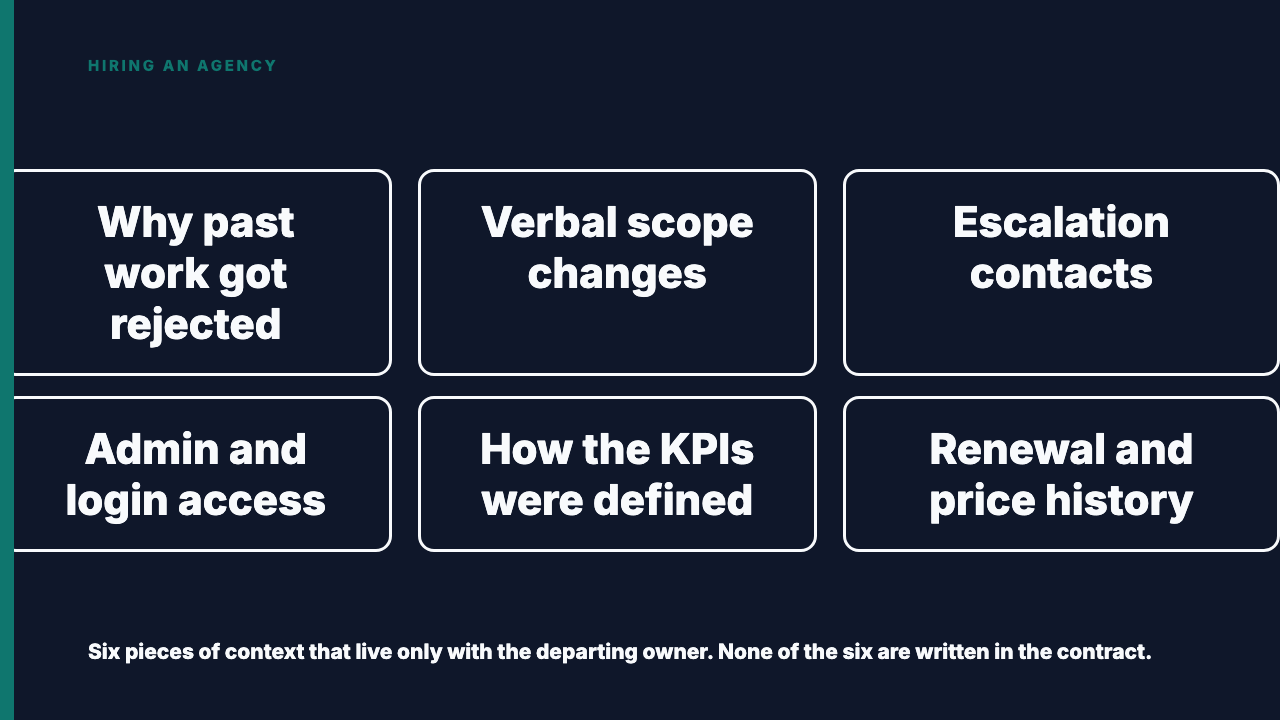
Six things live in one person’s head or personal mailbox. None are in the contract.
- Why past work got rejected. The reasons behind past no answers, the difference between an agency that learned your brand and one guessing.
- Verbal scope changes. What was agreed on calls and never written into a change order, both directions.
- Escalation contacts. Who must see a post before it runs, and who to wake at eleven at night.
- Admin and login access. Which platform, ad and analytics permissions sit under a personal account rather than a company one.
- How the KPIs were defined. Which metric definition both sides accepted at kickoff, and from what baseline.
- Renewal and price history. The original quote, what was discounted, what was traded for it, and when notice opens.
All six are recoverable while that person is employed, and expensive the week after.
The two weeks before the last day
Book one recorded session with the departing owner and the successor, agency not in the room, walking the six items in order. Write it up as a decision log, date, decision, reason, so the successor can answer the agency’s next question without guessing.
Run the access audit as its own task. For every platform, ad account and analytics property, confirm the permission came through a company owned account rather than a personal profile, then reassign it. In Google Analytics users are identified by email address and only an Administrator can add or remove them, and access comes in five distinct roles rather than one switch.
Mind the ordering trap. IT commonly disables a leaver’s accounts on the last day, so the transfer happens before that, not after. Correspondence sitting in a personal mailbox leaves the successor with the contract but not the conversation.
What to tell the agency, and when
The bad version: the agency finds out from a bounced email or an approval that never comes, then fills the silence with its own judgment and posts safer filler, or stops and invoices a retainer nobody reads.
The good version is a short written note before the departure naming the interim owner, the effective date, and who signs off meanwhile.
Look up the notice date first. A renewal falling inside the vacuum is the expensive coincidence here. And do not use the transition as cover for a renegotiation you have not thought through: a new owner with no history has no basis to argue price.
If they have already gone
Picture this. The marketing lead gives two weeks notice and leaves. The successor inherits an active retainer, a contract file, and nothing else.
Reconstruct in order: the executed agreement and scope of work, then the last three months of invoices read against that scope, then the published output, then the reporting decks last, because they frame the work in the agency’s words.
The gap runs both ways: work invoiced that the scope does not describe, and scope you pay for that produced nothing visible. Then tell the agency the internal owner has changed and ask it to restate scope, cadence and approval path in writing. Treat anything called agreed but untraceable to a document as suspect.
Making the role survivable next time
| What to document | Where it lives | Who keeps it current |
|---|---|---|
| Decision log: date, decision, reason | Shared team drive | The internal owner |
| Access register: each permission and its level | Same folder, reconciled quarterly | Internal owner with IT |
| Scope of work and change orders | Contract repository | Contract administrator |
| Metric definitions and agreed baseline | Scope appendix | The internal owner |
| Escalation contacts and out of hours path | Shared folder | Internal owner with IT |
| Renewal date, notice window, price history | Shared team calendar | Contract administrator |
The standing rule: no single person is the only one who can approve work, receive the report, or unlock an account.
If the handover turns into a search
If the audit shows the relationship was never worth its cost, browse vetted agencies and start from a documented scope. Agencies can list your agency free.
FAQ
Does the agency contract end if the person who signed it leaves?
No. The agreement is between the companies, not the individuals, and the signature does not travel with the employee. What changes is who can approve on your side. Read your own notice and termination clauses rather than assume a universal rule.
Should we tell the agency before or after our internal owner leaves?
Before, in writing, naming the interim owner and the effective date. The cost of silence is that unanswered approvals get filled by the agency’s own judgment.
What if all the platform access was under the departing employee’s personal login?
Treat it as urgent and fix it before IT disables the account. Move the assets under a company owned business account with roles assigned to people. See who owns your social accounts.
Should we pause the retainer until we hire a replacement?
Only if the approval path is genuinely dead, and only in writing. Otherwise appoint an interim owner with narrow authority to approve, pause and escalate. An unread retainer keeps invoicing.
Can we put a continuity obligation on ourselves in the contract?
Yes, and it is worth doing. Name a primary and a deputy in the scope of work with a stated substitution process. It constrains you and it protects you.
Sources
- Google Analytics: users and user groups, fetched 2026-09-08.
- Google Analytics: access management, fetched 2026-09-08.