How to Pause a Social Media Agency Without Firing It
The work has dried up for reasons that have nothing to do with the agency. Your season ended, the budget froze, or the marketing lead left. You want them back in four months, and the only exit in the contract is termination.
Why your contract doesn’t have an off ramp that isn’t termination
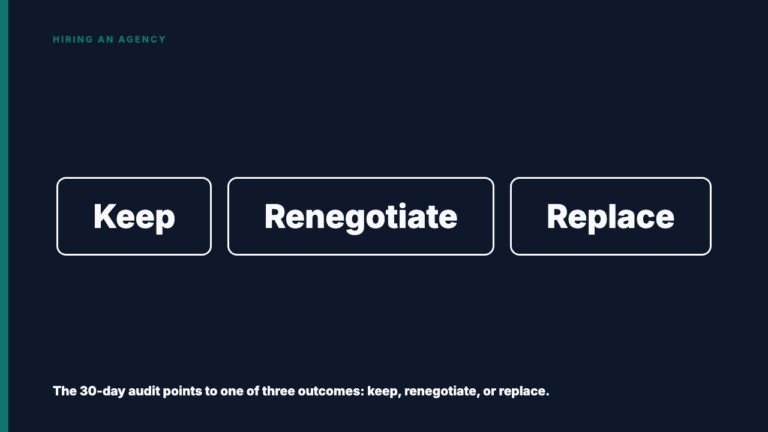
Nearly every retainer defines two states: in force, or terminated. Termination splits into for cause, after notice and a cure period, and for convenience, where either side gives notice and walks. The clause list in what to check in a social media agency contract has no hold provision.
That binary is structural. An agency prices your retainer against people already committed to your account, assuming continuous month to month work, so a pause leaves it paying salaried staff it can only occupy by giving your slot away. Termination releases that capacity cleanly. A hold, sometimes called a hibernation clause, is the third state you have to write yourself.
The situations that call for a pause, not an exit
The relationship is not the problem. The demand is.
- A seasonal drop-off. A tax practice, a ski resort, a garden centre. Terminating buys a fresh search and re-onboarding every year.
- A reorg or relaunch. Positioning is unsettled, so anything published now is wrong in six weeks. A replacement inherits no context.
- A marketing leadership gap. Nobody can approve work, so the retainer burns on chasing sign-off. End it and your next hire inherits a search.
- A budget freeze. The freeze has an end date. Termination does not.
What a hold clause actually needs to specify
You do not have to invent the anatomy. Federal procurement contracts have used a stop-work clause for decades: a written order halts work for a set period, after which the buyer must either cancel the order and resume, or convert it to termination. Steal that structure.
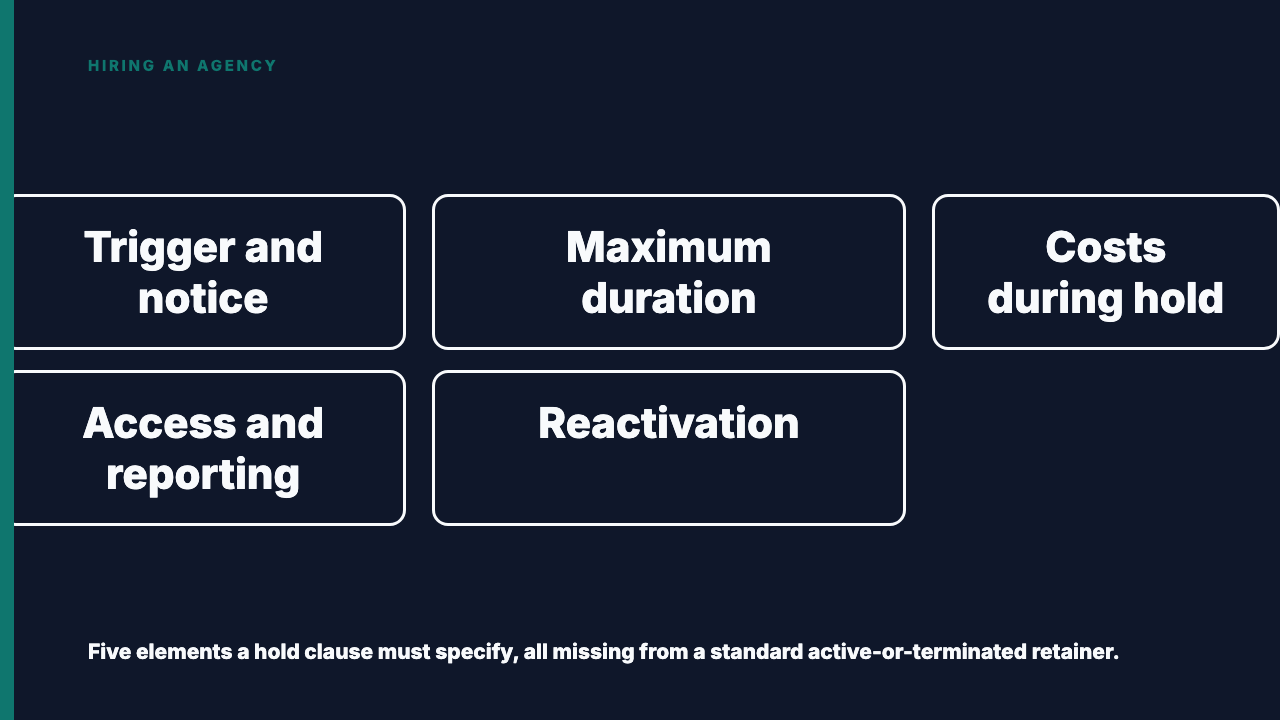
| Element | The vague version | The version that holds up |
|---|---|---|
| Trigger and notice | “Either party may request a pause.” | Who invokes it, in writing, to whom, with how many days of notice. |
| Maximum duration | “Until the client is ready.” | A cap in months, and what happens at it: termination for convenience, or auto-resume. |
| Costs during the hold | “Reduced fees apply.” | Pass-through licences, any slot fee, nothing else, keyed to how retainer, percentage of spend, and performance fees work. |
| Access and reporting | Silent. | View-only logins, who holds admin on the ad account, your right to export data mid-hold. |
| Reactivation | “Services resume by mutual agreement.” | The rate on return, pre-hold or renegotiated, notice required, whether the same team returns. |
What the agency will want in exchange
An open-ended hold asks the agency to keep capacity warm for a client who stopped paying, against a return date that does not exist. Nobody staffs that, so your team gets reassigned the week you invoke it. Three concessions are reasonable: a slot fee, some fraction of the retainer, buying continuity of the named team rather than any deliverable; a firm reactivation date rather than a window; and a commitment not to shop the account to a competitor mid-hold, the agency’s real fear.
When a pause is actually a slow-motion exit, not a hiatus
There is one tell. If no reactivation date was ever set, it is not a pause. It is a termination neither side wanted to say out loud.
That drift is expensive: an undefined pause leaves questions with money attached. Did the contract auto-renew, because the renewal clause kept running while the work didn’t? Are pass-through subscriptions still billing in the agency’s name? If you cannot name the month you want the agency back, invoke the termination process instead and recover your assets, because leaving an agency without losing the history has steps a drifting pause skips.
A hold clause, written out
Illustrative language written for this article, not a real agency’s template. Bracketed numbers are placeholders, not standards.
Hold. Client may place this agreement on hold once per contract year by written notice to the Account Director, effective [30] days after notice, for up to [4] consecutive months. During the hold no service fees accrue and no deliverables are due. Client remains responsible for third-party licences in Schedule B and pays a monthly slot fee of [15%] of the retainer, reserving the Schedule A team. Client may reactivate on [14] days notice at the pre-hold retainer with the Schedule A team. If Client has not reactivated by the end of month [4], this agreement terminates for convenience.
How to raise it without sounding like you’re already leaving
Two moments make a hold clause read as hygiene, not a warning: initial negotiation, when you are working through term and notice anyway, and renewal. Raise it in month seven and your account director logs a retention risk. Try this: “We have a quiet quarter coming. I’d rather plan for it in the contract than surprise you later.” Needing a hold less often is an argument for a paid pilot before a twelve month retainer.
Where to start
Put the hold clause next to the notice period before you need it. If you are still choosing, ask in the pitch. Browse vetted agencies, or list your agency free.
FAQ
Can I just ask my agency informally to pause without changing the contract?
For two weeks over a holiday, email usually works. Nothing informal defines invoicing, logins, or a return date, and that gets riskier the longer it runs.
Does pausing an agency retainer stop the invoices?
Only if the contract says so. Without a hold clause, most retainers treat the fee as owed whatever work you sent, because termination is the only off switch the document defines.
What is the difference between a pause and just restarting with a new project later?
A hold suspends the contract you already have, with the rate and account team held in place. Restarting later without one means a fresh scope of work and a fresh negotiation, closer to hiring from scratch.
How long can a hold clause reasonably last?
There is no industry figure worth quoting. Duration gets negotiated case by case against your reason for pausing and the agency’s tolerance for idle capacity. What matters is that the clause names an explicit cap, and what happens when it expires.
Sources
- FAR 52.242-15, Stop-Work Order. Fetched 7 September 2026.
- What to Check in a Social Media Agency Contract. Fetched 7 September 2026.
- How to Read an Agency Scope of Work Before You Sign It. Fetched 7 September 2026.