The Contract Line That Protects You If Your Agency Folds
You have already done the part most buyers skip. You checked how long the agency has been trading, you spoke to a client who left, you formed a view on whether the business will still be here in eighteen months. Now the draft contract is open and you want the line that protects you if that view is wrong. It is a boring paragraph about where your work is stored and who can reach it.
Vetting tells you the odds, not the outcome
Financial checks and reference calls change the shape of your risk. What they cannot do is convert a private company’s future solvency into a fact. You are making a probability judgment on information they chose to give you, and agencies with clean references still close. So the contract needs a mechanism that does not depend on the agency’s cooperation. Any protection that requires somebody there to answer an email or grant an export is worth nothing in the exact scenario you are worried about.
What the clause actually has to require
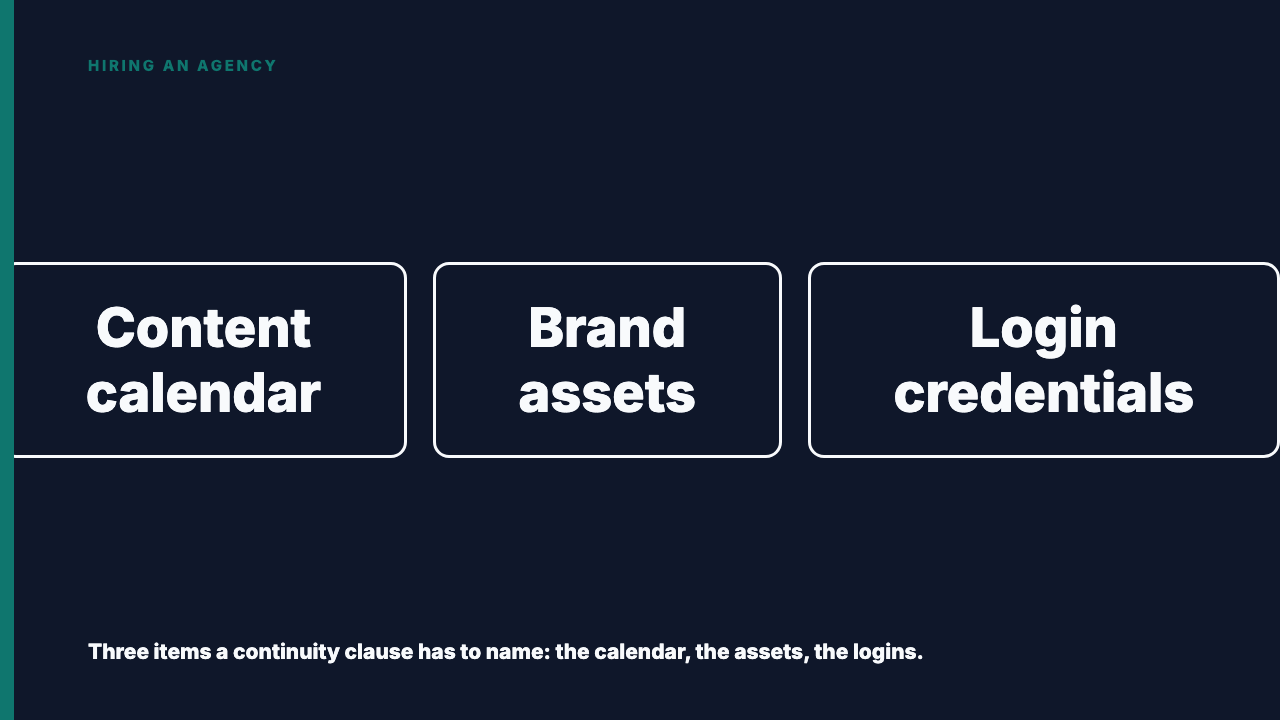
Continuity language becomes enforceable when it names things. Three items carry almost all of the value, and each has to specify a location, not just an intention.
- The content calendar and drafts. The working calendar, approved copy, and scheduled queue live in a workspace your company owns, or one where you hold a permanent administrator seat with export rights, not guest access to the agency’s project tool. If the only complete version of next month sits inside a subscription the agency pays for, it goes the day their card stops clearing.
- Brand assets. Raw files, editable templates, layered source documents, unedited photography and video, and any licences bought on your behalf, delivered into storage you control on a defined cadence. A JPEG of a carousel is not the carousel. The test is whether a new agency could pick the templates up on day one.
- Login credentials. Access held in a shared password vault your company owns or co-administers, with your side able to add and remove members. It matters most for what you cannot recover alone: business manager and ad account roles, third party tools, and the email addresses used to create them. This is the contractual edge of who owns your social accounts when an agency runs them.
Where these things actually live during a normal retainer
Picture a regional restaurant group signing a twelve month retainer. The client is invited into the agency’s project tool, added as a guest on its shared drive, and sent a link to a vault entry it created.
Nothing there is malicious. It is the fastest route to producing work, and everything landed in a container the agency owns because the agency set it up. Eight months in, nobody has asked where the copy of record lives, because from the inside it feels identical either way. The difference shows up on the morning the workspace stops loading.
A clause that works versus one that just sounds like it does
Most continuity language fails because it describes a sentiment. The decorative version reads like this:
The Agency shall maintain appropriate business continuity measures and shall act in good faith to ensure the Client suffers no disruption in the event of any material change to the Agency’s operations.
No named item, no destination, no date, no consequence. A working version is duller and commits to specifics:
Within ten business days of kickoff, and thereafter on the first business day of each quarter, the Agency shall deposit into Client-owned cloud storage nominated by the Client: all content calendars and approved drafts in editable format, all brand assets including layered source files and templates, and a current inventory of every platform and account used to deliver the services. Credentials for those accounts shall be held in a shared vault owned or co-administered by the Client, with at least one Client administrator holding full permissions at all times. Failure to complete a scheduled deposit is a material breach.
The parts doing the work are the named deliverables, the recurring date, and the consequence. Have your lawyer shape the wording for your jurisdiction, since this is what to ask for rather than legal advice, and read it alongside what else to check in a social media agency contract.
Test it before you sign, not after the agency goes dark
Signed language is a promise. Working access is a fact you can check first. Ask the agency to sit with you while you open the content calendar, the asset folder, and the credential vault from your own account, on your own device, with nobody sending you a link or reading you a password. If they can show that on day one, the clause describes something that already exists. If it requires someone to grant you access first, the clause is aspirational.
This clause is not the termination clause
Termination governs an exit you choose: notice period, fees owed, the final month of deliverables, the handover meeting. It assumes a counterparty still answering email, and it belongs with how to leave a social media agency without losing the history. Access continuity governs the case where the counterparty is simply gone, or reduced to one overwhelmed person not returning calls. The same logic applies at smaller scale when your agency account manager quits and takes the undocumented context along.
Before you sign the next one
Favour agencies that treat client-owned storage and shared vaults as ordinary practice rather than an unusual request. You can browse vetted agencies to start, and if you run an agency that already works this way, list your agency free.
FAQ
What is a continuity clause in a social media agency contract?
It requires the agency to keep your content calendar, brand assets, and account credentials somewhere you can reach without their cooperation. It makes sure that if they close or stop responding, you already hold what you need to keep publishing or brief a replacement, so a closure costs you a few disrupted weeks instead of everything.
What if the agency refuses to add one?
Adding it should not cost extra or delay signing, since it mostly changes where material is stored rather than creating new work, which makes a refusal informative. Ask what they object to, because an answer about deposit cadence or file format is negotiable. A flat refusal to let you hold your own assets and credentials is fair reason to look at the rest of your shortlist. Raise it before signing, while you have leverage.