What to Vet Differently for a Social Media Management Agency
You have decided the daily posting and comment replies should be someone else’s job. Not ad buying, not creator deals. Then you open a vetting checklist and most of it measures media efficiency and contract leverage, which is not this hire.
Why the usual vetting checklist doesn’t fit this hire
This post points the general framework for choosing a social media agency at one niche, as the posts on vetting a paid social agency and vetting an influencer marketing agency do. It is the largest: 44 of the 80 agencies in this directory are tagged for social media management.
Those siblings test what a management retainer does not contain: ad accounts, media spend, creator screening. The failure that follows is asking a management agency for ROAS or reach projections, when there is no spend to divide into and no attributable revenue to point at.
Response time is the first thing to test, not the first thing to ask about
Every agency calls itself responsive, so look for the document behind the word: a written commitment that separates business hours, evenings and weekends. Do not ask what the industry standard is. What counts as acceptable depends on what your customers post about, so set the number yourself and see whether they sign.
Better still, test it. Ask for two or three accounts they manage, with those clients’ permission, and watch the public comments for a few days. A question left unanswered from Friday to Monday tells you more than the agreement would. One answer disqualifies outright: nobody can say who is responsible for replies outside business hours.
What an escalation protocol has to specify
An escalation protocol is a decision tree written before onboarding. Ask for the document, not a description. Four things have to be on the page.
- The unilateral response boundary. Answered without asking: opening hours, published pricing, praise. Sent to you first: legal threats, safety claims, anything naming an employee or a journalist.
- A named escalation window. Not “as soon as possible.” A stated number of minutes to reach a named person on your side in business hours, and another outside them.
- Who may hide or delete, and who answers for it. Deleting a comment is a different act from replying to it, so name that authority separately, with accountability when the call is wrong.
- A named after hours path. A person, a number, and a definition of what qualifies, not a shared inbox watched in office hours.
Miss any of the four and what you were shown is a proposal paragraph, not a working document. Ask when it was last used.
Voice consistency comes from a process, not a personality
Agencies win these retainers by convincing you they get your brand, usually in a room with their best writer, who will not be the person doing your Tuesday captions in month seven.
So ask for the artifact: the written brand voice guide the account team works from daily. Not a mood board, not a line in the proposal. A real one is specific and boring: phrases the brand says and never says, how it handles a complaint versus a compliment. Then ask who reviews outgoing posts against it, how often, and what changes when someone new joins the account. If review is informal, it is not happening.
Drift is hard to catch because no single post looks wrong: a caption reads well on its own and would not be mistaken for the brand’s earlier work.
Community moderation practices to ask about directly
Speed is one axis. What the agency does with a comment once it has read it is another, and good answers come from written policy rather than reflex. Ask these four directly.
- Ask for the written policy on when a comment is deleted, hidden, answered publicly, or left alone.
- Ask how they separate a service issue, a complaint needing a real fix, from a public relations risk needing a careful public reply, and who makes that call.
- Ask how they handle spam and bots without over moderating real engagement.
- Ask whether moderation decisions are logged where you can review them later.
What this hire is not being judged on
Two things sit outside this brief: whether the content is creatively good, and what reported engagement or growth figures prove about skill. Both are separate from vetting an operating process, and neither is attempted here.
Two answers to the same escalation question
Picture two agencies answering the same hypothetical question: a customer posts a public comment on a Saturday claiming your product injured them.
The first says they handle it case by case and would be in touch straight away. Nothing there is false, and nothing is a commitment: whoever is looking decides, at a speed nobody promised.
The second calls it a mandatory escalation: nobody replies publicly, it reaches a named contact of yours within a stated weekend window on a named phone number, and nothing is hidden without approval. That is worth paying for, because it was decided by people who were not panicking.
The questions to bring to the call
Take these five into the sales meeting. The last one tests the other four.
- What is your response time commitment for business hours, and separately for evenings and weekends, in writing?
- Show me your escalation chain. Who can reply, hide or delete without my approval, and what must come to me first?
- Can I see the brand voice guide your account teams use, and who reviews outgoing work against it, how often?
- What is your moderation policy for spam, service complaints, and public relations risk, and where are those decisions logged?
- Is the person answering these questions the one who will run my account day to day? If not, read what happens when your agency account manager quits first.
Where to start
You can browse vetted agencies and take those five questions into every call. If you run an agency, you can list your agency free.
FAQ
Is a social media management agency the same thing as a paid social agency?
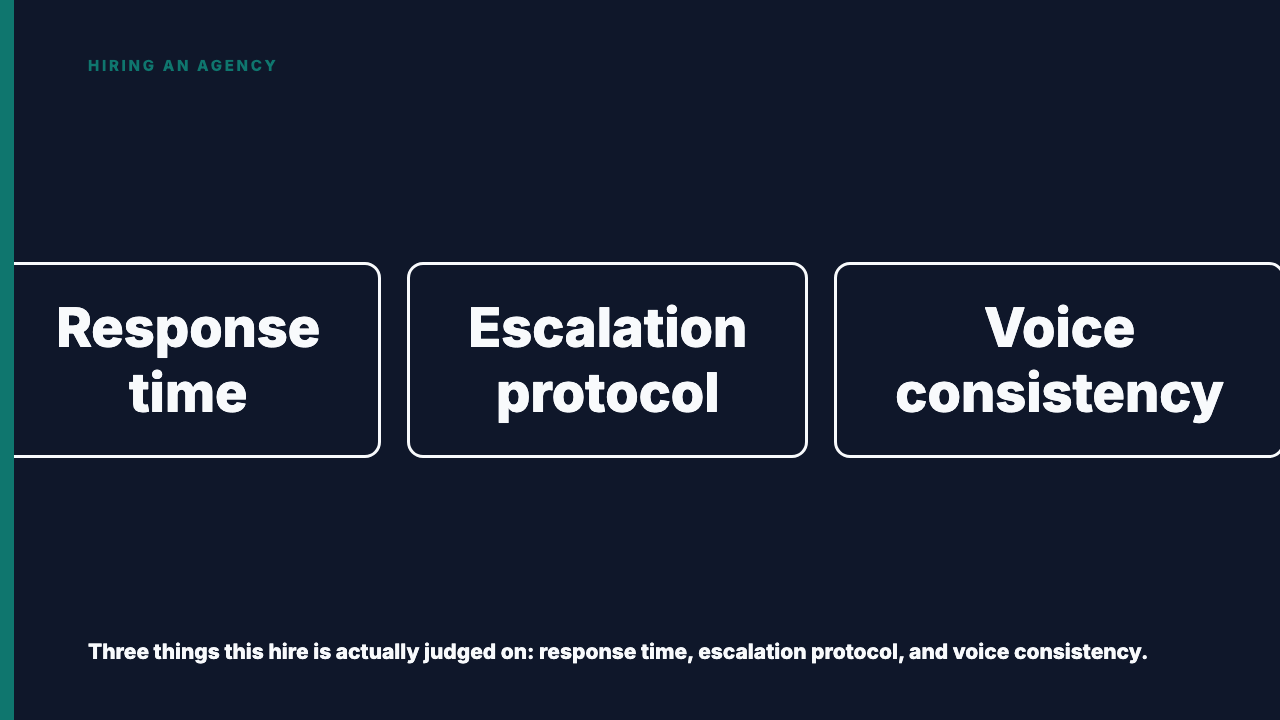
No. A paid social agency buys and manages ad spend and is judged on media efficiency. A management agency handles ongoing organic posting and community work, and is judged on responsiveness, escalation clarity and voice consistency.
What response time should I require from a social media management agency?
Set the requirement yourself rather than asking what is normal, because it depends on what your customers post about. Get it in writing, with business hours and weekend coverage stated separately, and treat a vague assurance as a disqualifier.
Sources
Both sibling vetting posts were fetched with curl on 6 September 2026 and read.
- Partner in Social, vetting a paid social agency, fetched 6 September 2026.
- Partner in Social, vetting an influencer marketing agency, fetched 6 September 2026.