Undisclosed AI Content? Fix It in the Scope of Work
You read a month of captions in one sitting and they all move the same way: short hook, three beat list, question at the end. You start to wonder whether a person wrote these. Then you check the scope of work, and it says nothing on the subject.
The moment this starts, and the moment it should stop
That gap is close to universal. A scope of work describes outputs: twelve feed posts a month, three story sets a week, two rounds of revisions. It almost never says how those things get made, by whom, or with what. The silence is fine when the only variable is whether a junior or a senior wrote the draft, and stops being fine when the variable is whether a person wrote it at all.
This is not a piece about whether AI assisted copy is worse than human copy. The question is narrower: were you told what you are paying for? A brand that knowingly buys AI drafted captions at an AI drafted price has no problem. A brand that thinks it is buying a copywriter’s hours and is not is buying something it never agreed to.
Why this is a buyer’s issue and not a craft issue
Whether AI assisted work is good creative belongs to people who review creative for a living. Two things matter on your side of the table.
The first is ownership and licensing. Ownership of human authored work under a normal agency agreement is well trodden ground. The treatment of machine generated output is considerably less settled, and copyright authorities are still working through the questions rather than closing them. The tool’s terms of service also govern what may be done with its output, so whether you can put an asset on packaging or run it as a paid ad can turn on a contract the agency accepted and you have never read. That sits next to the question of who owns your social accounts when an agency runs them.
The second is management. You cannot hold a voice consistent if you do not know which parts of the account are custom written and which are template generated. Feedback aimed at a writer who does not exist goes nowhere.
What “undisclosed” actually looks like in practice
Both scenarios below are hypothetical. Neither describes a real agency.
Picture a dental group, a gym chain and a coffee roaster who share an agency and compare feeds after meeting at an event. The subject matter is unrelated, but the captions share structural tics: the same opener rhythm, the same habit of closing on a question, the same bolded phrase in the middle. None of the three scopes of work said anything about process, so nothing obliged the agency to mention a shared one.
Or picture a furniture brand that agreed a photography direction in onboarding: natural light, real rooms, visible wear on the wood. Three months in, the grid fills with clean, evenly lit, slightly too perfect images no photographer took. The substitution was never flagged.
The three lines a scope of work is missing
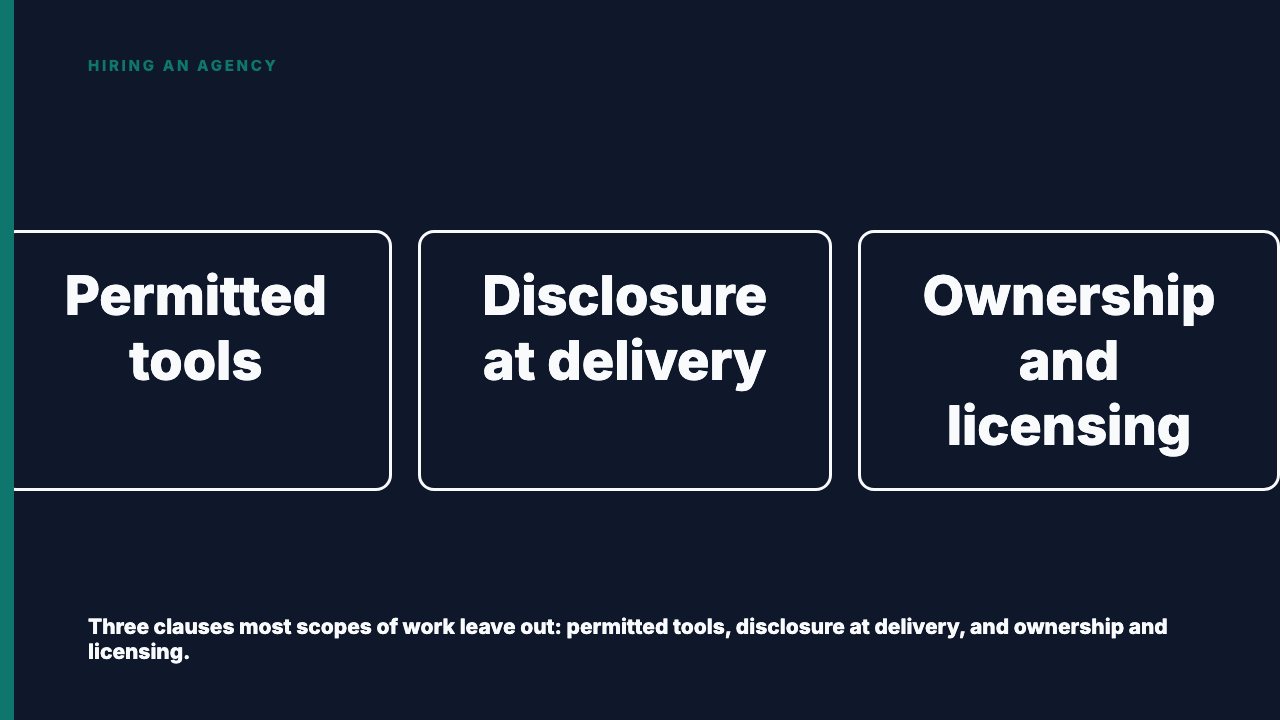
Not legal advice; your counsel shapes the wording. Three clauses.
- Permitted tools. The agency lists the generative tools it uses for drafting, imagery or editing, and you approve or exclude specific ones the way you would approve a subcontractor. The acceptable version is a list with names on it, updated in writing when a tool is added. The evasive version reads “the Agency may use industry standard productivity tools,” which names nothing and permits everything.
- Disclosure at delivery. Any deliverable where AI generation produced a substantial part of the copy or imagery is flagged at handover, in the delivery sheet or approval doc. The acceptable version says where the flag appears and who puts it there. The evasive version is “the Agency will disclose AI use upon request,” which makes you suspect something first.
- Ownership and licensing. The agreement states who owns the output and confirms the agency has checked that the tool’s licensing terms do not restrict your intended use. The acceptable version names the uses you care about: organic social, paid amplification, website, print. The evasive version assigns “all rights, title and interest” without acknowledging the third party tool upstream. Read it with what else to check in the contract.
How to raise this without accusing anyone of anything
Do not negotiate from suspicion. Raise it as a scope update that applies going forward: “We are tightening content policies across all vendors. The scope needs to list which AI tools, if any, you use for drafting or imagery, and to flag AI generated work at delivery. Can you send that list for the amendment?” That is a procurement sentence, not a challenge, and it claims nothing about the past.
Read the reply, because the reply is data. An agency that names its tools and says where in the workflow they sit is treating this like any other part of its process. An answer that never names a tool is worth noting, on the same logic as the answers that should disqualify an agency.
What to do if the agency won’t add it
Refusing to name tools, or to accept a disclosure clause that costs nothing when there is nothing to disclose, is reason to treat the relationship as higher risk. That is separate from whether you like the work. Most brands sign a scope of work they skimmed, so start with how to read a scope of work before you sign it.
Where to go from here
If you are shopping rather than renegotiating, you can browse vetted agencies and put the tools question in your first call. If you run an agency and this is already how you work, list your agency free.
FAQ
Is it reasonable to ask an agency to disclose AI use in deliverables?
Yes, and it lands best as an ordinary scope update, not a special demand. You already expect to be told when work goes to a freelancer or an offshore team, and the same logic already applies to subcontracting. An agency with a clean process loses nothing by putting it in writing.
Does using AI tools make content ownership more complicated?
Directionally, yes. Ownership and licensing of machine generated output is less settled than for human authored work, and the tool’s own terms of service add conditions on top of your agreement with the agency. Do not assume your contract’s assignment language behaves as it would for human authored deliverables. Ask the agency to confirm ownership and licensing in writing.
Sources
- U.S. Copyright Office, Copyright and Artificial Intelligence, which describes an inquiry opened in 2023 and a report still being issued in parts, with the part on copyrightability of generative AI outputs published in January 2025 and the part on generative AI training released only in pre publication form. Fetched 7 September 2026.