When One Quote Is Half the Others, Here Is What Usually Got Cut
You sent the same brief to three agencies. Two came back within a few thousand dollars of each other. The third came back at half. That is not a win. It is a discrepancy to explain.
A quote that is half the others is not a discount
Agencies pricing an identical brief are pricing hours, so the numbers cluster. When one sits far below the rest, the broken assumption is that all three proposals describe the same job.
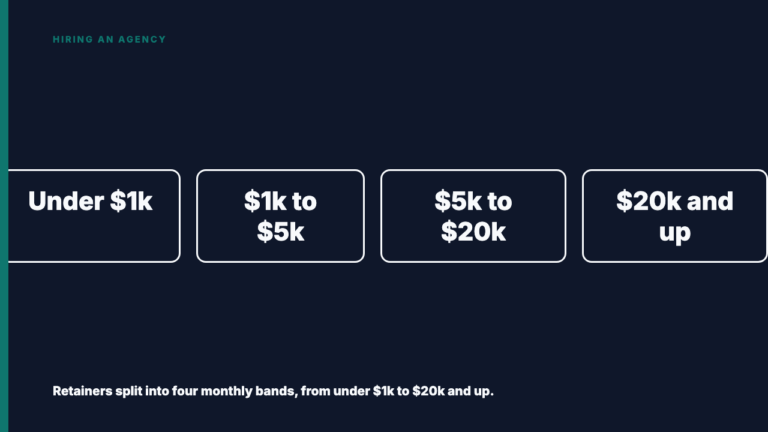
A discount is when the fee comes down against a fixed body of work, for a reason stated out loud. The work does not change. A smaller scope is when the number is lower because the work changed before you saw the document. Only one of those is a saving. So the question for a low outlier is not whether it is a good deal, it is what is different here. Knowing which of the four budget bands your brief belongs in is what tells you whether the low quote has left its band at all.
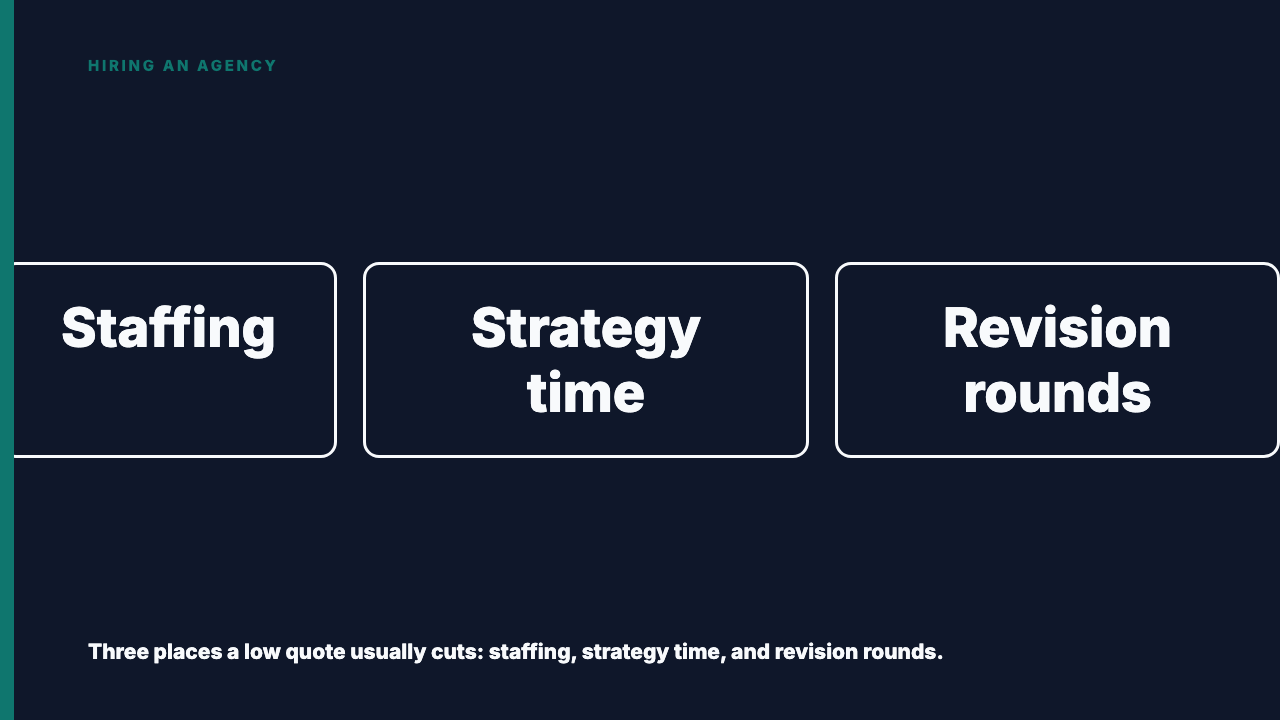
Cut point one: senior hours quietly become junior hours
Picture a regional home services company, hypothetically, comparing three retainers. In two of them, a strategist owns the account: they set the quarterly direction and notice in March that the lead story changed.
The third costs half. Its deck carries a senior name, and that person will attend the pitch. What the fee funds is a coordinator eleven months into their first marketing job, scheduling posts and answering comments. The scope says “strategic oversight,” and technically it is not lying.
What catches this is the staffing section, read for names rather than titles. “A senior strategist” is a category, filled by whoever is spare. A named person with an allocation beside them, hours per month or a percentage of the account, is a commitment. The same swap is covered from the seller’s side in the team that pitches you isn’t the team that runs your account.
Cut point two: strategy time disappears and execution takes its place
The second place the money comes out is the thinking. Planning, calendar strategy, audience and competitor research, and reporting analysis can all be dropped without touching the number buyers compare. Twelve posts a month stays twelve posts a month, and what changes is whether anyone decided what they should be.
A real strategy line names a deliverable and a date: a monthly content calendar delivered before the month starts, or a quarterly strategy review with a written output. A hollow one says “strategy and planning” and stops. Posts go out on schedule and nobody is paid to ask whether last month’s approach still works.
Cut point three: revision rounds get capped until the first draft has to be the final one
The cheapest hours to remove are the back and forth on content, invisible in a deliverable count. A revision policy worth the name states three things:
- How many rounds are included, per deliverable, as a number rather than an assurance.
- What counts as one round. One consolidated batch of notes from a named approver, not four stakeholders commenting separately over nine days.
- What happens at the cap. Further rounds at a stated rate, or the current version stands as final.
A quote with no revision language is not being flexible. The first version delivered is final unless you escalate, and escalation becomes a favor rather than an entitlement.
How to test which one it is before you sign
Three questions, one per cut point, asked on a call:
- “Who touches this account week to week, by name and seniority?” A real answer names two or three people and says what each does on a normal Tuesday. The dodge is about the team: “you get the whole agency behind you.” That describes the agency, not your account.
- “What is delivered to us before the first post goes live?” A real answer names an artifact: a research summary, a channel strategy, a first content calendar. The dodge is a process word. “We have a thorough onboarding” describes a period of time, and a period of time cannot miss a deadline.
- “How many revision rounds are included, and what happens after that?” A real answer is a number and a consequence, even if the number is small. The dodge is reassurance: “we’re pretty flexible on that.” Flexibility nobody wrote down is discretion, and it is not yours.
For the wider set, see the answers that disqualify an agency.
When a lower quote actually is a legitimate discount
Plenty of low quotes are honest, and treating every cheap proposal as bad faith costs you good partners. Hypothetically: an agency scoped two platforms while the others assumed four, and read your brief correctly. A fully remote team prices below an agency carrying an office lease. A newer agency underprices to build a portfolio, and says so.
The test is not the size of the gap. It is whether the agency explains it unprompted, tied to a named difference in scope, staffing or overhead. “We’re just more efficient” tells you nothing, and that silence is where the cut is.
Comparing quotes right now
Browse vetted agencies before you commit, and if you run an agency, you can list your agency free.
FAQ
Is a much cheaper agency quote always a red flag?
No. A lower price is honest when it maps to a named difference: fewer platforms, a leaner or remote team, or a newer agency pricing under market on purpose. The red flag is a low number the agency cannot account for in concrete terms when asked.
What is the easiest way to check if strategy time was cut from a quote?
Ask what is delivered before the first post goes live, by name. A written content calendar or a strategy document is a real answer. If the reply is vague, or the fee covers only posting and light community management, strategy time was not in the price.
How many revision rounds should be normal in a social media agency quote?
There is no industry norm to hold an agency to. What matters is that a number exists in writing, that the document defines one round, and that it says what happens at the cap. The site’s guide to how to read a scope of work line by line covers that clause.
Sources
- The Team That Pitches You Isn’t the Team That Runs Your Account, fetched 6 September 2026.
- How to Read an Agency Scope of Work Before You Sign It, fetched 6 September 2026.