Rebranding Mid-Contract? Treat It as a Scope Event
Your company is renaming and refreshing its look, and your agency is contracted to keep posting in the old one. Treat that as a note for the next status call and you will pay twice: once in quiet agency strain, and once in the argument about who owes what. A rebrand is a scope event.
The retainer you signed was priced for the brand you had
Picture a hypothetical home-services company. Leadership announces a rename and visual refresh in six weeks. The marketing owner has a retainer built around steady posting in the current look and voice. Nothing in that scope mentions a new name, new templates or a new tone.
A maintenance retainer prices recurring output in a fixed brand. A rebrand adds a second job on top: a migration that was never priced, scheduled or assigned. The bad version is familiar. The buyer mentions it in a status call, the agency absorbs the first two weeks quietly, and then the quality or the invoice shows the strain. To find what your current scope assumes, see how to read an agency scope of work.
Tell the agency early, and tell them the real dates
Share four things the moment they are real: the announcement date, the date the old brand stops being used, what is still undecided, and who on your side owns the rebrand. The bad version is a vague “we are refreshing things soon,” which leaves the agency scheduling content for a brand that will not exist. Provisional dates, labelled as provisional, beat reassurance.
Then deal with the pipeline. Scheduled and approved posts carrying the old name, handle or visuals each need a decision: hold, rework or publish. Make it before the freeze date, not on the morning of the switch.
Break the rebrand into the pieces that actually get billed
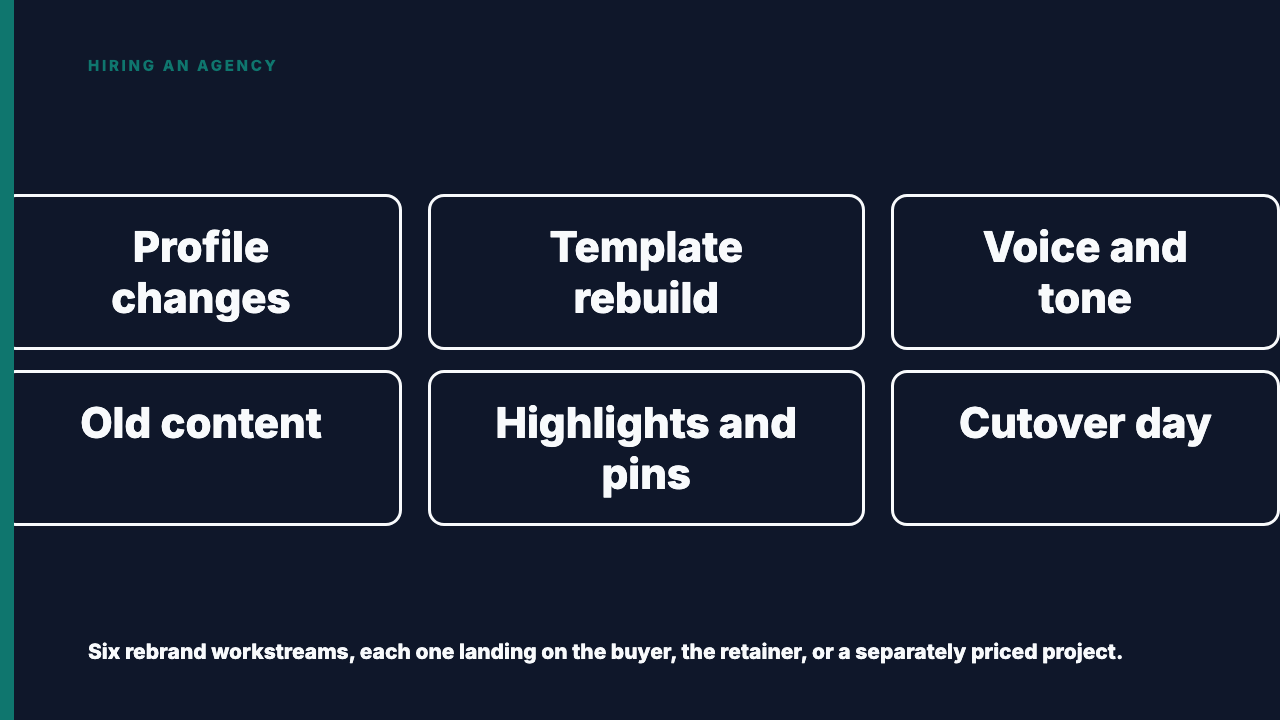
Arguing about “the rebrand” as one lump is how disputes start. Settle each workstream with one question.
| Workstream | Question that settles the owner |
|---|---|
| Profile changes: name, handle, bio, avatar, banner, links | Who holds the account role that permits the change? |
| Visual template rebuild | Does the scope list templates as a deliverable, or only use of existing ones? |
| Voice and tone rework | Is it a revision of the old voice or a new brief? |
| Archive decisions on old content | Who recommends, who approves, and is review time counted? |
| Highlights and pinned posts | Does the retainer maintain these today? |
| The cutover day itself | Who is online, who has access, and who can say stop? |
Each answer lands on one of three owners: the buyer, the agency inside the retainer, or the agency as a separately priced project. The cutover day is the highest-risk item. Name one person on each side, agree a checklist, and have the rollback conversation beforehand.
What the platforms will and will not let you change
Each platform sets its own rules for handles and display names, so build the plan after reading them. As one documented example, YouTube’s help page on custom URLs states that new custom URLs can no longer be set up and existing ones can no longer be changed, and that a handle URL is created when you choose or change your handle. Read the equivalent page for every platform you use.
A name change generally needs account-level access, which ties to who holds admin roles. Settle give your agency a role, not the keys before the rebrand. Whether a rename affects followers, reach or search visibility is a question for the agency. Treat its answer as opinion, not documentation.
Decide what happens to the old brand’s content
This gets skipped, then causes scope arguments months later. There are three options.
- Leave old posts. No agency time. Risks old and new identities side by side.
- Archive or remove selected posts. Review and execution time. Risks removing something still linked.
- Restyle selected posts. The most production time. Risks open-ended cleanup without a cap.
The buyer decides, the agency recommends, and the call is recorded in writing. Content tied to retired products, old pricing or a former name can confuse customers. The agency should flag it, not decide alone.
Amend the scope before the old guidelines are retired
This differs from the general process in what counts as a change order, because the trigger is predictable and the amendment can be drafted in advance. It should cover:
- Transition deliverables and deadlines.
- The transition fee, fixed or time-capped.
- What happens to regular retainer deliverables meanwhile.
- Who approves the new guidelines.
- The date the old guidelines stop governing.
The acceptable version is a short signed addendum with a fixed fee or a not-to-exceed cap, reviewed before the new guidelines are final. The unacceptable version is agreeing to “figure it out as we go.” Once the old guidelines are retired, the agency has no standard to be held to and you lose leverage on what counts as in scope. Check your own contract for how it treats out-of-scope work, and do not assume a norm.
If the agency is the wrong partner for the new brand
Watch the agency’s first response to the new voice or look. Thin, defensive or slow tells you how it handles change. Run a time-boxed transition as a test before renewing or ending. If the answer is to switch, read the overlap window when you switch agencies first.
A short script for the first conversation
- “We announce on this date, and the old brand stops being used on this date.”
- “Here is what is decided, what is not, and who owns the rebrand on our side.”
- “Please send a written transition estimate, split by workstream, as a fixed fee or a cap.”
- “Please hold any pipeline content past the cutover that carries the old brand.”
If the answers make you doubt the fit, Browse vetted agencies in the directory. If you run an agency, you can list your agency free.
FAQ
Is a rebrand covered by my existing social media retainer?
Usually not by default. Most retainers price recurring output in the current brand, so transition work is a separate line or an amendment. Check the scope for brand assets, voice and templates, and get the answer in writing.
Can the agency refuse the rebrand work?
It depends on the contract. If transition work is outside scope, the agency may decline or quote it separately. That is why the amendment matters.
Sources
- Custom URL overview, YouTube Help, fetched 2026-10-05