Hiring a Social Media Agency on a Nonprofit Grant Budget
A communications lead who has run a for-profit marketing budget usually gets three quotes, picks a favorite, and signs the familiar contract. Then the money turns out to be a grant, and a program officer later asks for documentation the agency never thought to produce. The scope was never wrong, only the paperwork underneath it.
Why the Funding Source Changes the Contract, Not Just the Price
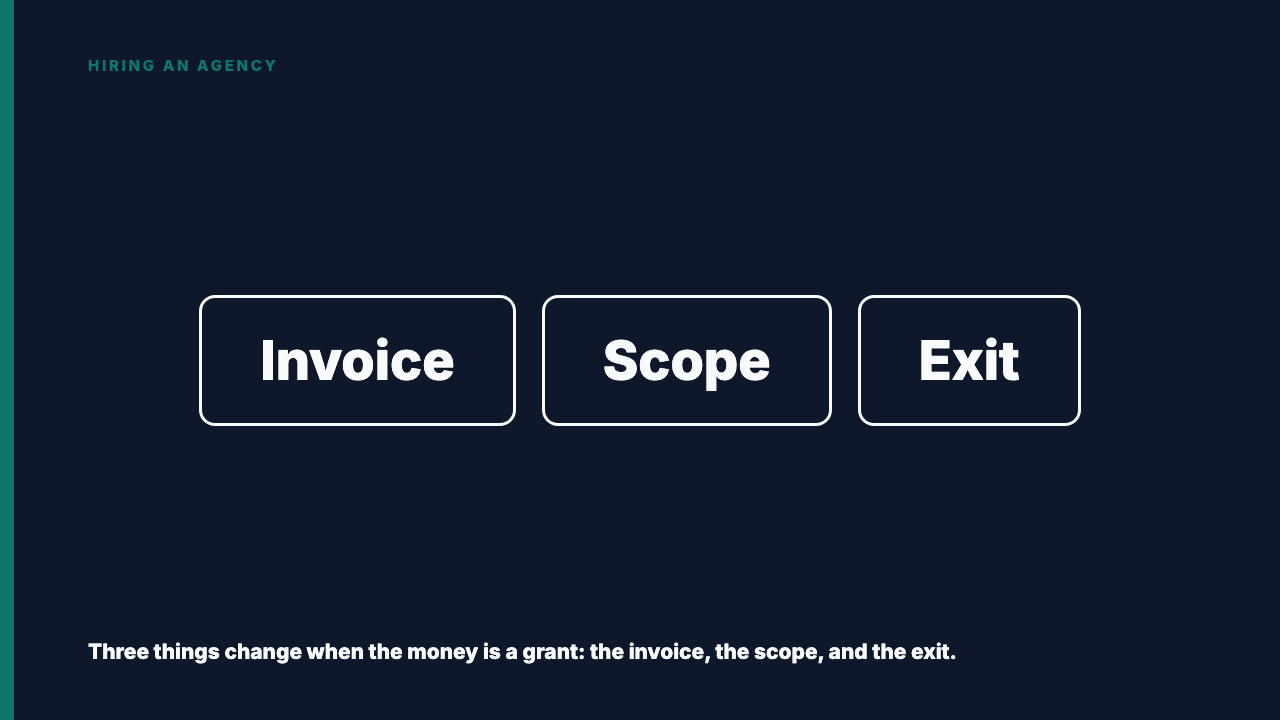
A grant-funded engagement and a commercially-funded one can buy the exact same content calendar and reporting cadence, and still need different paperwork behind it. Three things change: how the invoice reads, how the scope is written, and when the contract ends. The invoice must itemize what was delivered, since a program officer may need to match it against an approved budget line. The scope must tie back to what the grant proposal committed to, not just “ongoing social media management.” And the exit has to line up with when the grant money runs out, not the agency’s preferred cycle.
None of this replaces your own grant agreement. Restricted funds, matching requirements, and reporting conditions vary by funder, so check your award letter and ask your grant officer when in doubt.
Who Has to Sign Off Before You Talk to an Agency
- The program or communications lead proposes the spend, but finance confirms the grant line permits that spending category first.
- Many nonprofits require board or finance-committee approval above a dollar threshold set in their own bylaws. Look it up rather than guess.
- Some grant agreements require the funder’s own sign-off before subcontracting to a vendor. Ask your grant officer; do not assume either way.
- Start the approval clock before you shortlist agencies. A quarterly board meeting can outlast an agency’s willingness to hold a proposal open.
Nonprofits generally file an annual information return with the IRS, commonly Form 990, one reason board oversight of vendor spend is a standing structure, not a courtesy.
Deliverable-Based Scope Beats an Open-Ended Retainer
The bad version reads: “Social media management, $3,000/month.” Accurate, but it gives a program officer nothing to check against the approved budget. Ask what that $3,000 bought in March, and nobody wrote it down.
The acceptable version names outputs tied to the grant proposal: a monthly content calendar, a stated number of platform posts, one quarterly report mapped to a program objective. Same fee, but the invoice now describes what was produced, and each deliverable carries a defined value, easier to point to than a lump fee for match or in-kind requirements. For fee vocabulary, see retainer, percentage of spend, or performance fee, and for the mechanics, how to read a scope of work before you sign it.
What an Invoice a Funder Can Actually Audit Looks Like
- The billing period, stated in plain dates.
- Each deliverable completed in that period, named individually rather than bundled.
- The hours or unit cost behind each deliverable.
- A reference to the grant or program name, if you track costs by fund.
A lump-sum “retainer fee” invoice is not wrong for a commercial client, but for a grant-funded one it means reconstructing what was delivered later, for a funder’s report. Ask for the itemized format in writing before you sign.
Build the Exit Clause Around the Grant Cycle, Not the Agency’s Calendar
An agency’s standard contract term serves its own cash flow planning, not your funding cycle. A twelve-month retainer with a ninety-day auto-renewal suits a budget that renews yearly. Yours may not, and if the grant is not renewed you need to exit on short notice, without a kill fee sized for a guaranteed year of revenue. Tie the contract term, or at minimum the notice window, to the known end date of your grant period. See how to fire an agency without a surprise kill fee, or propose to buy a paid pilot before a twelve month retainer instead.
The ‘Nonprofit Rate’ Question, Asked the Right Way
Ask directly: “Do you have reduced pricing or a nonprofit rate, and if so, what is cut from the standard scope to get there?” That is a fair question. Assuming every agency discounts for nonprofits is not, and it can sour a negotiation before it starts. A lower quote for a nonprofit client behaves like a lower quote for anyone: something usually got cut, fewer platforms, fewer revisions, a junior staffer in place of a senior one.
Procurement Rules That Catch Nonprofit Buyers Off Guard
| Funding source | What to check |
|---|---|
| Federal funds or subawards | Commonly carry procurement standards: competitive quotes above a dollar threshold, documented vendor selection. [EVIDENCE NEEDED: the current threshold in your award’s procurement standards] Confirm this with your grants administrator. |
| Private foundation grants | Typically no formal bidding mandate, but many foundations still expect a documented comparison, which a simple request for proposals accomplishes. |
| Your own organization | A flag to check against your award terms, not a legal requirement. Ask first when unsure. |
Signs an Agency Is Not Built for a Grant-Funded Client
- It cannot itemize an invoice on request, or pushes back when asked: funder-facing reporting was never part of how it operates.
- It insists on a standard twelve-month term with no early-exit option: a sign it has not worked with grant-cycle clients.
- It cannot describe results in plain language tied to your objectives, only a raw analytics export. That gap becomes your job.
Get the Paperwork Right Before You Get the Proposal
None of this changes what a good agency does day to day, only what you ask for in writing. Browse vetted agencies to build a shortlist, or list your agency free if yours should be easier to find.
FAQ
Do social media agencies give nonprofit discounts?
Some do and some do not, so ask directly, and if a lower rate is quoted, ask what was cut from the standard scope to get there.
Can grant money pay for an agency retainer instead of one-off deliverables?
That depends entirely on your grant agreement’s restrictions on the funding. Confirm with your grant officer first.
What happens to the agency contract if the grant is not renewed?
This is exactly why the exit clause should be tied to the grant cycle, not the calendar. Negotiate a short termination notice window up front, rather than discovering the standard twelve-month term at renewal time.
Does a nonprofit need to run a formal RFP to hire a social media agency?
It depends on the funding source. Federal funds in particular can impose a competitive procurement requirement, so check your award terms or ask your grants administrator first.
Sources
- IRS, About Form 990, fetched 2026-09-28.