Does Your Social Media Agency Need to Be in Your City?
You’ve narrowed a shortlist of social media agencies and someone has told you to keep it to agencies based in your own city. Before you drop every agency outside a fifty mile radius, ask what that filter actually protects you from, because in most cases it isn’t protecting you from anything a location filter can fix.
Why “local” is the default filter
The instinct usually comes from one of three places: accountability, since you want to walk into an office if something goes wrong, trust, since you assume an agency in your market understands your customers better than an outsider, and social proof, since a local referral feels more vetted than a name from a directory.
None of these require an office lease. Accountability comes from contract terms, not distance. Trust in market understanding comes from what the agency knows, testable regardless of address. A trustworthy referral depends on who is vouching, not the zip code. Strip out the geography and what’s left is a requirement you can test. What’s left over is habit.
The three things “local” is really standing in for
- Time zone overlap. Enough business hours overlap for approvals and live issues. Satisfied by hours that overlap yours, wherever the agency sits.
- Market knowledge. A team that understands your city, region, or customers well enough to make good decisions. Satisfied by demonstrated expertise, not a mailing address.
- In-person production. A person physically present for a shoot or event. Satisfied by anyone who can show up that day, staff or freelance.
A same-city office satisfies all three by accident. An agency can satisfy each on its own merits without sharing your zip code, a sharper test than requiring the office.
What a local office actually buys you, and what it doesn’t
Picture two agencies bidding on the same account, proposing identical deliverables and the same approval turnaround. One is four blocks from your office. The other is nine time zones away but structures its hours so someone is online during your morning.
What does the local one offer that the remote one doesn’t? Functionally, one thing: the option of an unscheduled walk-in visit. That has real value to some buyers, and if it matters, name it honestly as a preference. But most retainer relationships run for years without a single drop-in, because the work happens over calls and shared documents.
When time zone overlap is the real requirement
Consider two brands. The first is mid-launch week, needs same-day sign-off on creative, and expects a live person to escalate to when something goes wrong. The second reviews a content calendar once a week, on a set day, with no same-day turnaround expected.
The first genuinely needs several hours of overlapping business hours, or approvals wait a day and escalations sit unanswered. The second needs none at all. Before deciding time zone matters, write down your actual approval and escalation cadence in hours, and test candidates against that number on the discovery call.
When market knowledge is the real requirement, and when it isn’t
An agency headquartered in your city is not automatically fluent in your neighborhood or the local press contacts who might cover your launch. A big downtown agency can staff your account with someone who has never set foot in your segment. The office address tells you where the lease is, not what the team knows.
The reverse is true too: an agency tagged Remote or Global can build genuine expertise in a metro or vertical without an office there. If hyperlocal knowledge is genuinely required, put it in the written scope of work as a qualification question, backed by past work or a named team member with local ties, not as a location filter. Coordinating one agency across several countries is a separate question, covered in running one agency across several countries.
When you actually need a body in a room
- On-location shoots. Someone needs a camera at the location. Remote agencies commonly hire local freelance crew for that day.
- Staffing a booth or activation. Someone represents the brand in person, usually via local staffing or production partners.
- Executive media training. A trainer needs to be in the room, and specialist trainers routinely travel for this.
- Store walkthroughs. Someone needs to be inside the space, a production day problem solved with local crew.
Ask any agency, local or remote, how they staff production days. A local team showing up in person is the exception, not the norm, even headquartered in your city.
What a local-only filter costs you
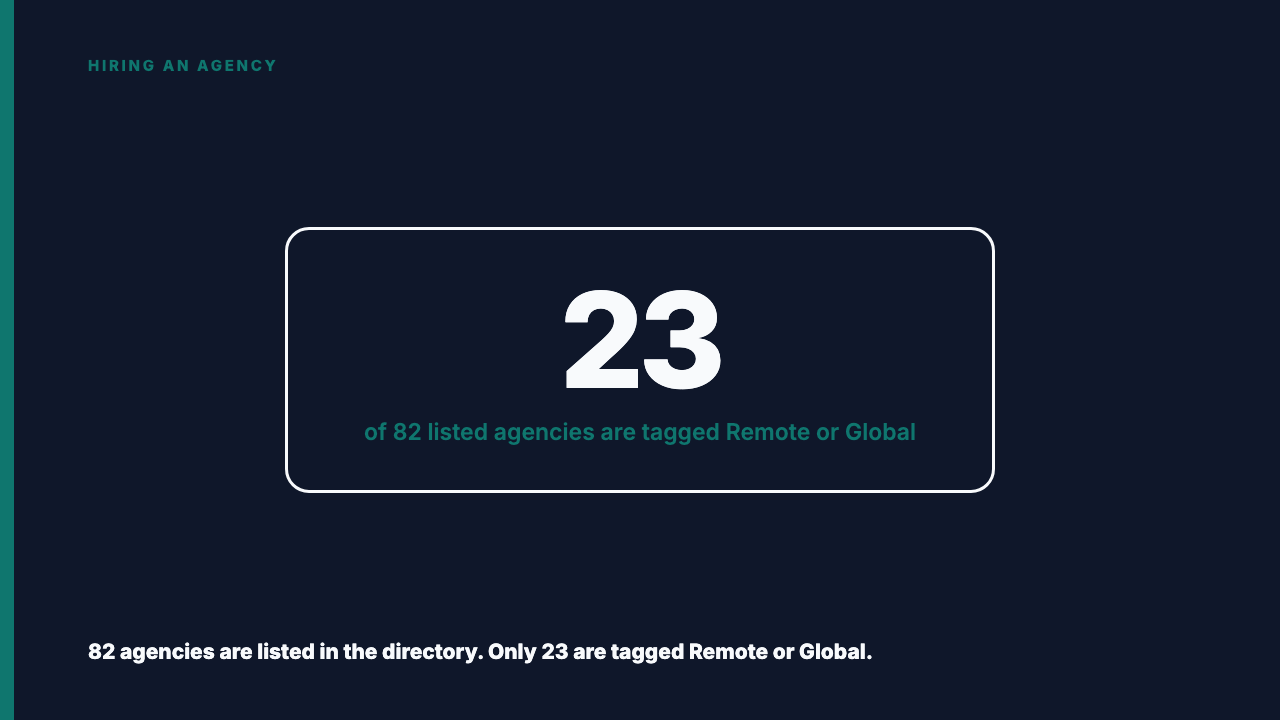
The directory lists 82 published agencies. Of those, 23 are tagged Remote or Global. Even the largest single-city concentration, London, accounts for only 12. New York, the largest United States city listed, has 4.
Filtering to your own city before evaluating anything else leaves you working from a small slice of the field. That pays off only if you’ve confirmed you need real overlap, real market knowledge, or a recurring production need, the same logic behind why agency size should be its own selection criteria rather than a habitual proxy filter.
Rewriting “must be local” into an actual requirement
- Write down the minimum hours of business-day overlap you need, and test it on the discovery call.
- Write down how often an in-person meeting is genuinely required, monthly, quarterly, only at kickoff, or never, and put that cadence into the scope of work.
- Name any recurring physical production need, and ask every candidate, local or remote, how they would staff it.
- Only filter by city if none of the above resolves without one.
That gives you a shortlist built on what your brand needs, not a proxy for it. See the broader agency selection checklist for the rest of the criteria, and how often you should actually hear from your agency once you’ve settled on overlap. Browse vetted agencies filtered by what matters, or if you run one, list your agency free.
FAQ
Is it ever fine to require a local agency with no other reason?
Yes, that can be a legitimate personal preference. Name it as a preference rather than dress it up as a requirement, since that changes how honestly you can compare it against a stronger remote fit.
How much time zone overlap is actually enough?
There’s no fixed number for every brand, and any hour count presented as a standard is editorial guidance, not an established norm. Work out your own approval and escalation cadence, state it in hours, and use that on the discovery call.
Sources
- partnerinsocial.com/blog/how-to-choose-social-media-agency/, fetched 2026-09-27
- partnerinsocial.com/blog/social-media-agency-communication-cadence/, fetched 2026-09-27
- partnerinsocial.com/blog/matching-agency-size-to-business-size/, fetched 2026-09-27
- partnerinsocial.com/blog/multi-market-international-social-agency/, fetched 2026-09-27