Run a Post-Mortem on Your Last Agency Before You Hire Again
You just ended a social media agency contract, and if you’re honest, all you can say about why is that it “wasn’t working” or the fit was “off.” That feeling is real, but it isn’t a diagnosis, and it won’t stop you from making the same hire again.
A vague feeling that it was ‘the wrong fit’ is not a diagnosis
Skipping a real post-mortem is how buyers repeat the same hiring mistake with a different agency name attached to it. The instincts that led you there, the questions you didn’t ask, the clauses you didn’t push back on, are still yours. Without a written accounting of what broke, those instincts run the next search unchanged.
Do this within roughly two weeks of the exit, while you can still recall which email went unanswered and which deliverable arrived late. Two months out, once the new search is underway, the relationship fades into a vague impression, nice people, didn’t quite work out, exactly what you’re trying to avoid repeating.
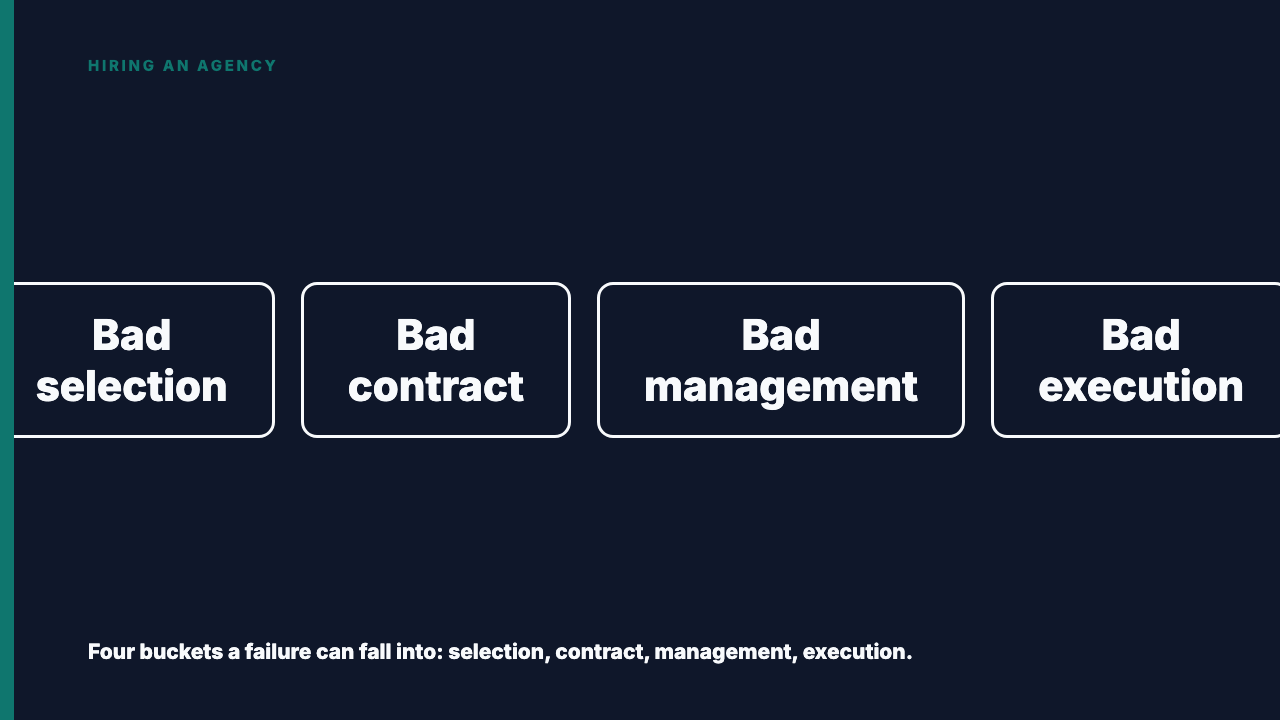
The four buckets a failure actually falls into
- Bad selection. Was this problem visible before you signed, if you had looked?
- Bad contract. Was the fix for this problem absent from the paperwork?
- Bad management. Did the buyer fail to provide something the agency needed, an approver, timely feedback, stable requirements?
- Bad execution. Did the agency fail at work it was clearly briefed on, resourced for, and given reasonable time to complete?
A single relationship almost always produces findings in more than one bucket. Don’t reach one verdict for the whole engagement, assign each specific incident to a primary bucket instead.
Bad selection: when the hiring decision was the flaw
Some failures trace back to who you chose, not to what they did afterward. The clearest sign is that the agency was picked mainly on chemistry or a slick pitch rather than evidence of relevant work. A second is no real experience in your niche, known going in. A third is that you never asked for a working reference or a real work sample before signing.
If an incident lands here, the fix is not “be more careful.” Name a specific screening step for the next RFP, a mandatory reference call, or a small paid trial project before signing. How an agency sells you is how it will manage you.
Bad contract: when the paperwork let the problem run
Imagine a brand that hired an agency for community management, with a KPI described only as “improve engagement.” The numbers were flat by the brand’s read and improving by the agency’s read, because the term was never defined precisely enough to prove either side wrong. Now imagine a separate case at the same brand: the agency acknowledged a real problem, but the contract had no cure period forcing a fix-or-exit decision, so the relationship limped along on reassurances for months.
Both are contract-bucket findings, each with a specific clause attached: a precisely worded KPI clause for the first, a cure period clause for the second. Name the exact clause and write it into the next contract, don’t just promise to read more carefully next time. Check what to check in a social media agency contract, including the cure period clause to add before you fire an agency and KPI clauses.
Bad management: what the buyer owed the agency and didn’t deliver
This is the bucket buyers are least likely to write down honestly, since every finding here implicates you, not the agency. Skipping it guarantees the next agency inherits the same unmanaged conditions.
Look for three patterns: no single internal owner authorized to approve work, so drafts sat waiting while the agency took the blame; feedback that consistently arrived after the deadline it was supposed to inform; and requirements or brand guidelines that changed after work was already approved, forcing rebuilds of finished material.
Bad execution: when it really was the agency
Once you’ve been honest about selection, contract, and management, some incidents remain, and those are genuine execution failures. The test: did the agency fail at work it was clearly briefed on, resourced for, and given reasonable time to do?
Concrete signs: missed deadlines with no advance warning, senior staff pitched during the sales process swapped for juniors without disclosure, and monthly reporting that doesn’t match what was actually delivered. A post-mortem finding zero agency-side fault should worry you: it usually means the exercise wasn’t honest.
Writing the post-mortem
- One line stating what ended and when.
- Three to five specific incidents, each one sentence, mapped to one of the four buckets.
- For each bucket that produced a finding, one required change to the next RFP and one required change to the next contract.
Turning the findings into the next RFP and contract
Each bucket converts into a named procurement change, not a resolution to do better. A selection-bucket finding becomes a specific RFP requirement, a mandatory reference call or a category-specific case review specific to your niche. A contract-bucket finding becomes a specific clause to add or tighten, a defined cure period or KPI language precise enough that both sides could check whether it was met.
A management-bucket finding is different in kind. It requires a change on your own side, naming one internal person with real authority to approve work, not just a contract edit. Use these findings to run a tighter RFP the next time around and revisit how to choose a social media agency.
Start the next search with fewer blind spots
A written post-mortem is the difference between a search that repeats old instincts and one that corrects them. Apply its changes, then browse vetted agencies against your tightened criteria. If you run an agency and want to be found by buyers who now know what to screen for, list your agency free.
FAQ
How soon after ending an agency relationship should I do this?
Within about two weeks, while specific incidents, emails, and decisions are still easy to recall accurately and before the new search starts coloring your memory of the old one.
What if the post-mortem points to more than one bucket?
That’s normal and expected. Most exits have contributions from multiple buckets. Still assign each specific incident to one primary bucket so the resulting fix stays specific rather than diffuse.
Sources
- What to check in a social media agency contract, fetched 2026-09-27
- The cure period clause to add before you fire an agency, fetched 2026-09-27
- KPI clauses in a social media agency contract, fetched 2026-09-27
- Agency sales process red flags, fetched 2026-09-27