What Counts as a Change Order With Your Social Media Agency
You signed for four platforms, twelve posts a month, and a monthly report. Nine months later there is a fifth platform, a weekly dashboard, and a second product line in the rotation. The invoice has not moved. Nobody said the word scope.
Scope creep does not arrive as a new project
Everyone catches the big ask. A six week campaign with original video announces itself. The erosion arrives as one line at the end of a status call. Can you also cover the new product on Instagram. Can we get the numbers weekly. Neither feels like a request you would ask a vendor to reprice.
Picture a skincare brand launching a second line. Same platforms, same twelve posts a month, just some of them about the new line. But the agency now needs a second set of claims cleared, a second approver, and one post count split across two audiences. No number in the scope of work moved, so nobody flags it as new scope.
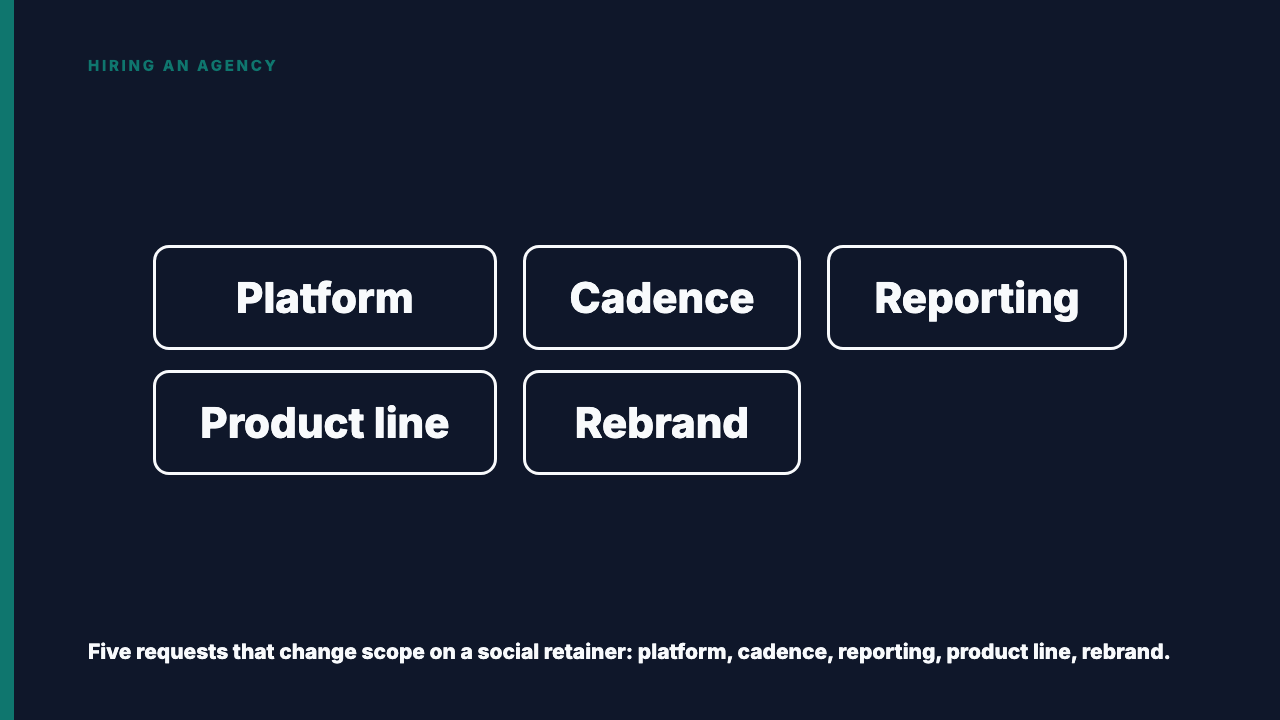
The five requests that almost always change the deal
Name these in advance. Each moves agency cost even when the monthly fee looks unchanged, which is clearer once you know how agency retainers are priced.
- Adding a platform. Brands assume this is free because the content already exists. It is a strategy problem, not a distribution one: new format specs, a different rhythm, separate analytics. Reformatting an asset takes ten minutes. Deciding what the brand is on a new channel does not.
- Increasing posting cadence. Twelve posts a month to twenty is not only more production. It is more concepting, more approval rounds, and a calendar nobody can plan in one sitting. Cadence scales coordination, the expensive part.
- Adding a reporting frequency or report type. Weekly reporting is work the monthly retainer never priced. Someone pulls the numbers and writes the commentary, every week. That is analyst time. A new report type costs setup once and maintenance forever.
- Adding a product line or sub brand. Each line multiplies inputs without multiplying outputs. Separate messaging, separate approvers. Post count stays flat while effort per post climbs.
- A rebrand mid quarter. The least likely of the five to be repriced, because it feels like a shared project rather than a request. It invalidates the templates and the content already built. The agency rebuilds what it made.
Why the contract usually does not catch this
Almost any social retainer scope of work is an inventory: platforms, monthly deliverable counts, reporting cadence. That snapshot is worth learning how to read the scope of work before you sign. What it rarely contains is a process, so nothing says what happens when the numbers change or who has to notice.
Without a trigger, either the agency absorbs the work and the absorption surfaces elsewhere, in thinner reporting and slower replies. Or it does the work and arrives at renewal with a number that reads as an unexplained increase. You see a price hike, they see months of unbilled scope, and neither of you has a record to argue from.
What a change order clause should actually say
A workable clause needs three parts: a definition of what counts as a change, tied to the triggers above, a notice requirement naming who flags it and within what window, and a pricing mechanism.
The bad version is already in most contracts. “Additional services outside the agreed scope may incur additional fees, to be discussed between the parties.” Technically true, entirely inoperable. It defines no scope, assigns no responsibility, and prices nothing.
The good version is boring. It names the categories: any additional platform, any deliverable count above the contracted number, any change to reporting frequency or format, any additional product line, and any messaging change requiring rework of approved assets. Either party may flag one, and the agency owes a written estimate within five business days, before work begins. Prices sit in the clause: a flat monthly add on per platform, an hourly rate for anything outside a category, and a scope swap, where you drop a deliverable instead of paying more. It belongs alongside what else to check in the contract itself.
How to raise it without it feeling like an accusation
Open with the list, not the grievance. Try: “Over the last two quarters we added a platform, moved to weekly reporting, and started covering the second product line. None of that went through a scope conversation. Can we agree on what counts as a change going forward?” That concedes you made the requests, which removes the accusation, and asks about the future rather than past work.
It goes better when you have your own record. A running list of every request outside the original deliverable, kept from day one, costs five minutes a month. Without it you are asking the agency to characterise what happened.
What to do if the agency won’t discuss it
A reasonable response engages with specifics. The agency concedes some additions were real scope, pushes back on others, and proposes a process. That is a good conversation.
The warning sign is not disagreement, it is evasion. Watch for an agency that insists everything is covered under the existing retainer but cannot explain how, or that agrees to a change order process and never produces one. Treat the answer as diagnostic. How a partner handles an uncomfortable commercial question in calm conditions predicts how they handle one in a crisis.
Where to go from here
If the conversation goes badly, or you are starting a search instead, browse vetted agencies and ask about change order process on the first call, not in the eleventh month. Running an agency? You can list your agency free.
FAQ
Is asking my agency to post more often on an existing platform a change order?
Yes, if the increase is meaningful against what was scoped at signing. Cadence is one of the five triggers, and the test is your own scope of work, not a general benchmark. Pull the document, find the contracted monthly deliverable count, and compare it to what is being produced.
Can I add a change order clause to a contract that’s already signed?
Yes, and it is normal. Propose it as an amendment governing future requests, explicitly not a renegotiation of work already delivered. Waiving the past is what makes it easy to agree to: the agency says yes without conceding it undercharged you.