When Your Agency White-Labels One Channel to a Third Party
You have noticed that one channel on your account feels like it belongs to a different team. The reporting tone is off, the turnaround is slower, or the creative does not match the visual voice you signed up for everywhere else. That might mean nothing. It might also mean a second company is running that channel under your agency’s name, and you were never told.
The tell is a seam, not a scandal
White-labeling rarely announces itself. What you notice is a seam: the paid social report uses different jargon and a different template than the organic recap, or one channel takes a day longer to answer questions than everything else. Maybe the creative for that channel looks like it came from someone else.
None of that is proof by itself. Agencies specialize internally too, and a strategist writing the organic recap while an analyst writes the paid report will produce different tones for reasons that have nothing to do with who does the work. The seam is what should prompt a direct question, not the verdict.
White-labeling is not the same problem as subcontracting
Subcontracting and white-labeling get used interchangeably, and they should not be. See the general question of whether your agency subcontracts for the broader question this one narrows. Disclosed subcontracting names your agency as the accountable party and confirms a second party exists, even if you never speak to them directly.
White-labeling is narrower and riskier. A second company operates a channel under your primary agency’s brand, and you may never learn its name or see its contract terms. If the primary agency folds, gets acquired, or has a falling out with the subagency, you find out about a relationship you never knew existed, usually mid-disruption.
The channels where this happens most
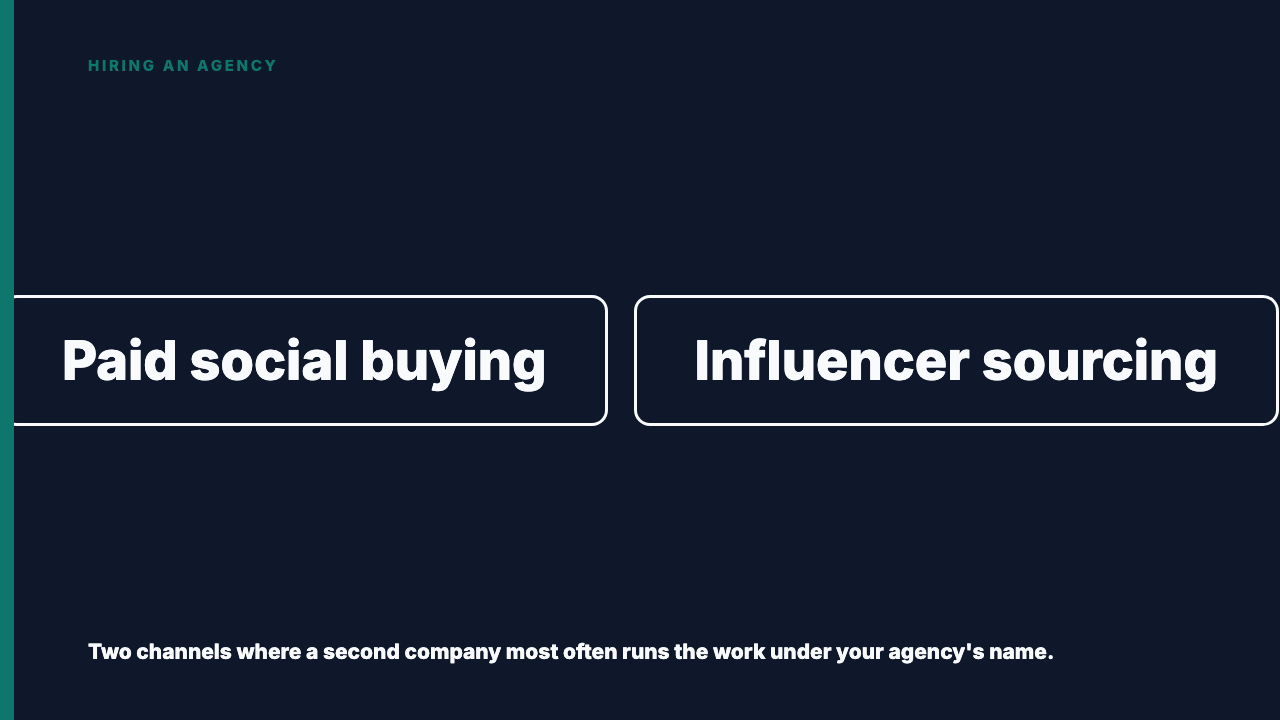
- Paid social buying and optimization. Running ads well takes current platform knowledge and ad account access a generalist agency may not maintain in-house. See who owns the ad account when an agency runs your paid social. [EVIDENCE NEEDED: a specific, verifiable platform certification or partner program requirement]. Absent that, the honest version stays qualitative: paid buying is specialist work, and pitching it does not require staffing it full time.
- Influencer sourcing and negotiation. A usable network of creator relationships takes years to build, and many agencies access it through a partner rather than owning it. This is a general pattern, not a statistic.
- Both are specialist, credential heavy or relationship heavy functions a generalist agency can promise without having built the capability in-house.
Ask this question, channel by channel
The question that surfaces white-labeling is specific, and it is not “does your agency subcontract.” For each deliverable, ask who on your team, meaning who is on your own payroll or a named, disclosed subcontractor, is actually doing this work. This matters because the team that pitches you is not always the team that runs your account. Asking once about “the agency” invites a reassuring answer that tells you nothing. A per-channel question forces a specific answer.
A clean answer names a role or a specific, disclosed partner: “our paid media lead runs that.” A dodge repeats relationship language without naming who executes the work, and that itself is informative.
A hypothetical: the paid social seam
Picture a brand that hires a generalist social media agency for content, community management, and paid social, bundled into one retainer. The organic posts and community responses sound consistent with the team that pitched the account, but the paid social report arrives on a different template with unfamiliar language, and the buyer realizes they have never spoken to whoever is optimizing the ad account, only to an account manager relaying numbers from someone else.
The buyer asks the channel-by-channel question. The answer, once pressed, is that paid social is run entirely by a specialist shop the agency has never named in any proposal or contract. This is a hypothetical illustration only, no real agency or company described.
Get it named in the contract, not just admitted out loud
If the answer confirms a subagency exists, the fix is disclosure, not termination. An admission on a call will not hold up six months later, so ask for the named subagency and its scope to sit in the scope of work or a subcontractor exhibit, and ask what happens if that relationship ends. See what to check in a social media agency contract for where that exhibit belongs, plus a clause requiring written notice of any future change in who performs a channel.
It is a dealbreaker if the agency denies the arrangement exists and is later shown to have been white-labeling anyway. It is fixable if it admits the arrangement and is willing to document it.
Find agencies who will answer this question before you sign
Browse vetted agencies and ask the channel-by-channel question during the pitch, not after the first invoice. If disclosure is not something you avoid, list your agency free.
FAQ
How is white-labeling different from normal subcontracting?
Disclosed subcontracting tells you a second party is involved and usually names them. White-labeling means that party operates under your agency’s brand, and you may never learn who they are unless you ask.
Is it automatically a red flag if my agency uses a specialist subagency for paid social?
No. Using a specialist for ad buying or influencer sourcing is common and can be reasonable. The red flag is not disclosing it, not the arrangement itself.
What exact question should I ask to find out?
Ask per deliverable, not about the agency in general. For this channel, who on your team is doing the work, and is anyone involved who is not your employee or a subcontractor you already know about.
What should happen if my agency confirms it white-labels a channel?
Ask for the subagency to be named in the contract or a written addendum, along with what happens if that relationship ends, rather than treating the admission as the end of the conversation.
When should undisclosed white-labeling end the relationship rather than just get corrected?
When the agency denies the arrangement exists and is later shown to have been white-labeling anyway. Admitting it, followed by a willingness to document it, is a fixable gap, not a dealbreaker.
Sources
- Ask If Your Agency Subcontracts the Work Before Anything Else, fetched 2026-09-10.
- Who Owns the Ad Account When an Agency Runs Your Paid Social, fetched 2026-09-10.
- The Team That Pitches You Isn’t the Team That Runs Your Account, fetched 2026-09-10.
- What to Check in a Social Media Agency Contract, fetched 2026-09-10.