A Quarterly Agency Scorecard You Fill In Before the Review
Your agency has asked for a quarterly review, and you know how it will go: they will open a deck, you will nod along, and you will leave unsure whether the quarter was good. This post gives you a one-page scorecard you complete yourself, before they present, so you walk in with your own agenda.
Why the agency’s deck should not set the agenda
In my experience the typical review goes like this. The agency opens a deck, narrates its own highlights in the order it prefers, and the buyer reacts in real time with nothing prepared. The party being assessed has chosen the evidence, the sequence and the framing.
The opposite approach fails too. Reviewing by mood means one bad week, or one charming call, colours the whole quarter. So there are two failure modes: reviewing by the agency’s narrative, and reviewing by mood. A scorecard moves the evidence onto your side of the table.
One scope line first. This scorecard grades how the agency behaves as a supplier, not whether the marketing outcomes were good. Outcome reporting is a separate question, and this post does not answer it.
The five criteria, and what each one actually measures
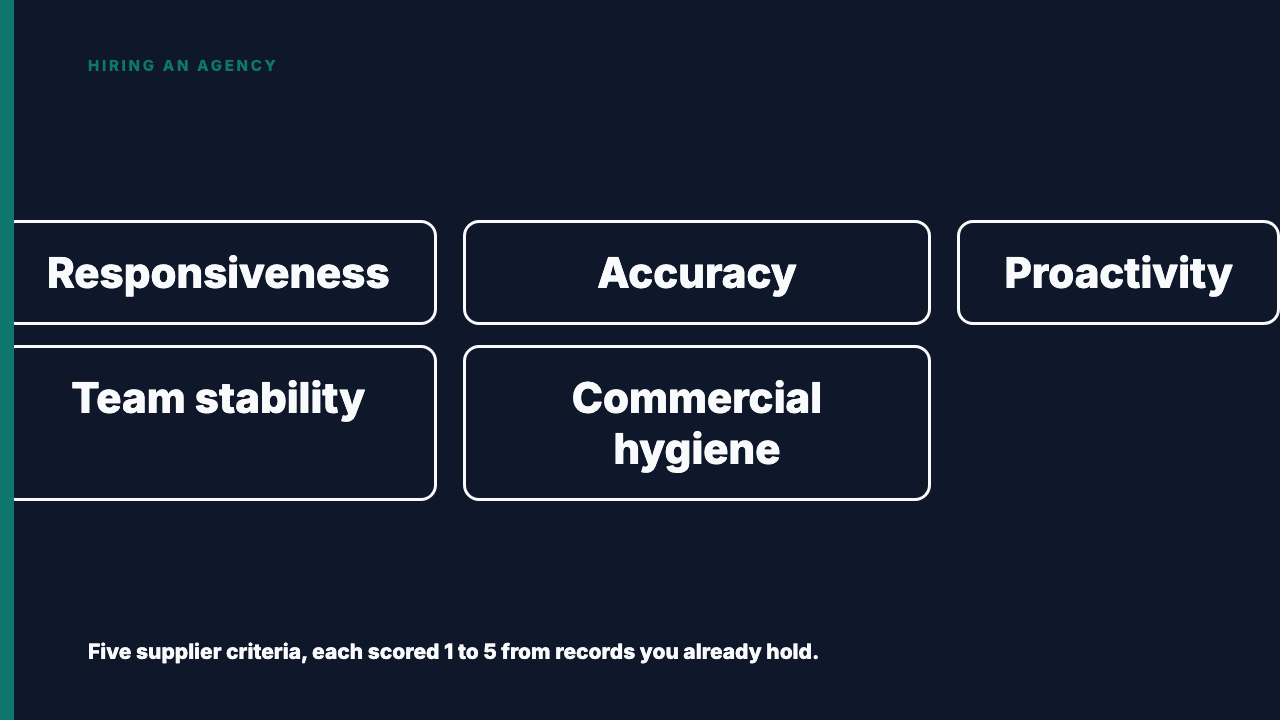
Score each criterion from 1 to 5, using records you already hold.
| Criterion | Measures | Your evidence | A 1 looks like | A 5 looks like |
|---|---|---|---|---|
| Responsiveness | Replies and escalation against what was agreed | Your inbox and chat history | Questions sit for days, you chase twice, urgent issues go nowhere | Replies land inside the agreed window, urgent issues reach someone senior fast |
| Accuracy | Work arrives correct first time | Your approval history | You keep correcting errors, wrong links and brand-guideline misses | Corrections are rare and no mistake repeats |
| Proactivity | Ideas raised unprompted versus work you requested | Your meeting notes and email threads | Everything happens because you asked | Considered suggestions arrive regularly, unrequested |
| Team stability | Who is on the account now versus at kickoff | Kickoff notes, the scope of work, calendar invites | People vanish and you find out by accident | Changes are announced with a proper handover |
| Commercial hygiene | Billing matches the agreement | Your invoices and retainer terms | Surprise line items, work billed with no change order | Invoices match the retainer, extra work agreed first |
For responsiveness, compare actual reply times against whatever was agreed. If nothing was, set your own benchmark now, tell the agency, and get the response time commitment in writing. For accuracy, keep a rough tally of corrections. For team stability, check team changes yourself. For commercial hygiene, a mismatch is a question, and a process for invoices that do not match the retainer covers what comes next.
Engagement, reach, conversion and every other reported result stay off this page on purpose.
A sample scorecard, filled in
This example is hypothetical. Picture a regional retailer a few months into a retainer.
- Responsiveness: 2. Replies to Friday requests regularly arrived the following Wednesday. Question: what turnaround is normal, and what is the route for urgent issues?
- Accuracy: 3. Two wrong links and one missed brand-guideline point, none repeated. Question: is there a checklist before work reaches me?
- Proactivity: 4. Two seasonal ideas raised unprompted. Question: what is on the radar next?
- Team stability: 2. A senior strategist named in the contract has not appeared on a call since month one. Question: who holds that role now, and when was the change decided?
- Commercial hygiene: 5. Every invoice matched the retainer, and one extra task had a change order first. Question: none, and say so.
It is mixed on purpose, not a pass or fail device, and each weak score becomes one specific question, never an accusation.
Complete it before they present, then change the meeting
Once you have heard a persuasive presentation, your scores drift toward it. Score first, privately. Appoint one owner on the buyer side and ask anyone who touches the agency day to day for input. With notes kept through the quarter, this takes under half an hour.
Then restructure the meeting. Send the criteria in advance so nothing is a surprise. Open with your two lowest scores and your one highest, with the evidence behind each. Only then invite their deck, whose slides now answer your questions instead of replacing them.
If the agency pushes back on a score, ask for the evidence, not for a re-grade. A calendar record can legitimately move a score. Disagreement alone should not.
Keep the evidence trail that makes the scores defensible
A running note turns scoring into minutes of tallying. Capture as it happens:
- The date of each significant request and of the reply.
- Each correction you had to ask for.
- Any staff change you noticed, and how you found out.
- Any invoice discrepancy.
This is your own working note, not surveillance, and the agency should know the review format in advance. For the contractual side, see the response time and billing dispute pieces linked above.
What the scorecard cannot tell you, and what to do with a bad one
A high service score does not prove the work is working, and a low one does not prove the agency is bad. Judging the marketing results needs its own separate review.
Treat a low score as a conversation. There are three paths: fix it inside the relationship, give formal notice under the contract’s cure period if your agreement has one (terms vary, so read your own), or plan an exit. As a rough rule, the same criterion scoring low across two quarters, after you raised it and the agency agreed to change it, moves you from the first path to the second.
Finally, hold up the mirror. Slow approvals or late briefs on your side depress an agency’s responsiveness and accuracy, so check your own approval history first. Re-score lightly after any change in account team or scope, without waiting for the quarter.
Next step
If your scorecard points toward a change, Browse vetted agencies among the 83 published on Partner in Social. If you run an agency, you can list your agency free.
FAQ
How long should the scorecard take to complete?
Under thirty minutes if you kept a running log through the quarter. If it takes much longer, the evidence trail was not kept, so start the log today.
Should I share the scorecard with the agency?
Share the criteria in advance so nothing is a surprise, but keep your private scoring until the meeting. Then discuss each score alongside its evidence.