Negotiating an Agency Contract: What to Fight, What to Concede
You are holding an agency’s standard contract, and legal has asked what actually matters. You have two weeks. If the answer is “everything”, you will send back a redline with forty comments, and the agency will spend its goodwill answering it.
Negotiating capital is finite, so rank before you redline
An agency will trade a handful of concessions before the conversation shifts from setting up a partnership to managing a difficult client. From vetting agencies, my judgement is that the first redline is read as a preview of the working relationship. A short, reasoned list reads as a careful buyer. A wall of marked-up boilerplate reads as a client who will dispute every invoice.
So the test for any ask is not “is this clause unfavourable?” The test is: what does this cost me if it goes wrong, and can I recover from it? A late fee you dislike is recoverable. Finding out at exit that the agency holds the only admin login is not. This is general buyer guidance, not legal advice.
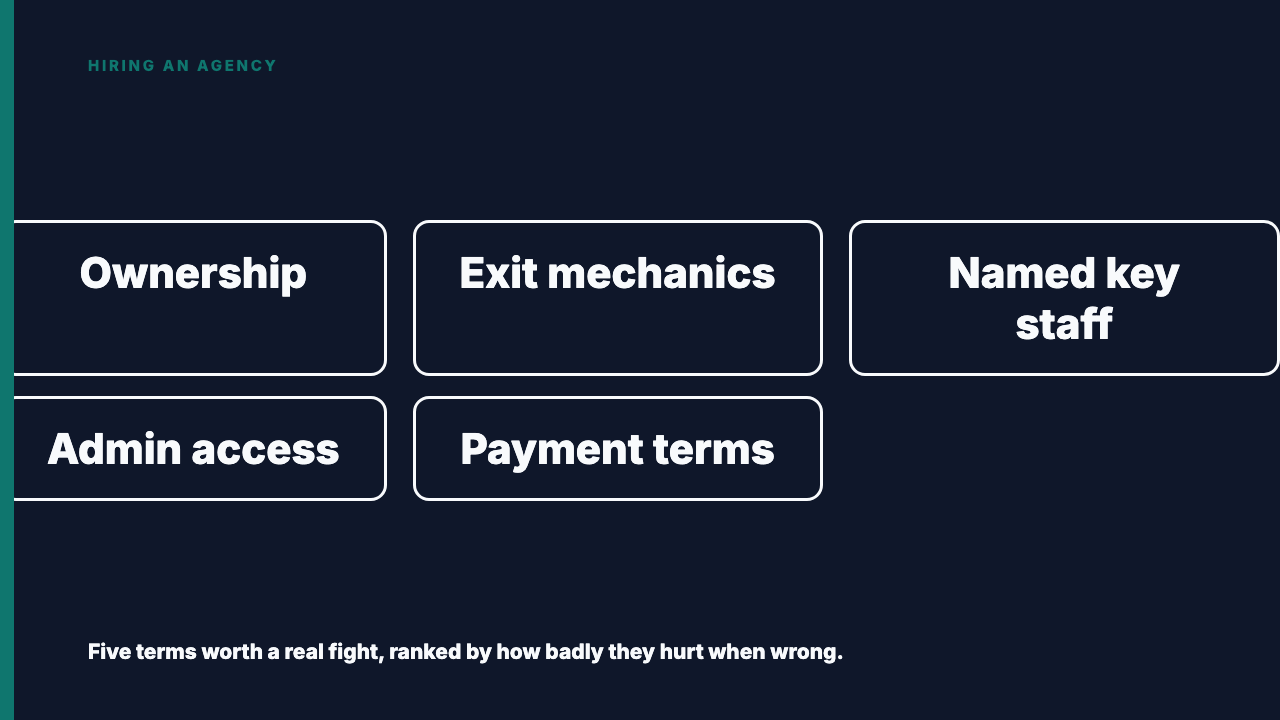
The five terms worth a real fight
Ranked by how badly they hurt when wrong and how hard they are to repair after signing. For clause detail, see who owns the content your agency made, termination clause and kill fees, what happens when your account manager quits and payment terms buried below the retainer number.
| Term | What goes wrong if you concede | What a fair version looks like |
|---|---|---|
| 1. Ownership of accounts, audiences and content | You cannot take your page or finished work with you. | You are owner or admin on every account from day one, and the contract says who owns or licenses content. |
| 2. Exit mechanics | Leaving becomes a negotiation at the worst moment. | Stated notice, stated early-termination cost, named handover list and window. |
| 3. Named key staff | You sign for the senior team and get whoever is free. | A named lead, with notice and your approval on change. |
| 4. Access and admin rights | Every dispute becomes a hostage situation. | Role-based permissions, you hold admin. |
| 5. Payment terms | You prepay for work never delivered. | Reasonable deposit, clear timing, a rule for undelivered work. |
Ownership and exit: the two that decide whether you can leave
You should be admin or owner on every account, page, ad account and asset library from the first day. Agencies seldom resist this for accounts. They resist harder on bespoke creative and templates, so decide in advance what you will trade, such as a perpetual licence to delivered creative while the agency keeps its templates.
Do not assume silence helps you. In US law, a transfer of copyright ownership is not valid unless it is in a writing signed by the owner of the rights conveyed (17 U.S.C. 204(a)). “Work made for hire” for a non-employee covers only listed categories of commissioned work, and only if both parties sign a written agreement saying so (17 U.S.C. 101; see also the Copyright Office’s Circular 30). Social posts often fall outside those categories, so a silent contract may not give you the content. These points are US-specific; other jurisdictions differ.
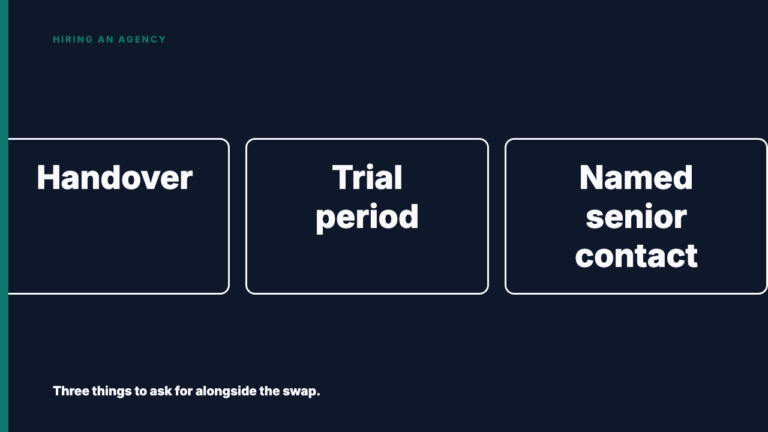
On exit, pin down three things: notice period, what you owe on early termination, and what the agency must hand over and by when. The bad version hands materials over “at the agency’s discretion” and withholds fees for content already delivered. The good version attaches a named deliverables list, covering logins, files and ad account access, with a fixed handover window. The ask is not “rewrite the termination clause entirely”. It is a short list of specific edits.
Key staff, access and payment: the three people often forget
- Key staff. Ask for the named lead and a notice-and-approval mechanism if they change. Do not demand a guarantee that nobody ever leaves. No honest agency can sign that, so it is theatre.
- Access. Ask for role-based permissions with you holding admin, and a clause that the agency never holds the only admin login. It costs the agency nothing, which is why it is a good use of an ask.
- Payment. Separate the retainer number from the terms around it: deposit, timing, late fees, and paid-for but undelivered work. Pick the one or two that move cash risk and drop the rest.
Hypothetical: a buyer wins admin rights over every account in one email, then concedes the agency’s late fee on invoices they intend to pay on time anyway. Right trade. The fee is small and recoverable, while access removes the one risk that could trap them.
What agencies concede easily and what they defend hard
This is my judgement from vetting, not measured data. The split follows cost to the agency. Asks costing nothing or a little admin tend to land: access, reporting formats, named contacts, a cure period for disputes. Asks that touch margin or the business model get defended: unlimited liability, guaranteed results, free unlimited revisions, working for free during an exit.
Sequence accordingly. Open with two cheap asks, such as access and a named contact, so the record shows you are reasonable. Then make the ownership and exit asks. If the agency resists one, offer a trade. A longer initial term costs a well-vetted buyer little and gives the agency real comfort.
The asks that burn goodwill and change nothing
- Rewriting boilerplate. Governing law wording, notices, entire agreement and severability rarely change your outcome and mark you as difficult.
- Guarantees the agency cannot control. Platforms and audiences do not belong to the agency, so a guaranteed reach number is a promise nobody can keep.
- Mutual versions of every clause. Where the risk is not symmetrical, forced symmetry wastes time.
Instead, read the boilerplate once for anything unusual, flag only those items, and let legal spend its time on the five.
What to give legal on day one
Tell legal: our priorities in order are ownership, exit, key staff, admin access and payment. Minimums: we are admin on everything from day one; handover has a named list and fixed window; the lead is named with notice and approval on change; the agency never holds the sole admin login; any prepayment has a rule for undelivered work. Leave other boilerplate alone unless it is unusual. Then add a walk-away rule: if the agency refuses the minimum on ownership or exit, that tells you how the relationship will end. Do not haggle over it. For real spend or IP exposure, have a lawyer review the final text.
Next step
Browse vetted agencies, 83 published at the time of writing, or, if you run one, list your agency free.
FAQ
Can you negotiate a social media agency contract?
Yes. Most agencies expect some edits, so choose a few specific ones rather than a full rewrite.
Will asking for changes make the agency less keen to work with me?
In my judgement, targeted and reasoned asks rarely do, while a long unfocused redline of boilerplate can. Refusal on ownership or exit is a decision signal; refusal on boilerplate is normal.
Sources
- 17 U.S.C. 204, execution of transfers of copyright ownership, fetched 2026-10-14
- 17 U.S.C. 101, definitions (work made for hire), fetched 2026-10-14
- US Copyright Office, Circular 30: Works Made for Hire, fetched 2026-10-14