When Your Agency Runs a Giveaway, Who Carries the Legal Risk?
Your agency has suggested a giveaway for next month, and it sounds like an easy win. Before you reply, ask who answers for it if something goes wrong. The honest answer is you, and the way to protect yourself is to decide in writing who does which job before anything goes live.
The yes that nobody read the rules for
Picture a hypothetical skincare brand. The account manager proposes a product giveaway for next month on a call. The owner replies “sounds great” and moves on. Three weeks later the post is scheduled, and when the owner asks to see the rules, there are none. No eligibility terms, no end date, no description of how the winner is chosen. Nobody was negligent. The proposal never listed those things, so nobody was asked to produce them.
That gap matters because the brand is the promoter in the eyes of the platform, the entrants and any regulator. It is the brand’s product on offer, the brand’s account hosting the post and the brand’s name on the prize, whoever types the caption. This is not legal advice, and rules differ by country, state and province.
Why “it’s just a social post” is the wrong frame
An ordinary deliverable ends when it is published. A giveaway creates obligations to strangers: entrants who accepted your terms, and a winner who is owed a prize. Those obligations outlast the post, and they sit with the party whose account ran the promotion.
Platforms publish their own rules for promotions run on their services, and those rules are typically enforced against the account that runs one, which is yours. Read the current text yourself rather than relying on the agency’s summary, and ask the agency which rules it is working from.
In some places the mechanism decides which rules apply: a random draw, a skill-judged contest and a purchase-required promotion can each be treated differently. In the UK, for example, the CAP advertising code has a dedicated section on promotional marketing. That is a reason to ask someone qualified, not to guess.
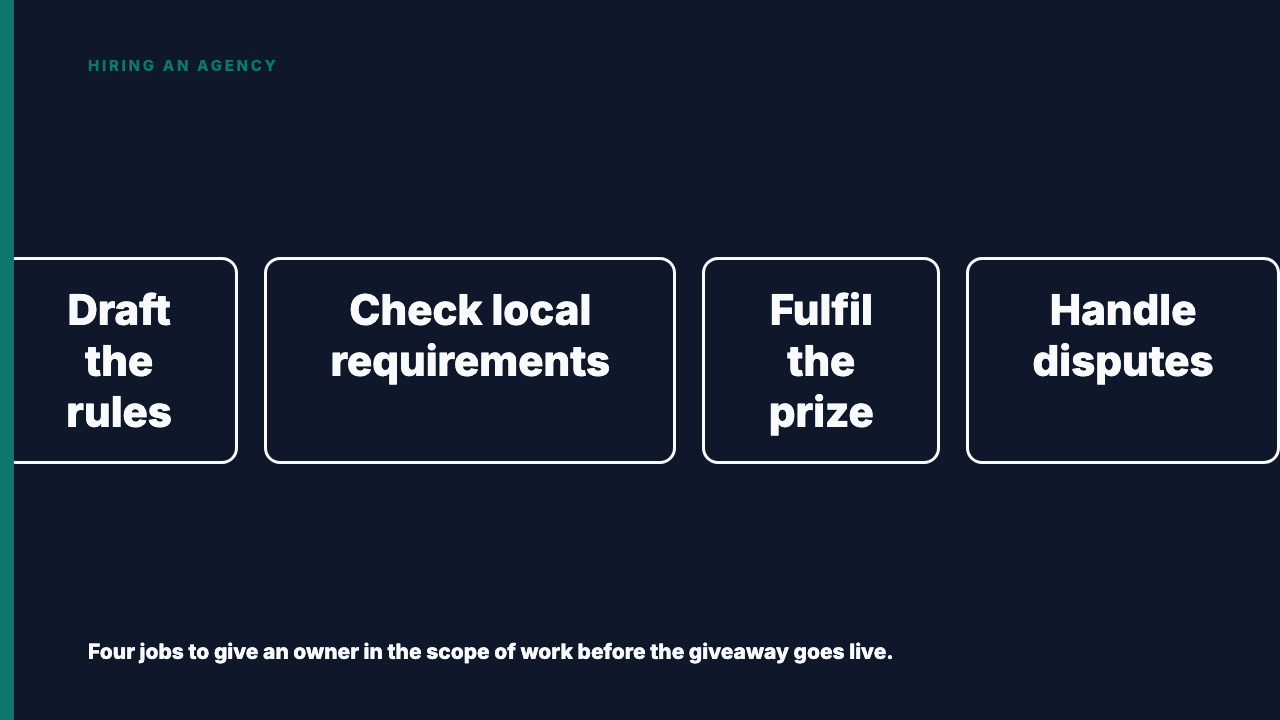
The four jobs to assign in the scope of work
If the scope of work does not name an owner for each job, whoever happens to be in the thread does it, or nobody does. Here is how to read an agency scope of work if you need a refresher.
| Job | What it covers | Acceptable owner |
|---|---|---|
| 1. Drafting the official rules | Who writes them, who approves them, and where they are published before the first entry. | Agency drafts, with a review date. Brand approves in writing. |
| 2. Checking local requirements | Eligible regions, age limits, registration or bonding rules where they exist, tax treatment of prizes. | The brand’s counsel or a named qualified adviser. Not the account manager. |
| 3. Prize fulfilment | Who buys, ships, pays and documents delivery. Who covers a lost prize or an out of stock one. | Named on both sides, cost line stated. |
| 4. Disputes | A skipped winner, an entrant who calls the draw unfair, a platform that removes the post. | One named person per side, with a response time. |
What the good version and the bad version of the proposal look like
The bad version, hypothetically, is one line item: “Monthly giveaway, included.” No rules document, nothing on who judges or draws, nothing on who holds entrant data.
The good version lists the rules draft as a deliverable with a review date, says legal review is the brand’s responsibility, describes how the winner is selected and recorded, and names a fulfilment owner.
The test: if the proposal cannot tell you what happens when a winner disputes the outcome, the agency has not thought about it.
Disclosure, entrant data and what the agency is actually positioned to handle
If creators or staff are asked to promote the giveaway, material connections generally need to be disclosed. The US Federal Trade Commission’s endorsement guides Q and A has a section on social media contests and sweepstakes. It is one regulator’s published position and applies to its own jurisdiction.
Entrants also hand over personal details. Decide who stores them, for how long and who deletes them after the winner is chosen, and make sure it matches what your privacy terms promise. An agency is staffed to run social media, not normally staffed or insured to give legal advice. Ask what its liability insurance covers, and do not assume the answer.
Contract language to ask for before the first giveaway
The general checklist for a social media agency contract covers the rest. For giveaways, ask for:
- No promotion goes live until the brand has approved the final official rules in writing.
- The agency flags jurisdiction questions but does not decide them, and routes them to the brand’s named adviser.
- Prize cost is paid by the brand and sits outside the retainer unless stated.
- The agency keeps the entry log, selection method and winner notification, and hands them over on request or at exit.
- A giveaway not in the original scope is a new deliverable with its own review step. See what counts as a change order.
If a winner disputes the result
Hypothetically, on a Friday evening a runner-up posts that the draw was rigged and tags the brand. With the four jobs assigned, the named owner pulls the selection record, the brand’s contact approves a reply, and the answer cites the published rules. Without them, the agency assumes the brand will respond and the brand assumes the agency will, and the comments pile up all weekend.
Either way, the brand’s name is on the account, so the public sees the brand’s answer, whatever the contract says about who pays. Tie this to who responds when a post blows up.
Before you say yes
Decide the four jobs in the scope of work, not during a dispute. Browse vetted agencies and ask each how it handles promotions. If you run an agency, list your agency free.
FAQ
Is the brand or the agency the promoter of a giveaway?
In practice, the brand, because its account, product and prize are involved. A contract can shift cost and tasks, but do not assume it shifts public accountability. This is not legal advice, and rules vary by place.
Should the agency draft the official rules?
It can, as a named deliverable. The brand should approve the final text in writing and have a qualified adviser review it where the stakes or locations warrant.
Sources
- FTC’s Endorsement Guides: What People Are Asking, fetched 2026-10-02
- ASA and CAP Non-broadcast Code, fetched 2026-10-02